


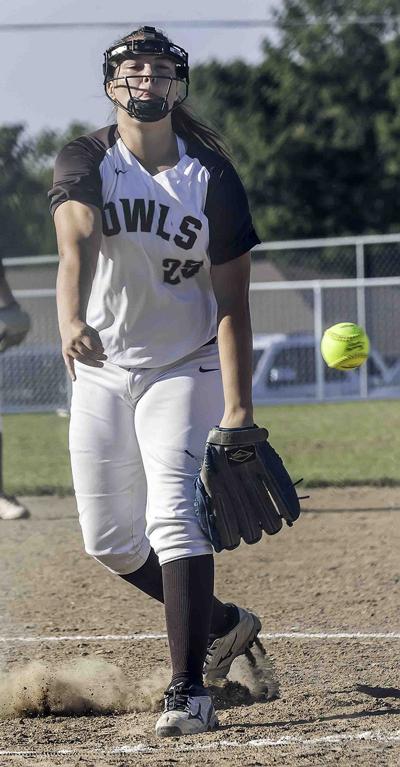
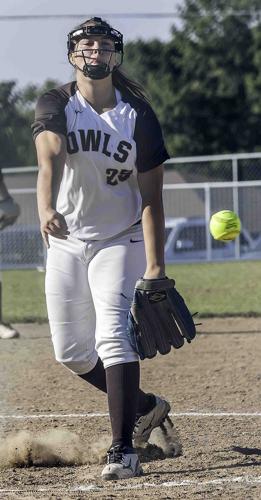
Hillsboro junior pitcher Emma Nichols was fidgeting with her face mask during a hot preseason practice.
Asked if she had gotten used to wearing the mask, now mandatory for high school pitchers in Missouri, Nichols said something that didn’t coincide with the thumbs-up she flashed at me.
“Emma isn’t a huge fan of the mask,” Hillsboro head coach Kevin Lucas said half-jokingly.
When the season started on Aug. 18, Nichols didn’t appear distracted by the metal bars protecting her face because she won two games and closed out the championship game against Troy, helping her Hawks win the prestigious Troy Tournament.
“Once she gets used to it, I think she’ll be fine with it,” Lucas said. “I’m trying to get her used to it in practice. She can’t be thinking about wearing the mask when she’s pitching.”
The Missouri State High School Activities Association started thinking about making high school pitchers wear masks last fall when an advisory committee made up of softball coaches contemplated making first and third basemen do the same.
“As the discussion developed, it was mentioned that if any defensive player should be required to wear (masks), it should be the pitcher,” said Jason West, a spokesman for the state association.
The committee strongly recommends that masks are worn by first and third basemen. Usually when MSHSAA “strongly recommends” something, it becomes a requirement sooner than later.
“I hate to say by next year, but yes I do see it becoming a requirement,” West said. “Kentucky made (corner infielders wearing masks) a regulation this spring. I see softball players getting more used to wearing them as we progress because they’ve been wearing masks since playing in youth leagues.”
MSHSAA isn’t allowing veteran varsity pitchers to be grandfathered out of the new requirement.
In 2006, MSHSAA made it mandatory that all softball batting helmets be outfitted with a full cage. West said it took a couple of years for the players to get used to the change. West said the feedback he’s seen about the new mask rule for pitchers has been mixed.
“We haven’t seen anything overly negative,” he said. “We’ve heard things like, ‘Why is this not a local decision?’ Or, ‘Why does the player not have the ability to be grandfathered in?’ That’s been the negative side of the feedback.”
It’s 43 feet from the pitching rubber to home plate. When a pitcher releases the ball, it brings them a couple of feet closer to the ball coming off of a bat. Lucas has never seen any of his pitchers get smashed in the face with a ball, but he’s seen some close calls.
“More or less, the girls have to watch the ball all the way through because a lot of times the girls turn or duck their heads and there’s no protection on the sides,” Lucas said. “Anything’s better than nothing.”
Festus has two of the top pitchers in the Jefferson County Activities Association in senior Sara Hoffman and junior Cailey McFadden.
Jeff Montgomery, the only coach the Tigers have had in their 20-year history, said from the start of practice on July 31, he made his pitchers wear the masks each time they stepped into the circle.
“I don’t think it is a big issue with us. We aren’t going to allow the mask to be an excuse for anything,” Montgomery said. “I think it was a smart move. Anything to make it safer for the kids should be a no-brainer.”
Part of the reason Montgomery said he supports the rule change is because the velocity of the ball after it is struck by a bat has increased over the years.
“The girls are bigger and stronger overall than they were 20 years ago,” he said. “The bats are better also. It puts the pitcher in danger when she is only 40 feet away at the release of the pitch. There is very little reaction time on a ball at your face or head in some cases.”
Seckman hurler Zoe Martin, a second-team all-state pick last year, had never worn a mask before. Seckman head coach Steve Bonastia asked Martin to wear a mask with her summer softball team but she declined.
“It’s uncomfortable for her,” Bonastia said. “When you put something on your face, it’s uncomfortable. She’s such a competitor, that won’t hurt her this season.
“It’s a good rule. The bats are better, the girls are stronger.”
West said because measures have been made to make bats safer in baseball, there hasn’t been as much of a push to make pitchers in that sport wear masks or even batting helmets.
But that could change someday. Sadly, baseball could be one horrible injury away from fixing masks on pitchers in high school.
“As far as making it a requirement, it’s not an issue right now,” West said. “The major difference between baseball and softball is baseball has tried to minimize the risk in the bat technology by putting maximums and minimums on bat length and size. That might be the next step in baseball but that will be farther down the road because of the technology.”