


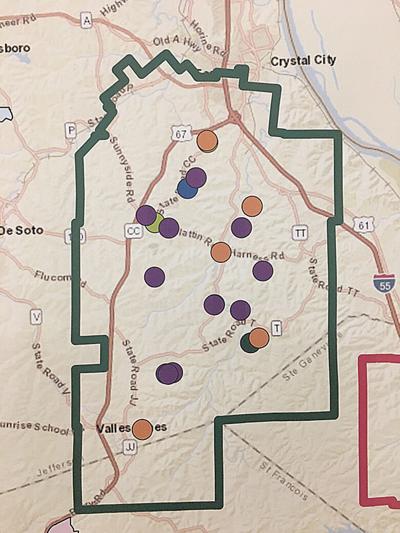
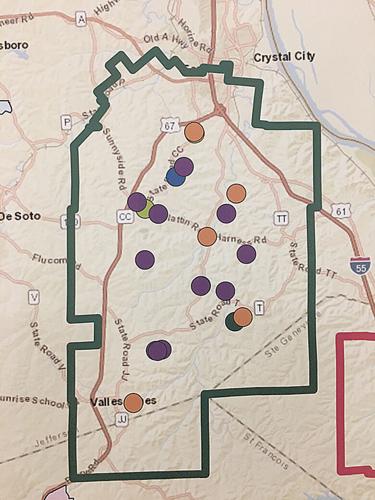
The state Department of Conservation has a new plan of attack for monitoring and managing chronic wasting disease in southern Jefferson County.
Landowners inside the core area south of Festus and east of De Soto can apply for special management permits that can be filled by hunters in addition to their regular deer tags during the open archery and firearms seasons.
The department created the core areas as two-square-mile boxes surrounding each location where harvested deer have tested positive for CWD. Inside those areas in Jefferson, Ste. Genevieve and Perry counties, qualifying landowners may apply for up to 10 permits and assign them to specific hunters.
The hunters must obtain their regular permits, but the management permits are no extra charge. Once deer are harvested with the special permits, they should be submitted for testing either through participating taxidermists and meat processors or at special freezers where deer heads can be dropped off for testing.
The new procedure puts hunters in the woods during the parts of the year when deer are most active and the weather is more cooperative. As someone who participated in the postseason targeted culling last year, there were very few days in late January and February where sitting outside wasn’t uncomfortable, and when the deer were moving consistently.
Hunters can be reimbursed up to $75 for their deer processing costs, and whole deer can be donated to the Share the Harvest program, which distributes venison through local food pantries and schools in the form of shelf-stable snack sticks produced by local processors.
“Seventy-three deer were donated to the backpack programs for kids in area schools,” said A.J. Hendershott, a regional supervisor for education with the department. “There are many children who have food insecurity over the weekends. There were 2,300 pounds of venison that made 37,308 snack sticks last year.”
Another 80 deer were donated to Share the Harvest and turned into ground venison for families who rely on food pantries for assistance.
Hendershott said the deer submitted for testing are also used for research that could provide faster and easier detection of the disease or require smaller amounts of sample material in the future. The department is collaborating with other states for research on potential vaccination options.
The southeast region, which includes Jefferson County for the management of chronic wasting disease, also recently conducted a population study in the core area in Ste. Genevieve County. Using thermal detection equipment and air surveillance, the study showed about 40 deer per square mile in the core area.
Wildlife regional supervisor Matt Bowyer said the effort was the first thermal imaging survey in the state, and he suggested that the program could be used again in the future, perhaps in the Jefferson County core area.
The application process for landowners to receive management permits can take place any time prior to the opening of the hunting seasons, but does require about two weeks turnaround time.
The regional office in Cape Girardeau has a specific CWD direct telephone line for hunters or landowners seeking additional information about the disease and efforts to control the spread. Call 573-332-4940 for more information.
John Winkelman has been writing about outdoors news and issues in Jefferson County for more than 30 years and is the Associate Editor for Outdoor Guide Magazine. If you have story ideas for the Leader outdoor news page, e-mail ogmjohnw@aol.com, and you can find more outdoor news and updates at johnjwink.com.