



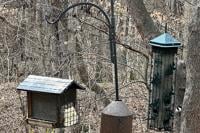
There is never a bad time to help a good cause, so the required donation to the Cornell Lab of Ornithology was not a barrier to keep me from joining a program called Project FeederWatch. One week into my membership, I already consider it $18 well spent.
My obsession with the birds that flock to my backyard feeders is well documented. I can watch for hours through a number of different windows or from my favorite perch on our screened porch. Throughout the year, the time I spend spying on my feathered friends accumulates obsessively.
Now I get to put those avian observations to work in the name of citizen science. From November through April thousands of FeederWatchers like me from all over North America report information on the birds they see at their homes or out in their communities.
For now I have only added the feeders in my backyard for reporting, but the program allows me to identify as many locations as I can track regularly. Even though FeederWatch is the project’s name, supplemental food sites are not a requirement. The instructions say you may pick public parks, nature centers, community areas, and obviously any private property you have permission to access.
During November and December I spend time in several different deer hunting stands. While I am focused on something big and brown visiting my vicinity, I do a lot of bird watching on those outings. My last hunting trip did not include any deer, but I did see wild turkeys and five different woodpecker species, including several cool looking redheaded woodpeckers, which prefer forested areas over backyard feeders.
I saw many other common birds from my post, but the highlight was a tiny brown creeper that worked its way up the big sycamore tree that holds my stand, less than six feet from me. The little bug-eater is uncommon in Missouri in the winter and not shown in Jefferson County on the state Department of Conservation map.
Back to the backyard. I did my first official count for Project FeederWatch this past weekend. The process is simple. For two consecutive days you tally the number of each bird species you see simultaneously. It is not a running total, but the maximum number counted of each bird type at one time. I reported 11 different species that included a group of seven tufted titmice, five northern cardinals, five chickadees, and nothing as exciting as the tiny creeper from the woods.
Project FeederWatch is not about the rarities. It is looking to gather information on population trends for all birds. While it would be bad news, reporting no birds is an option, and important because it provides evidence of potential declines.
The program requires that I wait at least five days before my next report. Three days after my first count, I looked out the window to see 13 northern cardinals at one time. The five-day wait is intended to avoid bias in the data, caused by choosing to count only on big bird days. There is no minimum number of counts per site each year, but it is recommended that you complete as many as possible.
In addition to bird data, the counts ask about snow cover during the reporting period. The Cornell Lab has access to data on temperature, rainfall and wind speeds for a specific area, but snow depth can be variable. Participants also track mammals seen near the feeder including cats, dogs, squirrels, and any other creatures. It also asks about birds that may appear to have eye disease, and for reports about dead birds or those that are attacked by predators.
Members receive tally sheets and others tools, a poster of common feeder birds, a calendar, digital access to Living Bird magazine, and annual Winter Bird Highlights reports dating back to 2005. The annual fee of $18 makes the program possible, paying for website and database maintenance, data analysis, printing, and distribution of information.
For more details on participation, visit feederwatch.org. If you are looking for a last minute Christmas gift idea, you can enroll your favorite bird watcher.
John Winkelman has been writing about outdoors news and issues in Jefferson County for more than 30 years and was the Associate Editor for Outdoor Guide Magazine. If you have story ideas for the Leader outdoor news page, e-mail ogmjohnw@aol.com, and you can find more outdoor news and updates at johnjwink.com.