



A couple of weeks ago, I wrote about Camp Hellbender, a program for adults to relive their childhood summer camp experiences. It sounded like a good time, but I was disappointed when I found out that the annual program didn’t have anything to do with Missouri’s endangered aquatic salamander.
I spent many of my formative years swimming, fishing or walking the banks of the Mississippi, Missouri, and Gasconade rivers. In my teens and 20s, I was obsessed with floating or wading every Ozark stream where I could find access. Even with all that time spent where they live, I have never seen a hellbender.
Admittedly, I was always more interested in fishing and fun in the flow, so I never really looked for the creatures some people called mud puppies or water dogs. Unfortunately, habitat changes and associated population declines are reducing the chances that I’ll ever find one even if I look in all the right places.
Missouri is the only state that has both identified subspecies. The pair are distinguished by their sizes and the places they call home. The smaller Ozarks hellbender is found in the southern flowing streams of south-central Missouri, from the North Fork of the White River to the Black River near Poplar Bluff.
The larger, eastern hellbender lives in the mid-state waters that flow north into the Missouri and Mississippi rivers, specifically the Meramec and Gasconade. The eastern hellbender is considered an endangered species in Missouri, but efforts to have the hellbender protected nationally have stalled.
The non-profit Center for Biological Diversity filed suit in federal court in February to force the U.S. Fish and Wildlife Service to set a date to enact federal protections for hellbenders under the Endangered Species Act.
According to the organization, FWS was required to finalize protections for Eastern hellbenders in December 2025, but missed that deadline, changing the status to a “long-term action.” In 2025, zero plants or animals were protected under the Endangered Species Act. It was the first year that has happened since 1981.
“It’s horrifying that political attacks on environmental safeguards could erase the existence of an animal as ancient and magnificent as the hellbender,” said Tierra Curry, endangered species co-director at the CBD.
The proposed endangered species listing would protect hellbenders throughout their range including the clear water streams of Alabama, Georgia, Illinois, Indiana, Kentucky, Maryland, Mississippi, Missouri, New York, North Carolina, Ohio, Pennsylvania, Tennessee, Virginia and West Virginia.
The Center for Biological Diversity said hellbenders face threats from activities that harm water quality in rivers and streams. Throughout their home territories, only 60 percent of historical populations survive and only 12 percent of remaining populations are stable and successfully reproducing.
The Center and other environmental organizations first filed a legal petition seeking Endangered Species Act protection for hellbenders in 2010. A decade later, in 2021, hellbenders from the Missouri River gained protection, but the Ozarks hellbender and the waters of the 14 other states were not included. The plaintiffs challenged the denial in 2021, and a court ordered FWS to redo its analysis, leading to the 2024 listing proposal.
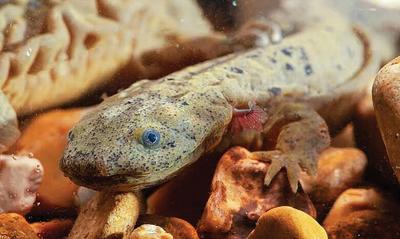
Unlike more common salamanders, hellbenders are completely aquatic, according to the state Department of Conservation field guide. While adults have gill openings, they actually absorb oxygen from the water through folds in their skin. Eastern hellbenders range in size from 13 to 23 inches. Ozarks hellbenders average 10 to 21 inches.
Hellbenders live under flat rocks and in bedrock crevices in the clear, cool water of large streams and rivers. They are slow swimmers and often move by walking along the river bottom hunting for small fish and crawfish to eat.
Not all news about hellbenders is bad. The conservation department and other organizations are working with the St. Louis Zoo in a captive breeding program that is reintroducing offspring to the wild hoping to increase their numbers or slow the decline. Hopefully those efforts and habitat protection will provide the opportunity for close encounters in the future.
John Winkelman has been writing about outdoors news and issues in Jefferson County for more than 30 years and was the Associate Editor for Outdoor Guide Magazine. If you have story ideas for the Leader outdoor news page, e-mail ogmjohnw@aol.com, and you can find more outdoor news and updates at johnjwink.com.