


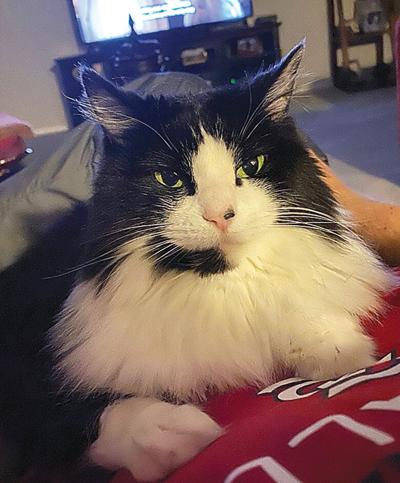
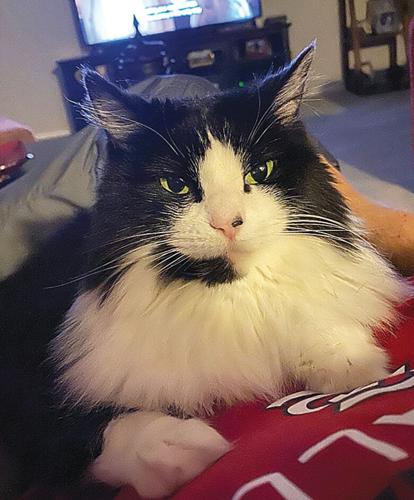
Fifteen years ago I became a cat owner for the first time. Actually, I’m more of a co-owner, and in all reality, we are the ones who are owned. We have had a few barn cats in the past, but that was more like cohabitating on the same property than ownership.
Our now 15-year-old cat is living large with all the creature comforts, but her life did not start out so rosy. I first spotted her with her mother, who was teaching three kittens that hiding close to a bird feeder was a strategic ambush position.
The lessons continued for a day or two while I hoped they would all move on, but then mom was gone along with the other two kittens, never to be seen again. Either they tricked the little black and white fluff ball and made a dash for it, or mom advised, “Don’t worry, these saps will take you in.”
Whatever the ruse, she was left to fend for herself on the mean streets of Crystal City. “We” went to the store to buy kitten food and placed it outside, gradually moving it closer to the back door of the house: the patio, the deck, the screen porch, and eventually inside.
For a while it worked OK. She could eat our dry kitten chow but also was free in the woods to catch and consume whatever she could. When something bigger out there got its claws on the cat, the veterinarian bill convinced even the most cold-hearted among us that our mostly outside pet needed to come inside for good.
She still watches the bird feeder almost as intently as I do, but now the screen porch is as close as she gets to the outside world. While I admire our feathered friends, I’m pretty certain the cat is thinking, “I could catch that bird for lunch, if I wasn’t so comfortable on this padded bench.”
I recollected this old story after a Christmas break vacation to the warmer temperatures of Texas. We were surprised by how frequently we saw cats on the prowl in each of the three towns we stayed in on our trip.
The Cornell Lab of Ornithology estimates that cats kill 2.4 billion birds each year in the United States. Habitat loss is the only thing that has a bigger negative effect on bird populations in this country, and none of the other human causes are even close to the catastrophe we have created with free-roaming felines.
By comparison, collisions with windows kill a mere 600 million birds and automobiles another 200 million. I have accidentally driven through a flight pattern or two in the past, but those incidents are relatively rare. Power lines and transmission towers are responsible for an estimated 37 million bird fatalities annually.
The best data on bird deaths caused by wind-powered turbines dates to 2022, and from most sources, the highest estimate is 1.2 million birds each year. That’s still a lot of death, and improvements can be made, but it would take 2,000 years for all the wind farms in America to kill as many as prowling cats catch each year.
I understand and have witnessed the importance of cats in controlling vermin around a cattle and grain operation or other farm environments. But we need to do more to limit the population of feral felines.
All owned-cats should live indoors with the people they own. Pets and those that work alongside livestock must be spayed or neutered, as should all the free-rangers we can get our hands on. Being a deadly predator is inherent to a cat’s nature, but keeping them safe while protecting their victims is a measure we all must take more seriously.
John Winkelman has been writing about outdoors news and issues in Jefferson County for more than 30 years and was the Associate Editor for Outdoor Guide Magazine. If you have story ideas for the Leader outdoor news page, e-mail ogmjohnw@aol.com, and you can find more outdoor news and updates at johnjwink.com.