



David Moloney, the oldest of Ann Moloney’s nine children, was the first to join the military. He enlisted in the U.S. Navy in 2003 and served for almost 10 years.
David started what’s become a family tradition. Three of Ann and Mike Moloney Sr.’s daughters – Elise Rich and Lauren Slough of the Missouri Air National Guard and Mary Margaret Moloney of the U.S. Army Reserves – not only served in the military but are married or soon to be married to servicemen. Mary will tie the knot in February.
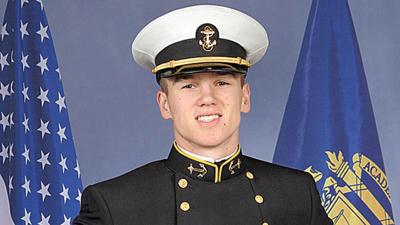
Ann and Mike Moloney Sr. had eight children together but were divorced in 2019. Ben Moloney is a sergeant in Force Recon with the U.S. Marines. Douglas Moloney is a freshman at the Missouri University of Science and Technology in Rolla and a member of the ROTC. James graduated from Herculaneum High in 2018 and is now a senior at the U.S. Naval Academy in Annapolis, Md.
Ann’s youngest son, Michael Moloney, is a junior at Herculaneum. A daughter, Catherine Marie Moloney, was stillborn in 2001. David, Ann’s child from a previous relationship, became a fishing guide in the Florida Keys after his discharge from the Navy. He drowned in Florida in 2019.
At the Moloney house, the squad-sized family started learning a sense of duty early in life. At times there was no TV. Hand-me-downs were standard. Joining the military wasn’t so much from an overriding sense of patriotism as it was realizing what the benefits of service could be.
“I’ve thought about it for many years and I was raised in a family of nine, and mom was always sick, so we had to take care of everything,” Ann said. “Everybody in our family has a job to do. The same with anybody who comes over and asks if there’s something they can do. Everybody is part of a team when they are in our home.
“Once Dave got into the Navy and realized the benefits of the (military) life, he told his sister it was a great way to pay for college. My kids all knew we weren’t going to pay for their education. They knew they weren’t going to get a free ride.”
As midshipman lieutenant (junior grade), James Moloney is a platoon commander at the Naval Academy. He leads three squads of 40 people. While the Academy offers an education like most four-year colleges, Moloney is also taught the discipline of being in the military. That means endless drilling, the fundamental aspect of all the services.
“The thing about the academy is, the main goal is to turn civilians into officers,” Moloney said. “It’s a four-year process. There are several ways to become an officer. It can be difficult to get in. The best way to describe it is it’s leadership, military training and college. The academics are very hard. The best thing is the leadership training.”
The first year at the academy is the hardest. Between classes in chemistry and calculus, there are endless tasks that go beyond what a normal college freshman has to do. First-year students are called plebes. Moloney learned the first rule of the military early on: Hurry up and wait. Standing in line for long periods was common.
“It was absolute chaos for the first six weeks,” he said. “It’s difficult and there’s long days, You get screamed at a lot, (but) it wasn’t too hard because of the advice my siblings had given me and I was in good shape physically. The hardest part that (first) year was the classes. I had a 4.2 GPA in high school and in my first year at the academy it was 2.8. There were a few areas (where) I didn’t meet the standards and the academy is really good about giving you help.”
Moloney has traveled to Japan and Israel as part of his education. In Japan, he spent a week on a ship that carries Marines and learned about how they conduct amphibious landings, the hallmark of their island-hopping campaign against Japan in World War II. Last year, the academy took a cautious stance on the COVID-19 pandemic and Moloney spent the entire academic year in online classes.
From January to May of this year, Moloney attended the University of Haifa in Israel studying Arabic, which is his major. Moloney said his confidence in speaking Arabic is growing. The two most recent U.S. wars were fought in Arabic-speaking Afghanistan and Iraq.
“What a practical skill,” Moloney said. “This is my third year of taking it. It’s a very difficult language to learn. There are several dialects. The unfortunate part of my time in Israel was, it was hard to talk to Israelis because they speak Hebrew, which is a sister language to Arabic.”
Rocket attacks by Hamas against Israel while he was there helped shape his view of his purpose for being sent there. He called the Jewish state the western foothold at the center of a decades-long conflict.
“I saw both sides of it,” he said. “I had a good idea of what the conflict was about and then got to see it where it’s happening. Rockets were shot into Israel from Lebanon and the Gaza Strip. I saw it happen. There were students at my school who would come back from protesting with rubber bullet wounds on them. I was challenged daily about what our country and military is doing. I was defending capitalism and democracy with some who believed in communism. It strengthened my beliefs and I love my country even more.”
After graduating next spring, Moloney will either join the Navy or Marine Corps. His choice is the Marines where he wants to serve in the infantry, but ultimately the Navy will decide where Moloney is needed the most.
If he gets his wish, Moloney will be commissioned a second lieutenant in the Marines. If he goes into the Navy, he will be an ensign. Either way, his service commitment is for five years.
Second lieutenants who choose the infantry are sent to Quantico, Va., for the Basic School, which trains new officers. Thus far, Moloney’s exposure to life in the infantry has been very limited.
He may have already grasped the concept of esprit de corps means, as he played football and was an all-state track and field athlete at Herculaneum.
“The best thing for an infantry commander is to have confidence, courage and love for his men,” Moloney said. “One common trait is that good officers are the ones who care for and love their men.
“If war breaks out, and the way it’s looking is that anything can happen any day, we’ll need men on the ground and there’s no place I’d rather be. For myself, there’s nothing I’d rather do than to be with them to fight for values that you believe so deeply you’d die for them. That draws me to that community.”
Ann said as a mother of military children she learned to trust that God has a plan for them. She said whether they serve in the military, there are no guarantees that a parent won’t have to bury a child.
“And that’s OK because each one is special and has a purpose,” she said. “If one of my children has to give their lives for their country, yes, it’s scary, but it’s part of what they committed to.
“James is one of those kids who will give his all at anything. He started going to gym at 4:30 a.m. a couple years ago and had his brothers at 6:30 a.m. Mass at St. Joe’s. He did that when (she and Mike Sr.) were getting divorced for stability. I am proud he kept his eyes on God. His leadership style is ‘Leave no man behind.’ I see him in any situation that nobody gets left behind. I see him being a leader and helping people find meaning in their lives.”