


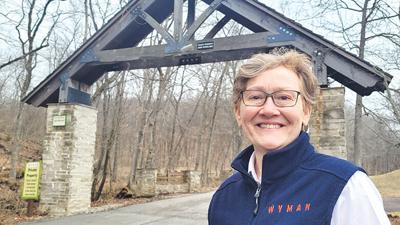
A camp tucked away in the northern part of Eureka has been offering outdoor experiences and helping area teenagers mature and find their path in life for 125 years.
The Wyman Center, originally Camp Wyman, began operating in 1898 at 600 Kiwanis Drive, and according to the organization’s website, it has helped more than 1 million teenagers.
Claire Wyneken, Wyman’s president and CEO since 2016, said the organization’s ability to change and adapt to the needs of those it serves has allowed it to continue its mission for so long.
“The organization has been innovative since the early days,” said Wyneken, 59, of St. Louis. “As early as the 1930s, they didn’t call it youth development but they looked at how to enhance young people’s lives. We have had a focus on young people’s results.”
Missy Maness, 22, of Imperial is one example of how Wyman helps teenagers create better lives for themselves.
Maness became a member of the Wyman Leaders program when she was an eighth grade student at Ridgewood Middle School, a Fox C-6 School District school north of Arnold.
She remained in the mentoring group through her time at Fox High School in Arnold, from which she graduated in 2019 with a scholarship to attend St. Louis University.
Maness said she is on track to graduate from SLU with a business degree in May 2024 and plans to enter the banking industry.
She credits a lot of her success to her years at Wyman, where she also now works as a member of the organization’s youth leadership council.
“Wyman changes teenagers’ lives one life at a time,” Maness said. “They push you outside of your limits in a healthy and respectful way. You can learn more about yourself by spending a little time at Wyman than you would during a whole year in a classroom. Wyman helps you open your eyes to different possibilities and futures that you can have.”
Celebrating
Wyman kicked off its anniversary celebration Jan. 25 with a social media blitz. The organization was actually founded on March 12, Wyneken said.
Wyman has been asking past program and camp participants to share their stories at wyman125.org and have collected more than 100 responses since the kickoff, according to Wyneken.
The organization also will hold a 125th anniversary gala April 1 at the Ritz-Carlton in St. Louis. Tickets to the event range from $175 to $250 and ticket and sponsorship packages sell for $1,250 to $25,000.
For information about the gala and to purchase tickets or packages, go to wymancenter.org.
“It will be a time to celebrate with the community,” Wyneken said. “It is a huge party. We will be celebrating our young people, and it is a fundraiser. The idea is to lift up the success our young people have achieved.”
Wyneken also said Wyman is finalizing a schedule to have pop-up exhibits at area museums, businesses and community centers throughout the year.
“It will tell the story of Wyman in the context of what was happening in St. Louis and throughout the region at the same time,” she said.
Programs
Wyman began as an adventure camp for teens to take part in character-building activities.
“We have been outcome-driven from the very beginning,” Wyneken said. “In a diary of our first director, Prudence Tillery, she had written how much weight she wanted young people to gain while they were here because a lot of them were malnourished.”
The adventure camp that features numerous camping activities such as canoeing, swimming and hiking remains part of Wyman, and the organization also has developed specific programs focusing on middle and high school students.
Wyman Leaders has been in place for 20 years, Wyneken said.
The nine-year program helps guide participants through eighth grade year, high school and a post-secondary school, such as attending a four-year or two-year college program or attending a technical school.
The program is for teenagers in low-income environments, and Wyneken said participants are recommended by more than 18 organizations, mainly schools, that work with Wyman.
“They identify students who don’t always get great opportunities,” she said. “We follow through high school to graduation, and then the vast majority go onto some kind of post-secondary program. They have a mentor whom they work with on a road map to take them to success. We don’t prescribe what their path should be. We want them to dream big and we work with them to help them build the skills, networks and their capacity to achieve their dreams.”
In 2021, Wyman reported that 100 percent of the program’s participants graduated high school. The organization also said 62 percent of that year’s class enrolled in a post-secondary program.
Wyman also reported that in 2021, 71 percent of the members of the 2020 Wyman Leaders program entered their second year of a post-secondary program.
“They gave me a sense of purpose, and no matter what I come from, I can do anything I want to do and I am worthy of good things happening,” Maness said. “I grew up in a low-income neighborhood. I was supposed to be a statistic based on my neighborhood and parents’ income level.
“They push you with different physical and mental activities that you have to overcome, and then other challenges you face in everyday life are not that difficult to handle. Wyman is different. They don’t just help teens; they build leadership skills that last a lifetime.”
Wyman has operated the Teen Outreach Program (TOP), which focuses on middle school students, since 2005.
Wyneken said Wyman directly leads the nine-month program in the University City and Ferguson-Florissant school districts. Wyman also works with numerous school districts throughout St. Louis and the nation as well as area groups to train others on how to implement the program.
“They are learning a lot about community service, learning life skills and issues that are of importance to teenagers,” Wyneken said of middle school students in the program. “TOP is very successful in building life skills, helping young people progress well in school and have better health outcomes.
“Many school districts offer it for sixth, seventh and eighth grade. They like that group dynamic and having a space they can discuss issues important to them with someone who is skilled and cares.”
Wyman’s newest program, Teen Connection Project (TCP), started in 2016.
Wyneken said Wyman has only established this program in University City, but the organization is working with at least 10 potential partners to expand it throughout the region.
“This program is about helping teens learn how to build healthy connections and maintain those over time,” she said. “It is something you need in your family, at work and at school. It is the foundation for everything else.”
Along with the long-term programs, the Camp Wyman Experience allows school and youth camps as well as adult retreats to be held on the property. The facility also may be rented for weddings and other special events.
“We have 5,000 people a year come to the camp,” Wyneken said. “What we pride ourselves on is the quality of our program staff. They are extremely well-trained. They care deeply about young people. They care about not just giving young people an experience, but they help young people take what they learned from the experience and apply it to their lives.”
Future
Wyneken said Wyman has about 50 employees, but that number swells to almost 100 during the peak season between April and early November.
She said about 15 percent of the year-round staff participated in one of the group’s programs or a Camp Wyman Experience, and she said almost half of the peak-season staff are Wyman alumni.
Maness said she is compelled to work for Wyman because of what the organization has done for her.
“I want to show the next generation that even if you are supposed to be a statistic, you don’t have to be,” she said. “I was supposed to be pregnant and dropping out of high school based off where I live. I feel compelled to help because of the change it made in my life. I want to be a guiding light and show them all the good in the world they can do through this organization.”
Wyneken said Wyman will continue to grow its programs both in-house and by forming partnerships to implement programs throughout the region and nation. She also said the organization will work on plans to keep Wyman open for another 125 years.
“We will continue to fill this facility with folks who don’t always have opportunities for these types of experiences,” Wyneken said. “We want to build up our financial strength, so if we have another rainy day like the last three years with the pandemic, we can weather that and be here for future generations.”