
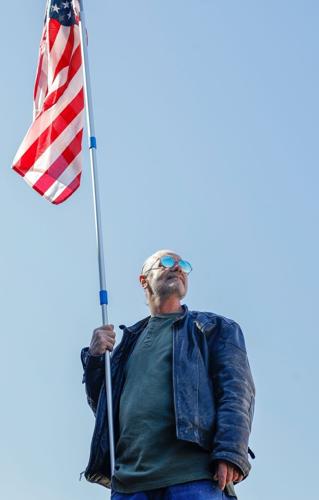
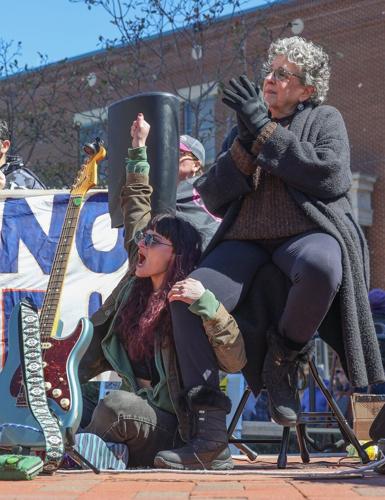
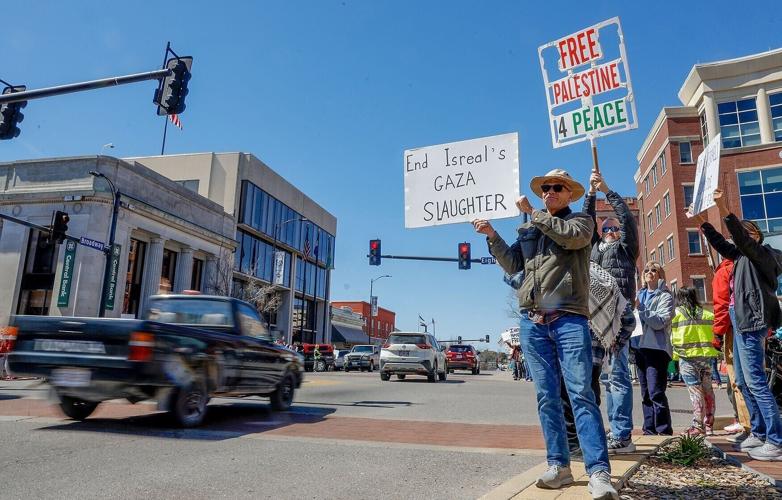
Thousands gathered across the state Saturday for the third nationwide No Kings protest, part of a global demonstration against the Trump administration.
It was one of 3,000 protests expected to organize across the country in opposition to policies they view as dictatorial. It was the third widespread No Kings protest in less than a year, and it was anticipated to be the largest.
More than 40 protests were scheduled Saturday in cities across Missouri, including Jefferson City, Fulton, Moberly, Boonville, Fayette, Springfield, Kansas City and St. Louis.
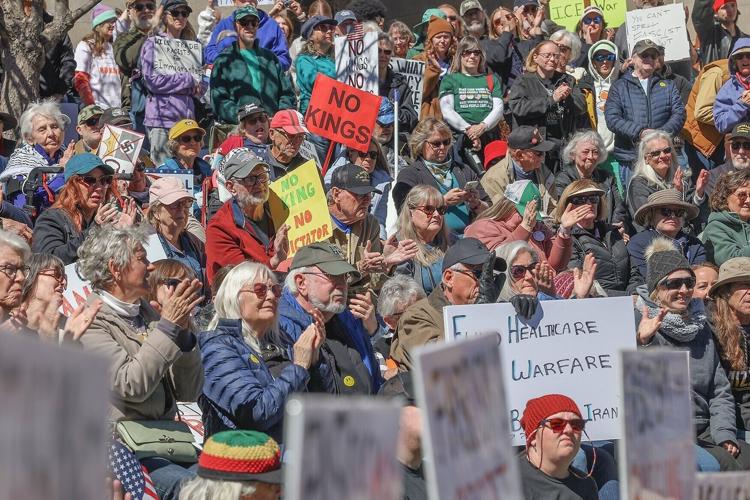
In Columbia, roughly 2,500 people gathered in front of the Boone County Courthouse to listen to speakers, musicians and poets express their grievances against President Donald Trump and his governing practices.
According to a release from No Kings' organizers, over 5 million people in the U.S. participated in No Kings protests last June, with more than 7 million attending the October protests. Columbia's organizers said Saturday's protest seemed to be about the same size as the one in October.
Between 11 a.m. and 2 p.m., protest signs and speakers took aim at everything from the conflict in Iran to the release of the Epstein files.
When asked what issue brought her to the courthouse, Katie Mericle said it was difficult to pick just one.
"All of them," she said. "It's a nightmare. It's a literal nightmare."
Mericle was joined by her two children, Maissie and Leo, along with Eliza Weir, 10, the daughter of a family friend. Each held a sign protesting different policies handed down by the Trump administration.
"They're just as mad as we are," Mericle said, referring to the children. "Their daily lives are affected by this chaos."
Leo, 14, said he disagrees with how Immigration and Customs Enforcement has been deployed in the country.
"I believe we should stop misusing ICE to deport innocent civilians," he said.
Lauren Replogle, a student at the University of Missouri, called Trump's mass deportation policy a key motivation for her to attend. Replogle added that she thinks it's important for people her age to attend local rallies and keep up with world events as they become eligible to vote.
"It's a lot more empowering to attend events in person and see them on a local scale rather than to just absorb events through a screen," Replogle said.
Columbia City Council member Vera Elwood highlighted the history of protest movements in Columbia as she spoke to the crowd. She listed the protests for veteran rights after World War II, sit-ins during the Civil Rights Movement and student protests against the Vietnam War.
Elwood extended the list of protests to more recent actions taken by local organizers, including the effort to unionize library employees at the University of Missouri where she worked previously.
"The Trump administration wants us to believe that local movements are hopeless," Elwood said. "But we have proof. We in Columbia are the proof that when we stand together, we win."
Silas Marrero, whose father also spoke during the event, said he believes most people in the country are in agreement about the problems facing America, but finding common ground toward a solution remains a problem.
Marrero's father, Louis, runs La Bruja, a Latin-inspired food pop-up in Columbia, and he proposed that the first step toward a solution would be to impeach Trump.
"There's so many things that need to be done," Silas Marrero said. "So many things that need to be retracted and fixed just because of the last year from the sitting administration."
Although the protest in Columbia was peaceful, it was not without resistance. One woman came to support Trump and his actions in Venezuela and Iran holding a sign that read, "Make no peace with evil. Support Trump."
The Safeguard American Voter Eligibility Act, or SAVE America Act, was at the forefront of former City Council member Karl Skala's mind during the protest.
The SAVE America Act, now in debate in the U.S. Senate, would require Americans to prove they are citizens before registering to vote. It would also require voters to use accepted identification at the polls. Another provision of the act would require states to provide voter data to the U.S. Department of Homeland Security to allow the department to screen for illegal voting.
"It used to be that conservatives thought state's rights were important," Skala said. "These days they think federalism is important as long as they have someone who can control the information to their benefit."
Skala, a former Marine who served between 1966 and 1972, also pointed out his concern over the recent war in Iran. He said he believes military action with Iran has worsened because Trump's cabinet will not stand up to the president.
"It's a war of opportunism, if you will," he said. "There was no imminent threat to the United States, and obviously, it was not very well planned."
Skala also acknowledged how diverse the protest issues were, citing affordability, gas prices and tariffs as major motivators for many. But he said the focus now should be on the midterm elections.
"Obviously, people are getting killed in the war. The war should be paramount," he said. "But I think the most important thing right now is looking forward to the 2026 elections because if that guy is not stopped in 2026, we're going to have another three years of this. And I don't think the country can take it."