

Jefferson County officials learned last week that they will receive another $7 million-plus to help cover infrastructure costs for the James Hardie Industries manufacturing plant in Crystal City.
On Jan. 4, the Missouri Highways and Transportation Commission approved $75 million in grants for projects statewide through the Governor’s Transportation Cost-Share Program, which includes transportation-related projects deemed to be of the greatest economic benefit to the state.
Those grants include the $7,281,000 to Jefferson County for Project Redbird Roadway Improvements.
“Project Redbird” was the code name state officials gave to the Hardie development before it was made public.
That $400 million project calls for a 1.25-million-square-foot factory to be built on and around the Festus Memorial Airport.
County Executive Dennis Gannon said the grant for the Hardie project required a 100 percent local match and the county’s commitment in April 2020 of $7.25 million in federal American Rescue Plan Act (ARPA) funding to help cover infrastructure costs for the project will provide the match.
“We’ve essentially doubled our money,” Gannon said. “This is exciting.”
He said the money likely will be used to pay for engineering and construction costs to improve roads accessing the property, principally VFW Drive, Airport Road and Calvary Church Road, including repaving and straightening those roads.
“They will have to accommodate tractor-trailers and dump trucks,” Gannon said. “The engineering process also will determine whether railroad crossings need to be improved as well.
“This project will involve several different government entities, including the county, Crystal City, the Festus Special Road District and the state. Because the county sponsored the grant, we will most likely provide oversight, but we’ll probably have to sign intergovernmental agreements with everyone.”
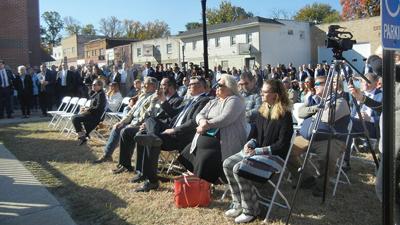
Gannon said he knows Gov. Mike Parson thinks highly of the Hardie project.
“I went to the Missouri Association of Counties conference (soon after the Oct. 20 public announcement about the project) and Gov. Parson was talking about it, and how it would be an asset to the state.”
Gannon said that Parson gave a speech and mentioned that Jefferson County was lucky to have landed the Hardie project.
“That’s true, but luck comes after a lot of work,” Gannon said. “There has been a lot of collaboration on this project along the way, including for this grant. The county worked with MoDOT (the Missouri Department of Transportation) and the Missouri Department of Economic Development to make sure we had our application as complete as we could.”
Soon after the Oct. 20 announcement, the Jefferson County Council voted unanimously to allocate another $1.5 million of its share of ARPA funds to help pay for preliminary design and engineering costs related to water and sewer service for the new plant.
Crystal City officials have discussed whether it will be necessary to build new facilities or expand their current ones, but an engineering firm has estimated that a facility to provide water and sewer service to the Hardie plant could cost $15 million to $30 million, which would be paid from the user fees from the plant.
The state previously approved more than $10 million in tax credits and other incentives for the Hardie project, including $9.7 million in tax credits through the Missouri Works and BUILD programs and $422,000 in training incentives through the Missouri One Start program.
The James Hardie company, based in Ireland, plans to invest $399,000,000 in the Crystal City project, state economic officials have said.
Hardie, which makes building materials, is expected to employ 238 people at the new plant, paying them $34 per hour on average.
Construction on the project is expected to begin this spring, with the plant to open in late 2025.