








Photo by Mikhail Nilov via Pexels
By Stephen Beech
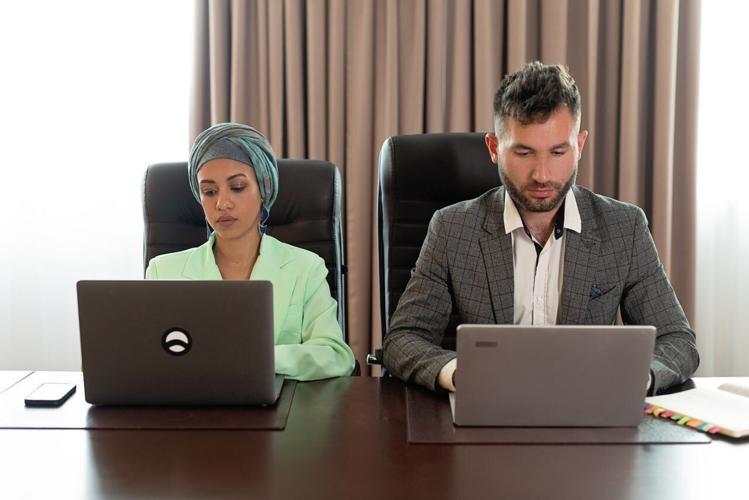
Working around men makes women feel worse about mistakes, suggests a new study.
With more men on the team, researchers found it may become harder for women to admit mistakes or see them as learning opportunities.
Mistakes happen at work regardless of the type of job and gender, but there is major variation in how employees feel about them and how they are perceived by others.
Women are likelier than men to perceive mistakes more negatively – depending on with whom they are sharing a workspace, according to the new study.
Study lead author Grace Lordan, from the London School of Economics (LSE), said: "On paper, a mistake carries the same consequences whoever makes it, and that is exactly what we found.
"But formal rules aren't culture.
"In teams that are three-quarters or more male, women told us they feel less comfortable admitting a mistake and less confident it will be treated as something to learn from.
"Where women are in the majority, that gap vanishes."
The research team surveyed how comfortable employees would be admitting mistakes, how likely they are to believe they'd be penalized for making them, and whether they'd consider them as a learning opportunity.

Photo by Yan Krukau via Pexels
More than 1,400 employees in the UK financial service sector participated in the study.
While this sector is male dominated, 81% of the study participants were women.
The findings, published in the journal Frontiers in Organizational Psychology, showed two consistent patterns:
Being a woman and being in a male-dominated work setting were associated with seeing mistakes more negatively, with the latter pattern regardless of gender.
Lordan said: "Extremely male-heavy, high-pressure teams may foster a general climate of fear or perfectionism and a 'no mistakes' norm."
Men reported more positive views of mistakes across all measurements than women, who felt less comfortable admitting mistakes.
Women were also more likely to think they'd be punished for mistakes and were less inclined to consider them learning opportunities.
In more male-dominated workplaces, the trends sharpened further.
Lordan said: "In teams where more than three-quarters were men, women report less comfort: 5.46 vs. 5.94 for men in the same settings on a seven-point scale.
"Women were also less likely to see mistakes as learning opportunities.
"In low-male-share environments, women's views are as positive as men's or slightly better."
Men's perception, on the other hand, varied very little depending on their workplace's gender composition.
The one score where the researchers didn't find a gender difference was the expectation of penalization.
In comparable roles and settings, women didn't expect to be punished more than men, neither in female- nor in male-heavy places of work.
The research team said that could be due to how respondents interpreted the term "penalization," which might have evoked formal consequences, for example, a note on the record or a career setback.

Photo by https://kaboompics.com/ via Pexels
Fear of indirect penalties, however, might be more widespread among women, according to the researchers.
Lordan said: "Comfort and learning tap informal, cultural dimensions, which is where bias tends to show up: being seen as less competent, having the mistake held against you in unwritten ways.
"Women may feel on 'thinner ice' psychologically even with the same consequences on paper."
She says that might not only affect employees and teams, but may also have negative repercussions throughout companies.
Lordan added: "Learning from failure is where innovation comes from.
"If women feel less free to admit mistakes, the organization doesn't just lose their confidence; it loses the lessons.
"The fix isn't expensive. Leaders, and especially men leading male-heavy teams, can change the climate simply by being open about their own mistakes."
The research team suggests peer groups for women, in- and outside of immediate teams, that offer safe spaces to discuss mistakes.
But excessive double-checking or avoiding "risky" projects can stunt career growth.
The researchers said that the gender-unbalanced sample means that the results can't be readily generalized.
Lordan says that the findings mostly apply to high-pressure, low-tolerance fields, but may extend to tech, engineering, and some medical specialties.
She added: "Over time, freedom to fail could contribute to gaps in expertise, confidence and advancement, caused by unequal opportunity to learn, not ability.
"A more inclusive error culture benefits everyone