


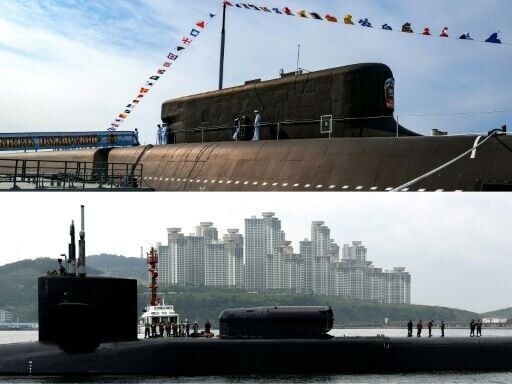
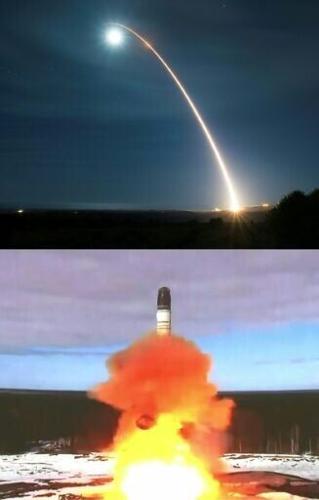
The United States on Friday urged three-way talks with Russia and China to set new limits on nuclear weapons, after the last treaty between top nuclear powers Washington and Moscow expired.
China has already rejected joining disarmament negotiations "at this stage", while Russia suggested other nuclear-armed states like Britain and France should be included.
"Arms control can no longer be a bilateral issue between the United States and Russia," US Secretary of State Marco Rubio wrote in an online essay.
"Other countries have a responsibility to help ensure strategic stability, none more so than China," he said.
Thomas DiNanno, US under secretary of state for arms control, presented a new plan to the UN Conference on Disarmament, charging that the New START treaty that lapsed on Thursday had "fundamental flaws".
"Serial Russian violations, growth of more worldwide stockpiles and flaws in New START's design and implementation gives the United States a clear imperative to call for a new architecture that addresses the threats of today, not those of a bygone era," he told a United Nations meeting in Geneva.
- 'Modernised treaty' -
The expiration of New START, which restricted the United States and Russia to 1,550 deployed nuclear warheads each, marks the first time in decades that there is no treaty to curtail the positioning of the planet's most destructive weapons, sparking fears of a fresh arms race.
US President Donald Trump did not accept a proposal from Russian counterpart Vladimir Putin to keep New START's restrictions in place for another year. He called Thursday for a "new, improved and modernised treaty".
Rubio said that the United States will "negotiate from a position of strength".
"Russia and China should not expect the United States to stand still while they shirk their obligations and expand their nuclear forces," Rubio wrote.
"We will maintain a robust, credible and modernised nuclear deterrent.
"But we will do (so) while pursuing all avenues to fulfil the president's genuine desire for a world with fewer of these awful weapons."
Trump has said he wants to restart nuclear testing for the first time in decades, although there has been no follow-through.
- 'No limits' -
DiNanno accused China of taking advantage of the "legally-binding US-Russian restraint to begin expanding its arsenal at a historic pace", maintaining that it was "on track to have over 1,000 nuclear warheads by 2030".
"As we sit here today, China's entire nuclear arsenal has no limits, no transparency, no declarations, had no controls," he charged.
Russia and the United States together control more than 80 percent of the world's nuclear warheads.
But China's nuclear arsenal is growing faster than for any other country, by about 100 new warheads a year since 2023, according to the Stockholm International Peace Research Institute.
China's ambassador Shen Jian reiterated Beijing's official position on Friday, insisting to the disarmament body that "China's nuclear capabilities are nowhere near the level of those of the US or Russia".
"China would not participate in nuclear disarmament negotiations at this stage."
He insisted that "states possessing the largest nuclear arsenals should continue to fulfil their special and primary responsibilities for nuclear disarmament".
Russia, which has said it no longer considers itself bound by New START limits, insisted that any new nuclear talks should include other nuclear-armed states such as France and Britain, its ambassador Gennady Gatilov told the conference.
- 'New era' -
Britain's ambassador, David Riley, appeared to dismiss the idea, insisting that "the United Kingdom maintains a minimum credible nuclear deterrent" and that arms control talks should focus on "those states with the largest nuclear arsenals -- China, Russia and the US".
French ambassador Anne Lazar-Sury meanwhile said Paris believed that "credible measures capable of reducing the risk of nuclear weapons use" should be "the objective of all nuclear-armed states."
The end of New START has raised fears of a new arms race.
Senator Jeanne Shaheen, the top Democrat on the US Senate Foreign Relations Committee, said letting New START expire without a successor agreement in place "means we will lose the last remaining guardrails on Russian strategic nuclear force".
Trump said that New START was "badly negotiated" and "is being grossly violated".
Russia in 2023 rejected inspections of its nuclear sites under the treaty, as tensions rose with the United States over Moscow's invasion of Ukraine.
But Trump has resumed diplomacy with Putin's Russia. The two countries on Thursday announced a resumption of direct military dialogue to avert crises.
sct-nl/rjm/tw