


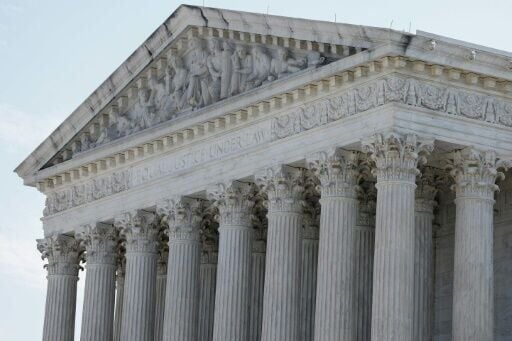
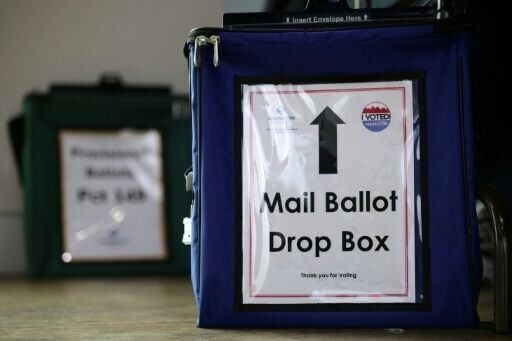
The US Supreme Court appeared likely on Monday to toss out a state law that allows mail-in ballots received after Election Day to be counted, a case that could have repercussions for November's midterm elections.
The case involves a challenge by the Republican National Committee (RNC) to a law in the southern state of Mississippi that allows ballots to be tallied if they arrive within five business days after Election Day.
Fourteen US states allow mail-in ballots to be counted after the date of the election if they bear a postmark by Election Day. Democrats tend to use mail-in ballots more than Republicans and the practice became more widespread during the Covid pandemic.
Republican President Donald Trump has been a vocal critic of mail-in ballots and has falsely claimed that they contributed to his 2020 election loss to Democrat Joe Biden.
A federal judge ruled in favor of Mississippi but was overturned by an appeals court panel which said ballots must arrive by Election Day to be counted.
The Trump administration has joined the opponents of the Mississippi law and a ruling by the conservative-dominated Supreme Court could affect the ballot-counting rules in other states.
Paul Clement, a lawyer representing the RNC, said it was problematic to have mail-in ballots received "with or without a postmark in differing ways in differing states."
"That reality gives the lie to the idea that we have a uniform national election day," Clement said.
"You can't have an election unless you receive ballots and there must be some deadline for ballot receipt," he said. "Nonetheless, Mississippi insists that ballots can trickle in days or even weeks after Election Day."
- 'Confidence' -
Having elections potentially turn through late-arriving ballots is another problem and can damage faith in the electoral process, Clement said, an argument which appeared to find some traction with conservative justices.
"Some of the briefs have argued that confidence in election outcomes can be seriously undermined if the apparent outcome of the election on the day after the polls close is radically flipped by the acceptance later of a big stash of ballots," noted Justice Samuel Alito, a conservative.
Justice Brett Kavanaugh, another conservative, asked Mississippi Solicitor General Scott Stewart, who was in court to defend the law, whether the tallying of late-arriving ballots could feed perceptions of fraud.
"Is that a real concern?" Kavanaugh said. "Is that something we should be thinking about -- confidence in the election process?"
Stewart said opponents of the Mississippi law "haven't cited a single example of fraud from post-Election Day ballot receipts."
Traditionally "states have broad power over elections," he said. "Congress has respected it and no one challenged it until now."
The mail-in ballot counting case is one of a number of voting rights cases being heard by the Supreme Court this term.
The court, which includes three justices nominated by Trump and has a 6-3 conservative majority, heard arguments last year over the use of race to draw congressional electoral districts.
The Supreme Court is likely to deliver its rulings in the cases by the end of June or early July, which would provide enough time for them to be applied to the November congressional elections.
cl/msp