


Every spring, the urge hits to be somewhere alive with color after months of gray. Flower festivals scratch that itch in a way few travel experiences match. They're time-sensitive, they're photogenic, and they tap into something primal about the turning of seasons. The U.S. flower festival circuit is richer than most Americans realize, and rivals anything Europe has to offer without requiring a passport.
Start Where Everyone Does, It's Still Worth It
Washington, D.C.'s National Cherry Blossom Festival is the easy first choice, and the crowds haven't made it less deserving. The story behind the trees is itself worth knowing: Tokyo Mayor Yukio Ozaki's first gift of 2,000 trees, sent in 1909, had to be burned on orders from the Department of Agriculture after inspectors found them infested with insects and disease.
Undeterred, Ozaki had new shoots grafted onto wild cherry roots, grown pest-free, and shipped 3,000 replacement trees to Washington in 1911. On March 27, 1912, First Lady Helen Herron Taft and Viscountess Chinda, wife of the Japanese ambassador, planted the first two trees on the north bank of the Tidal Basin. Those two original trees still stand today.
Today, the festival spans four weeks and welcomes more than 1.5 million visitors.Peak bloom can last as few as four or five days, which creates a useful kind of urgency. You plan months ahead, then hold your breath and watch the forecasts. Go on a weekday morning before 8 a.m. and it still feels like a discovery.
Head West for the Tulip Fields
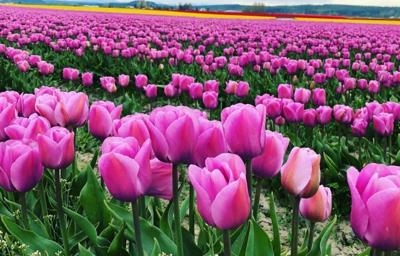
For sheer agricultural scale, nothing in the country competes with the Skagit Valley Tulip Festival in Washington State. About 1,000 acres of tulips and daffodils are grown in Skagit County, more than any other county in the United States. The operation is anchored by RoozenGaarde, a family farm that has grown tulips in Holland since the early 1700s and in Skagit Valley for over 75 years, started by William Roozen after he emigrated from Holland in 1947.
Two farms, RoozenGaarde and Tulip Town, have long comprised the heart of the festival; the former famous for its wide blocks of color stretching toward the Cascades, the latter scoring points with trolley rides and funky photo ops. The festival now spans five farms total, including Tulip Valley Farms, which introduced the valley's first illuminated night bloom and its only U-pick experience.
The Dutch have Keukenhof, and it's extraordinary, but Skagit Valley holds its own. The month-long April run makes timing forgiving, a luxury the D.C. cherry blossoms don't offer.
The South Has Been Quietly Doing This for Decades
Callaway Gardens in Pine Mountain, Georgia, traces its origins to 1930, when Cason and Virginia Callaway stumbled across a bright orange-red plumleaf azalea on a picnic and were so taken by it that they eventually purchased 2,500 acres to preserve and cultivate the land.
This spring, the property relaunches its seasonal event as Spring at Callaway, March 13–May 10, anchored by the 40-acre Callaway Brothers Azalea Bowl. The event showcases more than 700 varieties cresting in waves of pink, coral, lavender, and crimson beneath Georgia pines. Tulips, dogwoods, and seasonal annuals follow in stages, stretching the bloom window across weeks rather than days.
New this year is a Food & Wine Weekends series, where guests follow a trolley-connected tasting route through the gardens. Chef-curated small plates are paired with select wines. It's a smart addition that gives non-gardeners a reason to show up and turns a day trip into a full weekend.
When Nature Does the Work
The most dramatic spring blooms in America may be the least predictable. The Antelope Valley California Poppy Reserve spans over 1,700 acres in the Mojave Desert, about 15 miles west of Lancaster in northern Los Angeles County. In a good rain year, the hills turn a shocking shade of orange. In a great one, a superbloom year, the effect is almost hallucinogenic.
Eight miles of trails wind through the gentle rolling hills, including a paved section for wheelchair access, and the wildflower season generally runs from as early as mid-February through May.But the poppies are famously temperamental: they close up in cold or wind, and bloom timing can shift any time between mid-March and early May.
Checking the reserve's wildflower hotline before you drive out is non-negotiable. In 2015, a record heat wave shriveled the entire bloom in a matter of days. That's the risk, and somehow also the appeal.
The Best-Kept Secret in the Ozarks
Further inland, Garvan Woodland Gardens sits on 4.5 miles of wooded shoreline along Lake Hamilton near Hot Springs, Arkansas. The 210-acre botanical garden of the University of Arkansas features more than 128 species of ornamental and native shrubs and wildflowers, 160 varieties of azaleas, a 4-acre Asian garden with a 12-foot waterfall, and three unique bridges.
The annual Daffodil Days and Tulip Extravaganza kicks off with blooming crocus, daffodils, and hyacinths, followed by more than 150,000 Dutch tulips, with dogwoods and azaleas trailing behind into late spring. The architectural centerpiece, the Anthony Chapel, a latticework of wood and glass that blends seamlessly with the surrounding trees, is reason enough to visit on its own. Most Americans have never heard of this place. That's precisely why it belongs on this list.
The Case for Chasing Bloom Season
What flower festivals share, whether you're in the Skagit Valley or strolling the Tidal Basin, is a quality of urgency. You can't reschedule around a bad week. Peak bloom waits for no one, which forces a kind of intentionality most vacations don't require. You plan, you watch the forecasts, you show up. And when the timing works, the effort feels absurdly worth it. Spring doesn't last. That's the whole lesson.