


The dinner party is back, and it’s on a Tuesday. Exhaustion from screens and the thinning quality of digital socializing pushes more people back to in-home entertaining, not as a formal occasion but as a regular, low-pressure ritual. In-person gathering, including dinner parties, cooking circles and walking groups, is one of 2026’s defining counter-trends to digital overload.
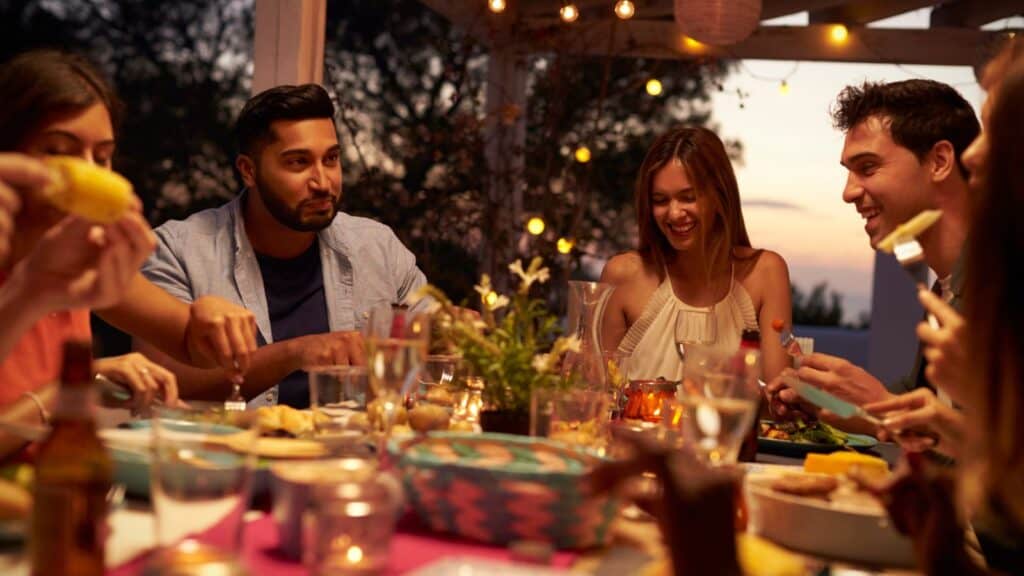
What is changing is not just frequency but format. The version of the dinner party that required a real starter, good china and a Saturday-night time slot is giving way to something looser: a weeknight gathering, a deli board, a bring-your-own-bottle policy and a group text instead of a paper invitation. The Global Wellness Summit’s 2026 Future of Wellness report frames the wider trend as a backlash against optimization culture, a cultural correction away from self-monitoring and toward experiences that feel human rather than curated. The dinner party, informal and low-barrier in its new form, fits that correction precisely.
Why the bar came down
For a long time, hosting carried weight it was never designed to hold. It meant a real starter, a wine pairing someone had researched, a Saturday because you needed Friday to shop. That version still exists, but it is no longer the template. What replaced it is more frequent and far less anxious.
Nearly three-quarters of Americans now prefer staying in with friends over going out, and half say that preference is relatively new. A weeknight works just as well as a Saturday, with a cutting board covered in things from the deli counter, olives, a wedge of something firm and bread that did not come from scratch; these are perfectly acceptable centerpieces. The same Global Wellness Summit report describes the shift as a move toward experiences that prioritize meaning over measurement.
The dinner party was always quietly subversive, and it just needed the rest of the culture to catch up. “Tuesday dinner parties are my favorite kind,” said Chef Jenn Allen, owner of Cook What You Love. “No pressure, no fuss, just good food and even better company.”
What it looks like now
The new hosting format has a few consistent features, and the first is the bring-your-own-bottle model, not as a cost-saving measure but as a social one. When everyone brings something, no one is purely a guest, and no one is purely a host. It flattens the dynamic in a way that makes the whole evening easier to repeat.
The second is the board. A platter, a slate, a large wooden something covered in things that required assembly rather than cooking, such as cheese, a cured meat and whatever fruit looked good at the market. It shows effort without demanding technique, which is the entire point.
The weeknight itself is the third attribute, where hosting on a Tuesday introduces a built-in limit. People arrive at 7 p.m. and leave by 10 p.m. because everyone has somewhere to be in the morning. That constraint, paradoxically, makes the evening feel lighter, as there is no pressure to stretch it into something memorable. It is just dinner, which means it can happen again next month.
Connection as the main course
Cooking circles, small groups who take turns hosting and cooking together rather than for each other, are a related setup gaining ground in cities. The meal becomes the activity rather than just the backdrop, and the host does not need to be skilled.
The Global Wellness Summit frames gatherings like these as part of a growing cultural appetite for what it calls the “festivalization of wellness,” the recognition that in-person connection and shared sensory experience are not soft additions to wellbeing but central to it. Seventy-four percent of people report having deeper conversations at home gatherings than when going out, which may be the most straightforward explanation for why the arrangement is holding.
The dinner party has always understood this. A shared meal at someone’s home is one of the few remaining social formats that are genuinely phone hostile. The food is a reason to gather, and the conversation is the event.
The easiest table you’ll set all year
If the 2026 dinner party has a manifesto, it is a short one: invite people you like, feed them something and do not apologize for the simplicity. The hosts who do this most often are the ones who stopped waiting for the right weekend, recipe and occasion. They decided a Tuesday night and a box of crackers was enough. Increasingly, their guests agree.
Zuzana Paar is the creator of Sustainable Life Ideas, a lifestyle blog dedicated to simple, intentional and eco-friendly living. With a global perspective shaped by years abroad, she shares everyday tips, thoughtful routines and creative ways to live more sustainably, without the overwhelm.
The post The dinner party is back — and it’s happening on a Tuesday appeared first on Food Drink Life.