




(NASA/JPL-Cal/ASU/Kevin M. Gill via SWNS)
By Dean Murray
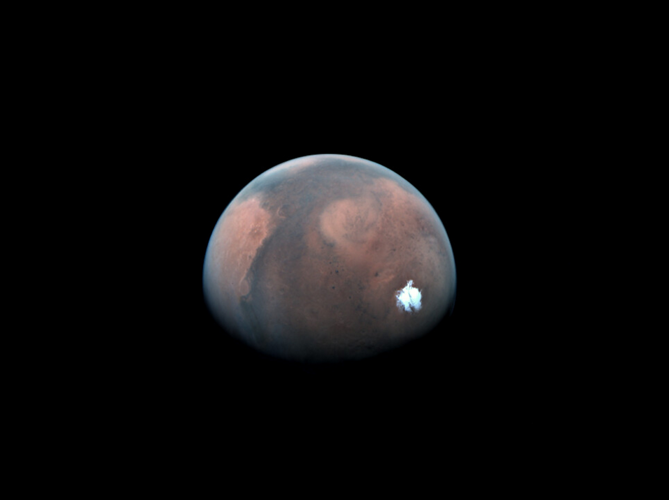
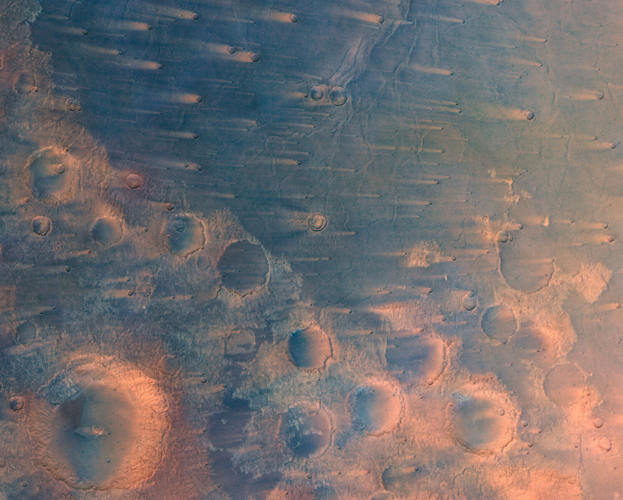
A spacecraft has taken jaw-dropping close-up snaps of Mars on its way to a $10,000 quadrillion asteroid.
NASA’s Psyche spacecraft completed its close approach of the Red Planet on May 15, coming within 2,864 miles (4,609 kilometres) of the planet’s surface.
NASA’s Jet Propulsion Laboratory (JPL) said Tuesday, May 19, that this flyby used a gravity assist from Mars to provide a critical boost in speed and to adjust the spacecraft’s orbital plane without using any onboard propellant, sending it on its way towards the metal-rich asteroid Psyche.
The mission aims to study the space rock that could be worth more than the entire global economy.
The craft will journey to the unique metal-rich asteroid orbiting the Sun between Mars and Jupiter, some 499,555,545 km away from Earth.

(NASA/JPL-Cal/ASU/Kevin M. Gill via SWNS)
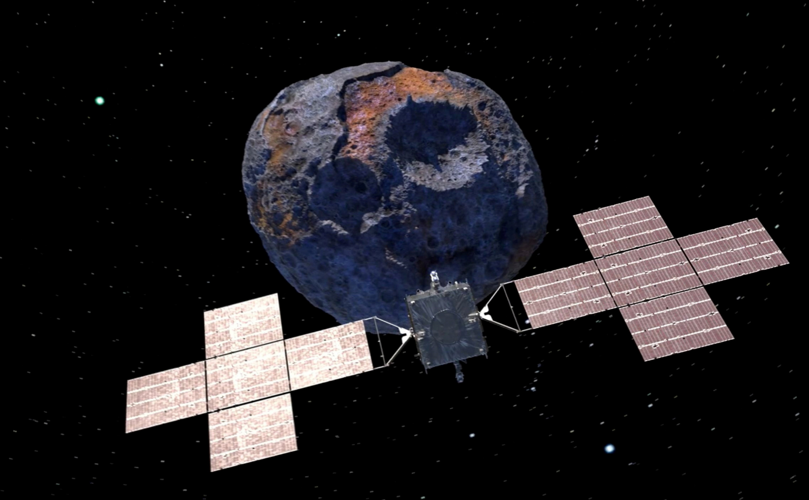
The rock, named 16 Psyche, potentially has a core of iron, nickel and gold worth $10,000 quadrillion.
Currently, the entire global economy is estimated to be roughly $110 trillion.
JPL said the spacecraft is now headed directly towards the asteroid, located in the main asteroid belt between Mars and Jupiter.
After the Mars flyby, the flight team analyzed radio signals between the spacecraft and NASA’s Deep Space Network (DSN), the agency’s global system for communicating with interplanetary spacecraft, to confirm that Psyche was on the correct trajectory.
“Although we were confident in our calculations and flight plan, monitoring the DSN’s Doppler signal in real time during the flyby was still exciting,” said Don Han, Psyche’s navigation lead at NASA’s Jet Propulsion Laboratory in Southern California. “We’ve confirmed that Mars gave the spacecraft a 1,000 mileâperâhour boost and shifted its orbital plane by about 1 degree relative to the Sun. We are now on course for arrival at the asteroid Psyche in summer 2029.”

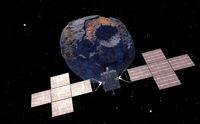
The rock named 16 Psyche. (NASA/JPL-Caltech/ASU via SWNS)
With Mars behind it, the spacecraft will soon resume using its solar-electric propulsion system to travel to the main asteroid belt where Psyche is located. When it arrives in August 2029, it will insert itself into orbit around the asteroid, which is thought to be the partial core of a planetesimal, a building block of an early planet.
Through a series of circular orbits that go lower and then higher in altitude around Psyche, which is about 173 miles (280 kilometres) across at its widest point, the spacecraft will map the asteroid and gather science data.
If the asteroid proves to be the metallic core of an ancient planetesimal, it could offer a one-of-a-kind window into the interior of rocky planets like Earth.
“We’ve been anticipating the Mars flyby for years, but now it’s complete. We can thank the Red Planet for giving our spacecraft a critical gravitational slingshot farther into the solar system,” said Lindy Elkins-Tanton, principal investigator for Psyche at the University of California, Berkeley. “Onward to the asteroid Psyche!”