


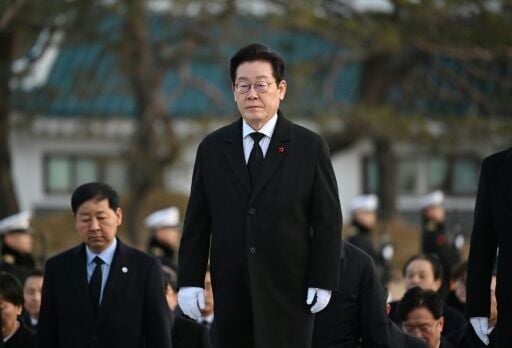
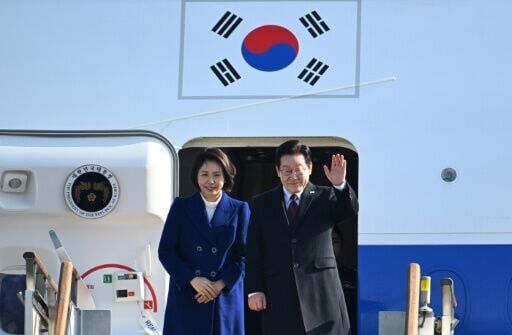
South Korea's President Lee Jae Myung arrived in China on Sunday for a four-day visit, eager to boost economic ties with Seoul's largest trading partner while keeping a lid on potentially explosive issues such as Taiwan.
Lee is the first South Korean leader to visit Beijing in six years, and his trip comes less than a week after China carried out massive military drills around Taiwan, the self-ruled island it claims as part of its territory.
The exercise, featuring missiles, fighter jets, navy ships and coastguard vessels, drew a chorus of international condemnation that Seoul has notably declined to join.
Lee, accompanied by a delegation of business and tech leaders, hopes to expand economic cooperation in meetings with President Xi Jinping and other top officials.
And he hopes to possibly harness China's clout over North Korea to support his bid to improve ties with Pyongyang.
"China is a very important cooperative partner in moving toward peace and unification on the Korean Peninsula," Lee said during a meeting with Korean residents in Beijing, according to Yonhap news agency.
Lee added his visit "would serve as a new starting point to fill in the gaps in Korea-China relations, restore them to normal and upgrade them to a new level".
Hours before Lee departed for Beijing, Seoul's military said the North had fired a ballistic missile into the Sea of Japan -- its first test of the year.
Seoul has for decades trodden a fine line between China, its top trading partner, and the United States, its chief defence guarantor.
But Kang Jun-young, a professor at Seoul's Hankuk University of Foreign Studies, said Beijing was now seeking to draw South Korea away from Washington's sphere of influence.
"China views South Korea as the weakest link at a time when trilateral cooperation among South Korea, the United States and Japan is strengthening," he told AFP.
Lee has deftly stayed on the sidelines since a nasty spat erupted between Beijing and Tokyo late last year, triggered by Prime Minister Sanae Takaichi's suggestion that Japan could intervene militarily if China attacks Taiwan.
In an interview with Chinese state broadcaster CCTV on Friday, he said that he "clearly affirms" that "respecting the 'one-China' principle and maintaining peace and stability in Northeast Asia, including in the Taiwan Strait, are very important".
- Trade, AI and K-pop -
On economic ties, Lee has called for South Korea and China to work towards "more horizontal and mutually beneficial" trade.
He is bringing with him a large delegation of executives from some of South Korea's biggest and best-known firms including Samsung -- one of the world's top memory chip makers which produces crucial components for the booming AI industry.
Hyundai Motor Group's executive chair, Chung Eui-sun, is also part of the delegation alongside figures from the entertainment and gaming industries.
A summit with Xi is planned for Monday, followed by trade talks with top officials including Premier Li Qiang on Tuesday, according to top South Korean adviser Wi Sung-lac.
Lee will then travel to the financial hub of Shanghai, home to a substantial South Korean business community, where he will attend a startup summit and visit the former headquarters of the Korean government-in-exile during Japanese rule.
Xi and Lee last met in November on the sidelines of a regional summit in Gyeongju in South Korea -- a meeting Seoul framed at the time as a reset following years of tense relations.
The South Korean president plans to pitch a potential role for China in his efforts to rekindle frayed ties with the North, which is heavily dependent on Beijing as a trading partner.
Officials also hope the meetings will lead to China easing an unofficial ban on imports of South Korean pop culture, in place for almost a decade.
"China's official position is that there is no such thing as a ban on Korean content, but from our perspective the situation looks somewhat different," said Wi, the presidential adviser.
hs-kjk-sam/dhw/ceg/ami