



(Olli Loukola via SWNS)
By Lauren Wilkin
Scientists have taught bees to play football as part of a new study revealing the surprising intelligence of the insects.
Olli Loukola, the senior author of a new study, says he is a "behavioral ecologist," but is now "also known as the guy who taught the bees to play football."
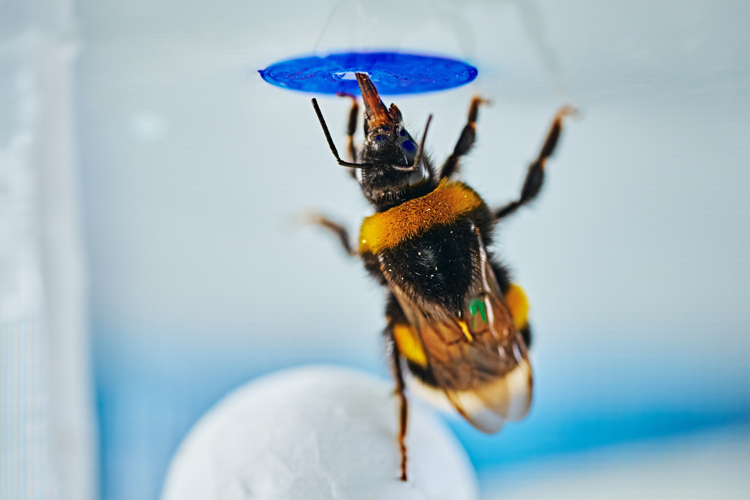
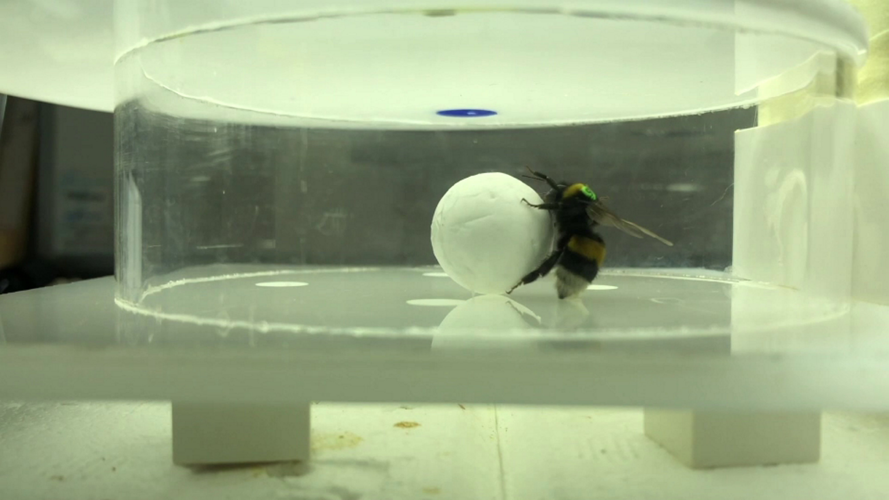
Researchers taught the bees two things before the study: That the small Styrofoam ball was non-threatening, and that blue meant a reward. The researchers then placed a blue circle - imitating a flower - just high enough so the bees couldn't stand and reach it, but just low enough so they couldn't fly either.
They then observed the bees to see how they would overcome the problem.
Published in Science, the new study proves bees can solve similar complex tasks to elephants and chimpanzees, despite their brains being smaller than a grain of rice.
“The animal must realise that an object can be repositioned and then used as a tool to reach an otherwise inaccessible goal," says senior author Olli Loukola, docent at the University of Oulu.
“This is essentially an insect version of the classic ‘box-and-banana’ problem,” he says, referring to the infamous experiment Wolfgang Köhler conducted on chimpanzees.
After placing a box of bananas out of reach, Köhler observed the chimpanzees stacking boxes to reach the food.
This is referred to as spontaneous problem-solving, and Loukola was determined to find out whether bumblebees were capable of such complex thinking, despite their brains being only about 0.0002% the size of the human brain, according to Imperial College London.
“What makes this behavior especially remarkable is that the bees had never been trained to roll the ball. This was a completely new challenge," says lead author Akshaye Bhambore from the University of Oulu.

(Olli Loukola via SWNS)
Despite this, after a short time, the bumblebees maneuvered the ball, placed it beneath the blue circle, stood on top of it, and reached the imitation flower.
This behavior was repeated time and time again among different bees.
“Watching the bees solving the task was genuinely fascinating," says co-author Ece Nur AkmeÅe from the University of Helsinki.
“We are not claiming that bees think like humans,” says Loukola, who currently works as a Senior Researcher at the University of Turku.
“But our findings show that miniature brains can generate flexible solutions to novel problems in ways we are only beginning to understand.”
The new study titled “Spontaneous problem-solving in bumble bees” by Akshaye A. Bhambore, Ece N. AkmeÅe, Emma Häkkinen, Milla K. Jussila, Juha-Heikki Kantola, and Olli J. Loukola was published June 4 2026 in the prestigious Science journal.