


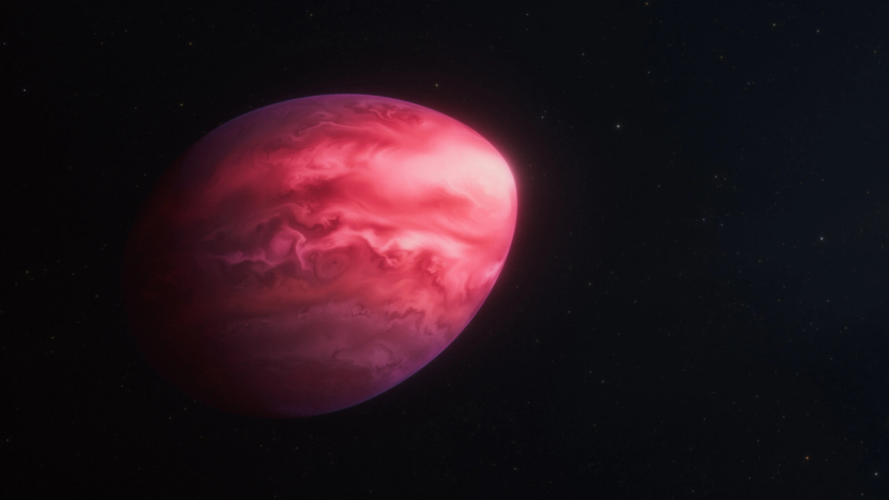
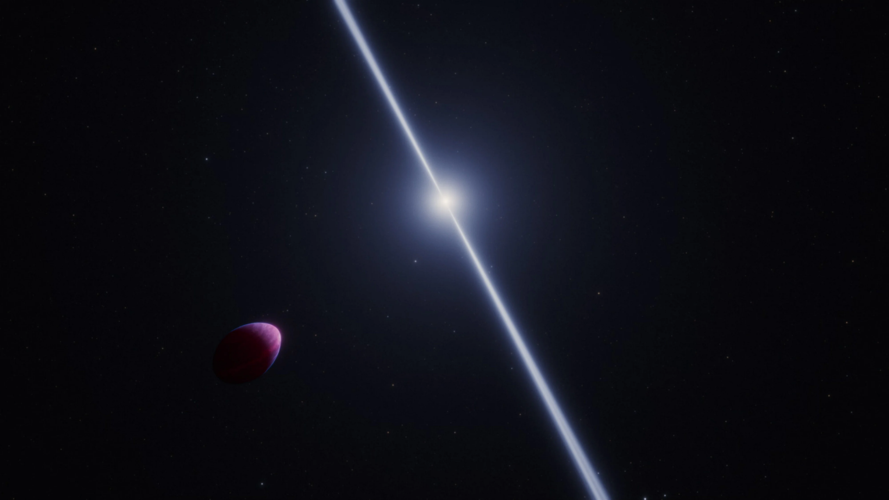

NASA’s James Webb Space Telescope captured planet PSR J2322-2650b. (NASA/ESA/CSA/R Crawford (STScI) via SWNS)
By Dean Murray
Space scientists are puzzled after the discovery of a bizarre planet — shaped like a lemon.
Astronomers have spotted an unusual exoplanet orbiting a pulsar, with a bizarre ovoid form sculpted by extreme gravitational forces.
NASA’s James Webb Space Telescope revealed PSR J2322-2650b, a Jupiter-mass world locked in a tight 7.8-hour orbit around a rapidly spinning neutron star just one million miles away.
Researchers, who have published a paper in The Astrophysical Journal Letters, said the planet appears to have an exotic helium-and-carbon-dominated atmosphere unlike any ever seen before.

(NASA/ESA/CSA/R Crawford (STScI) via SWNS)
The NASA Webb Mission Team said: "Soot clouds likely float through the air, and deep within the planet, these carbon clouds can condense and form diamonds. How the planet came to be is a mystery."
Study co-author Peter Gao of the Carnegie Earth and Planets Laboratory in Washington said: "This was an absolute surprise. I remember after we got the data down, our collective reaction was ‘What the heck is this?’ It's extremely different from what we expected."
The University of Chicago’s Michael Zhang, principal study investigator, said: "The planet orbits a star that's completely bizarre — the mass of the Sun, but the size of a city.
"This is a new type of planet atmosphere that nobody has ever seen before. Instead of finding the normal molecules we expect to see on an exoplanet — like water, methane, and carbon dioxide — we saw molecular carbon, specifically C3 and C2."
The study’s revelations challenge planetary formation theories and open new avenues for exploring extreme cosmic environments.