


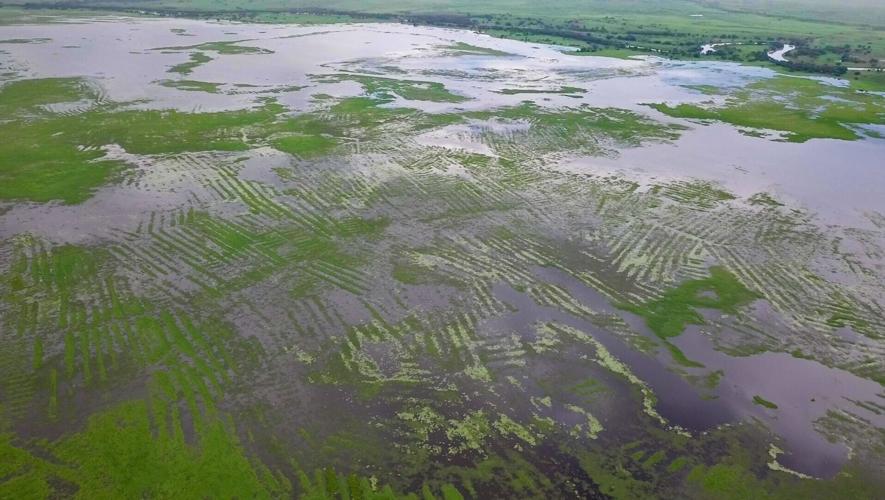
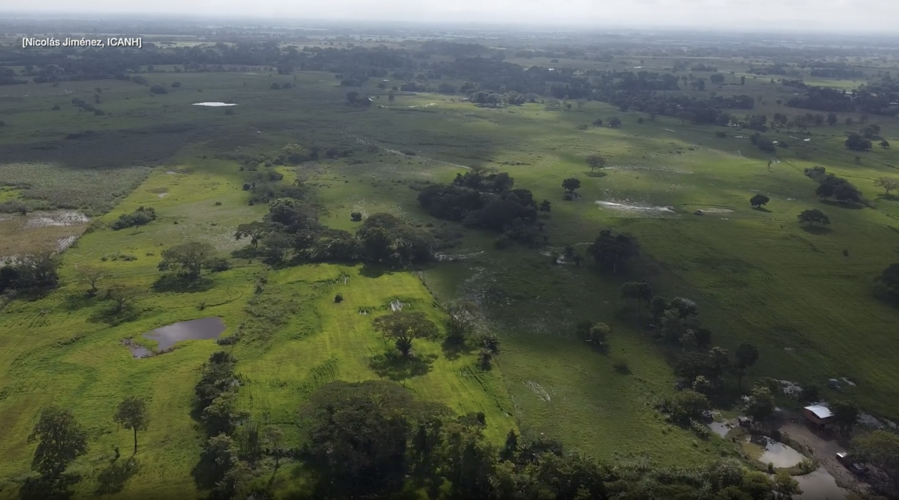
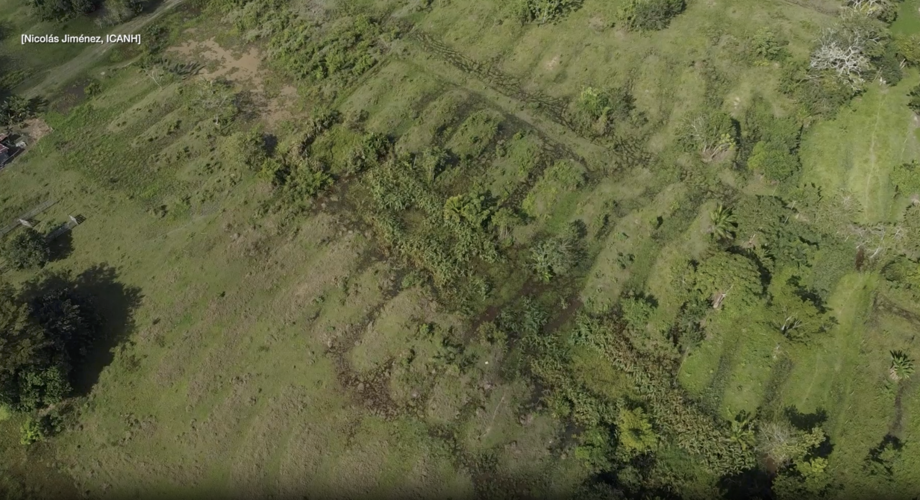
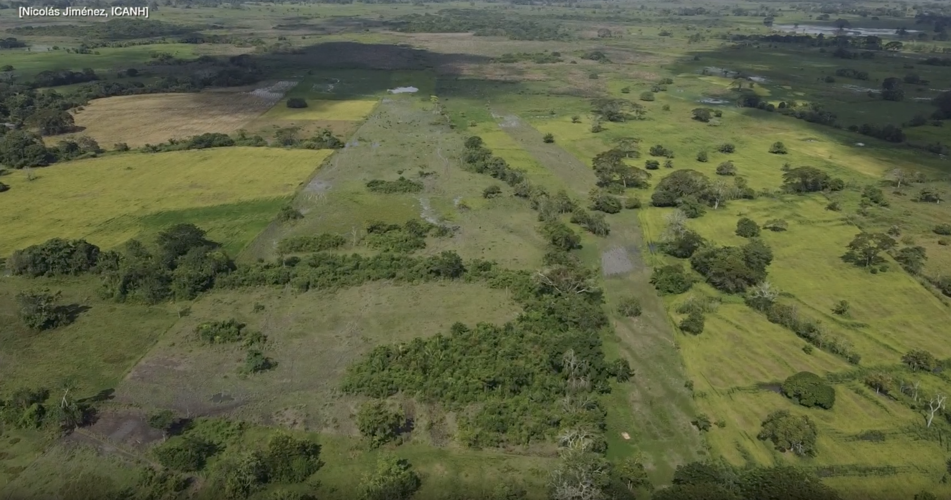

The canals and raised fields of La Mojana during wet season. (Nicolás Jiménez / ICANH via SWNS)
By Stephen Beech
Early farmers achieved an "engineering wonder of the world" by building a giant irrigation system in South America thousands of years ago.
Communities living in what is now Colombia created the remarkable network based on cooperation among family groups without top-down government, according to a new study.
Archaeologists say that policymakers in present-day Colombia should now adopt a similar strategy to solve the country's current water management crisis.
The pre-Hispanic field systems of La Mojana in the Colombian Caribbean are so vast you can see them from an aircraft at high altitude.
Their canals and raised fields — in use from the first centuries B.C. until the 11th century A.D. — cover an astonishing 500,000 hectares, three times the size of London today.

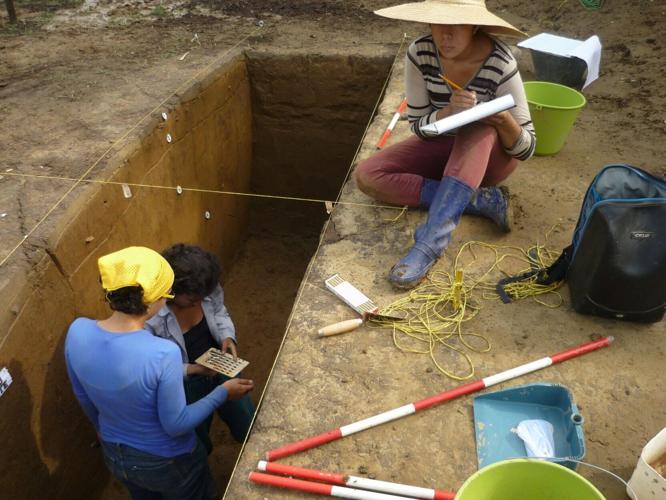
Archaeologists from the Colombian Institute of Anthropology and History (ICANH) recording an excavated section of a pre-Hispanic canal-ridge formation. (ICANH via SWNS)
It has traditionally been assumed that powerful rulers must have ordered and managed such an ambitious infrastructure project because of its complexity and the amount of work thought to be involved.
But the new study, led by University of Cambridge archaeologists, suggests that the work was most likely locally led, cooperative and much faster than previously assumed.
The team says their findings, published in the journal Communications Sustainability, are important historically but also offer hope to Colombians today who are suffering from a water management crisis linked to climate change, intensive farming and policy failure.
Study lead author Jasmine Vieri, from Cambridge's McDonald Institute for Archaeological Research, said: "These field systems are so impressive that people have assumed they were achieved by hierarchical chiefdoms.
"Our data tells a very different story.
"Our findings indicate that local communities were capable of building these systems in very short periods of time, and organizing themselves rather than relying on a powerful external force."

(Nicolás Jiménez / ICANH via SWNS)
She says the societies responsible for the hydraulic systems in La Mojana were contemporary with the Maya, and with the broader Mesoamerican and Andean state-level societies, which culminated in the Aztec and Inca empires a few centuries later.
The pre-Hispanic populations occupied an area where, the researchers point out, there is no evidence of state-level societies.
It has been assumed — encouraged by evidence of elaborate gold work and ceramics — that they were hierarchical chiefdoms on their way to state formation.
By contrast, the new findings support the idea that the people chose to organize themselves far more horizontally and were able to achieve great things.
Their raised field system managed huge quantities of water during heavy rains, gradually redirected it in drier months, buffering against both drought and floods.
The network of canals redistributed water from permanent bodies of water around raised areas of housing.
The system provided more fertile soils for cultivation in dry seasons and may have helped locals to trap fish.
Using satellite imagery, the researchers mapped a 500-hectare portion — about 700 football pitches — of pre-Hispanic field systems in the municipality of San Macros, Sucre.
They studied the infrastructure at an unprecedented level of detail, recording the dimensions and volume of 1,600 ridges and 63 housing platforms.

(Nicolás Jiménez / ICANH via SWNS)
The team worked out that when first constructed the formations were about 1.4 meters (4.6 feet) high from the top of the ridge to the lowest point of the canal.
The researchers then developed a new method to quantify the labor needed to construct the system and considered the social and spatial organization most likely to have underpinned this work.
Vieri said: "We are confident that one of these canal-ridge systems could have been built in less than two months, around half of a dry season.
"That's a far lower labor investment than has been previously assumed, and manageable through cooperation."
The researchers factored in volumes of moved earth, as well as information about local geology, Indigenous working practices, population density and available technology.
Starting from an estimated population of 1,600 people in the study area, they based their calculations on a workforce of 800 people which, the team emphasizes, represents a "conservative" estimate, given ethnographic evidence that men, women and probably children traditionally engage in subsistence farming.
Vieri said soils in the Colombian Caribbean are heavy clay which would have made the work harder and there were no metal shovels in the region at the time.
Study senior author Marcos Martinon-Torres said: "Arguments for centralized, top-down planning, unsupported by data, risk obscuring the agency of indigenous pre-Hispanic populations.

(Nicolás Jiménez / ICANH via SWNS)
"Pre-Hispanic societies were inventive and cooperative, they worked with nature rather than trying to obstruct it.
"And we already know that recovering ancestral practices has positive societal impact today through local populations connecting with their heritage through technology."
He said evidence for the use of raised field systems in the region ends before the Spanish arrived in the 16th century.
It isn't clear why they stopped being used, but it has been suggested there was population movement from the lowlands toward mountainous areas.
The researchers say that the pre-Hispanic sustainable solution to water management can be adopted by local populations without the need for state intervention.
Study co-author Fernando Montejo Gaitán, from the Colombian Institute of Anthropology and History (ICANH), said: "Policymakers have shown interest in these ancient systems, but lacked data.
"Our study is the first to show that these sustainable solutions can be organized locally and collectively."
He added: "Local people may need resources from the state but not necessarily state intervention."