


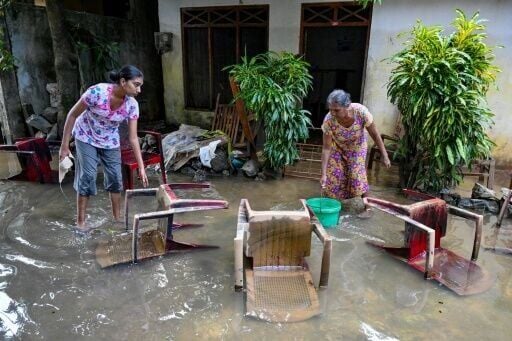
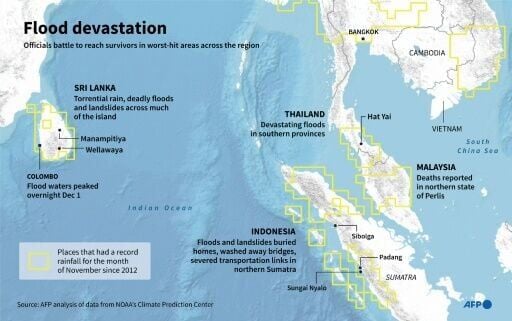



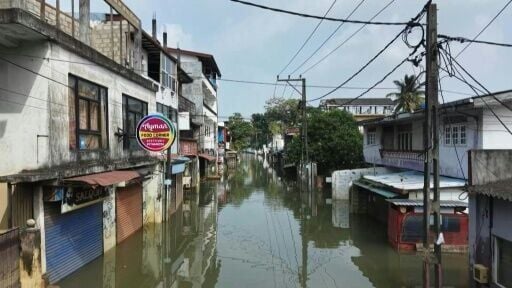
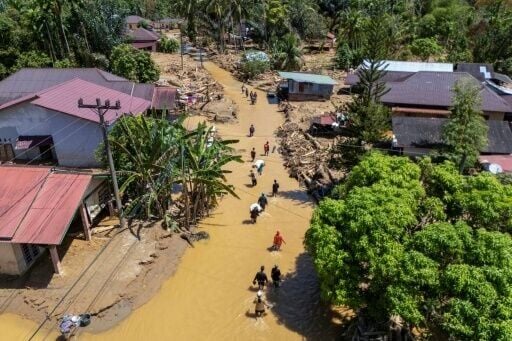
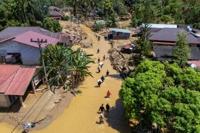
Rain forecasts on Thursday raised fears of more damage in flood-hit Indonesia and Sri Lanka, after earlier deluges killed more than 1,500 people in four countries.
In Indonesia, the weather agency warned the three hardest-hit provinces on the island of Sumatra would see "moderate to heavy" rain between Thursday and Friday.
The downpour started overnight and while it has not reached the same intensity as last week, it has frayed nerves in a region traumatised by flash floods and landslides.
"We are afraid that if it rains suddenly, the flood will come again," 54-year-old Sabandi told AFP at a shelter in Pandan, North Sumatra.
Indonesia's death toll stood at 776 on Thursday, revised down slightly from a day earlier as information arrives from remote, less accessible areas.
More than 560 people remain missing, with patchy communications and electricity making it hard to confirm their whereabouts.
Sabandi, who goes by one name, said she was stranded on her roof for two days without food or water before she could evacuate.
"My house was filled with mud," she said -- so high she couldn't enter.
- Losing sleep -
Seasonal monsoons bring rainfall that farmers across Asia depend on, but climate change is making the phenomenon more erratic, unpredictable and deadly.
Two separate weather systems drenched all of Sri Lanka, Sumatra, parts of southern Thailand and northern Malaysia last week.
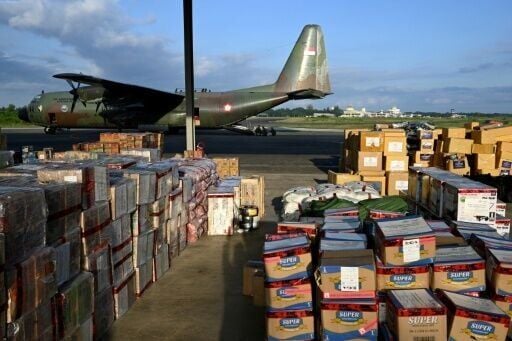
The scale of the disaster has made relief efforts challenging.
In Indonesia's Banda Aceh, an AFP reporter said the line for fuel at one gas station extended four kilometres (2.5 miles).
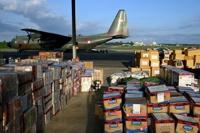
The provincial governor led a relief group to the devastated Aceh Tamiang region late Wednesday, delivering 30 tons of necessities including drinking water, rice, instant noodles, biscuits, eggs and medicine, according to a statement.
In nearby Langsa city, 49-year-old Erni sheltered with her family in an Islamic prayer hall after floods devastated their home.
They had received enough drinking water and food aid to last a few days, but power outages and irregular access to clean water were making it difficult to clean up, Erni said.
"The wardrobe, table, refrigerator -- all are ruined," she told AFP.
"We honestly can't sleep, constantly thinking about what if the flood comes again."
Elsewhere, survivors reported food shortages, price gouging and looting.
- 'This village is a cemetery' -
In Sri Lanka, forecasters said the northeast monsoon was due to arrive from Thursday afternoon.
Landslide alerts were renewed for some of the worst-hit areas of the central Kandy region, and residents were advised not to return home as the saturated slopes could collapse under more rainfall.
But some were searching for the missing on Thursday in the village of Hadabima, where 18 bodies have been pulled out of six homes flattened by landslides, survivor VK Muthukrishnan told AFP.
Six people remained unaccounted for, the 42-year-old electrician said.
"We can't live here anymore because this village is now a cemetery," Muthukrishnan said.
At least 479 people have been killed in Sri Lanka, and hundreds remain missing, with the president appealing for international support.
Authorities estimate they will need up to $7 billion to rebuild homes, industries and roads, a tough ask for a country still emerging from its worst-ever economic crisis three years ago.
burs-sah/sco/mjw