


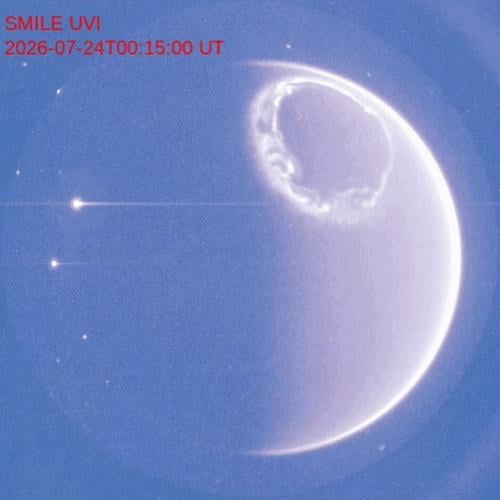
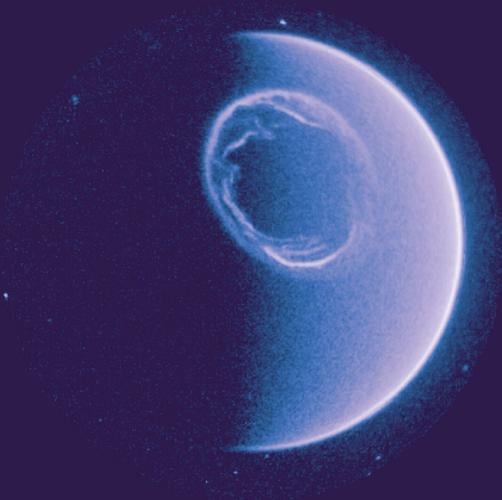

Still from first footage to be released from the ultraviolet camera (UVI) on the European-Chinese Smile mission. With UVI, Smile is now the first spacecraft since 2008 to capture the full ring of northern lights around the north pole in ultraviolet light. (ESA & CAS / Smile / UVI via SWNS)
By Dean Murray
The first images from a new spacecraft show a burst of aurora around the North Pole.
European and Chinese teams have released the first observations from the Smile spacecraft showing an auroral substorm.
Substorms are brief disturbances in Earth's magnetosphere that are created when the wind of charged particles from the sun squashes Earth's magnetic field lines.
With the ultraviolet camera now operational, Smile becomes the first spacecraft since 2008 to capture the full ring of northern lights around the North Pole in ultraviolet light.
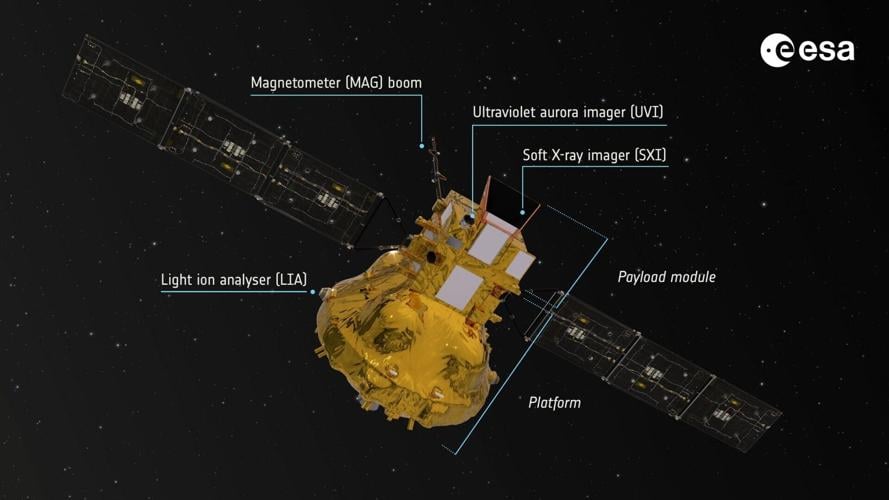
Smile will use four science instruments to study how Earth responds to the solar wind from the sun. This will improve understanding of solar storms, geomagnetic storms and the science of space weather.

This is the first image to be released from the ultraviolet camera (UVI) on the European-Chinese Smile mission. (ESA & CAS / Smile / UVI via SWNS)
ESA (European Space Agency) said Wednesday, Sept. 30: "Inspector Smile is ready for science! This is Smile's first ultraviolet view showing an auroral substorm."
The observations were taken during the recent in-space commissioning period.
ESA said: "During this time, European and Chinese teams got Smile ready by deploying mechanisms, switching on units, checking communications, and fixing any issues that came up.
"Smile's X-ray camera was also successfully switched on and has taken its first images.

Smile spacecraft (artist impression). (ESA via SWNS)
"Though the camera itself is working very well, the teams are currently working on reducing some unwanted light that was detected, even if its amount will naturally reduce over the coming weeks."
The commissioning period ended on Sept. 23, when the European-Chinese Smile mission was declared ready to start revealing how Earth responds to the wind of charged particles from the sun.
Smile stands for Solar wind Magnetosphere Ionosphere Link Explorer. It is a joint mission between the European Space Agency and the Chinese Academy of Sciences.
The spacecraft launched on a Vega-C rocket from Europe's Spaceport in French Guiana on May 19.