


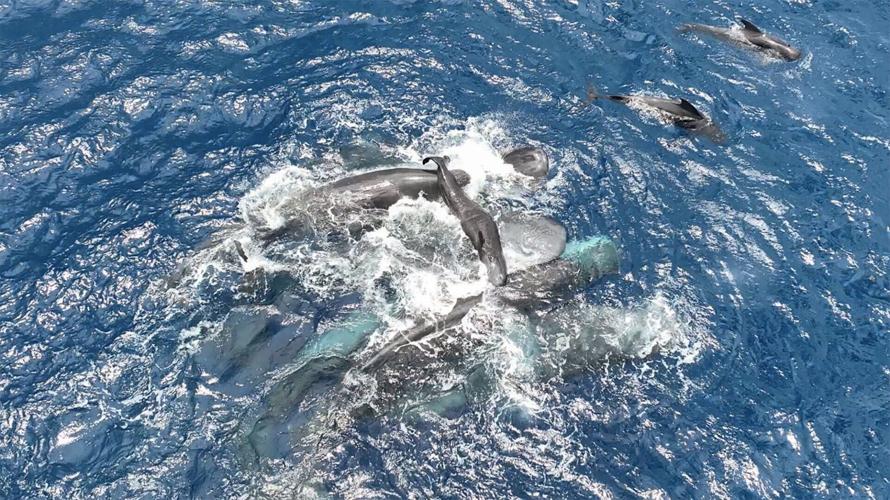
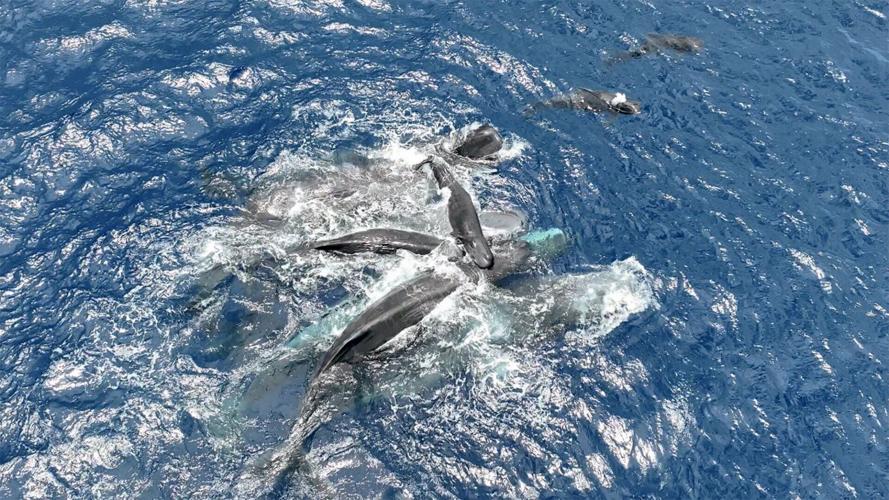

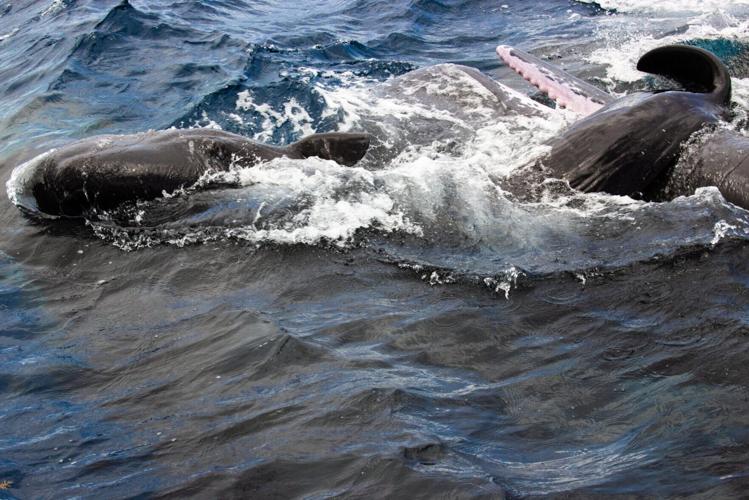
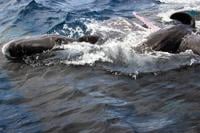


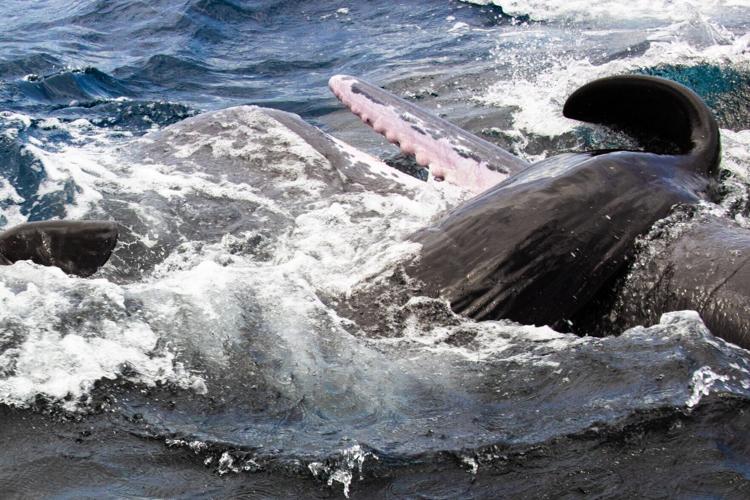

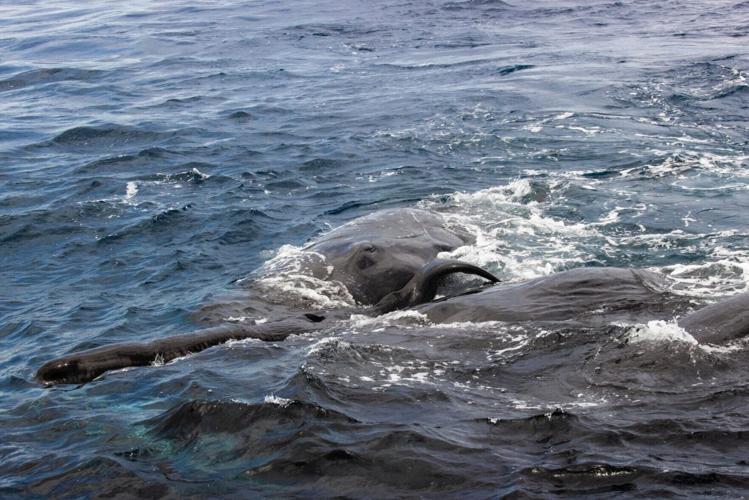

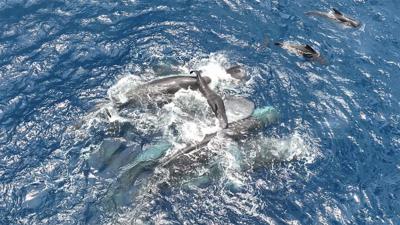

Female relatives acting as "midwives" as a sperm whale gives birth. (Project CETI via SWNS)
By Stephen Beech
Giving birth is a family affair — for whales, new research reveals.
Groundbreaking research shows female relatives — both young and old — acting as "midwives" as a sperm whale gives birth.
The most comprehensive footage of a sperm whale birth ever recorded has also provided the first clear evidence of cooperative birth assistance among non-primates, scientists say.
The whale giving birth — known to scientists as "Rounder" — was observed alongside both her mother, Lady Oracle, and her daughter, Accra, marking the presence of three generations of females participating in the event.
Scientists say underwater audio and aerial video reveal coordinated caregiving, vocal shifts, and social cooperation dating back more than 36 million years.

The whale giving birth - known to scientists as "Rounder" - was observed alongside both her mother, Lady Oracle, and her daughter, Accra, marking the presence of three generations of females participating in the event. (Project CETI via SWNS)
Two new studies analyzed more than six hours of underwater audio and aerial drone footage captured on July 8, 2023, off Dominica in the Caribbean.
Scientists from Project CETI (Cetacean Translation Initiative) have been studying the lives of sperm whale families in seas around Dominica for over two decades.
The studies, published in the journals Science and Scientific Reports, document an entire sperm whale unit — both related and unrelated females from two matrilines of grandmothers, mothers, sisters, and daughters — working together to support the labor, birth, and early moments of a newborn calf.
Researchers observed coordinated lifting, physical support, and caregiving behaviors rarely witnessed in marine mammals and never before recorded in such detail.
David Gruber, founder and president of Project CETI, said: “What we’re seeing is deeply coordinated social care during one of the most vulnerable moments of life.”
Gruber, who is also a distinguished professor of biology at the City University of New York (CUNY), added: “These findings fundamentally reshape how we understand whale society.”
He said observations of whale births in the wild are rare and have been recorded in less than 10% of species, making the documentation exceptionally rare.

(Project CETI via SWNS)
The Science paper utilized high-resolution drone footage, computer vision, network analysis, and a newly developed software tool created specifically for the analysis, paired with long-term data of the well-studied social unit, to quantify coordinated caregiving behaviors.
The findings show that female sperm whales from two unrelated matrilines come together during a birth to assist the mother in labor, with both kin and non-kin taking turns assisting the newborn.
Scientists say it is the first quantitative evidence of birth attendance outside of humans and a few other primates.
The Scientific Reports paper presents a "moment-by-moment" account of the birth.
Audio data revealed "distinct" shifts in vocal styles during key moments of the birth, including the presence of vowel-like structures, adding a new dimension to Project CETI’s ongoing work decoding sperm whale communication.
Together, the studies suggest that cooperative caregiving during birth is an ancient evolutionary behavior.
Analysis indicates that collective lifting of newborn whales may predate the most recent common ancestor of toothed whales more than 36 million years ago.

(Project CETI via SWNS)
The researchers believe that the behaviors caught on camera suggest that cooperation during births functions to reinforce social bonds between sperm whales, which underpin their large-scale society.
They say helping unrelated companions drives them to help in return later, creating a foundation of trust.
Diana Reiss, a professor at Hunter College, CUNY, said: “When you're as familiar with the individual animals, like the CETI team is with this unit of whales, the trust these whales have with their team is unique.
"I'm not sure this unit would tolerate observers being so close in any other instance.”
The research was made possible by decades of ongoing fieldwork led by marine biologist Shane Gero, of Project CETI and founder of The Dominica Sperm Whale Project.

(Project CETI via SWNS)
He said: “This is the most detailed window we’ve ever had into one of the most important moments in a whale’s life.
“Because this family unit has been studied for decades, we could see what the grandmother was doing, how the new big sister acted, and how each helped mom and newborn, placing this rare birth within a deep social and behavioral context.”
Members of the Project CETI machine learning, engineering, and biology teams were present on the research vessel during the birth, contributing firsthand observations alongside advanced technological analysis.
They say the findings place the complexity of sperm whale birth behavior and coordination in comparative context with terrestrial mammals, including humans.