



(SWNS)
By Stephen Beech
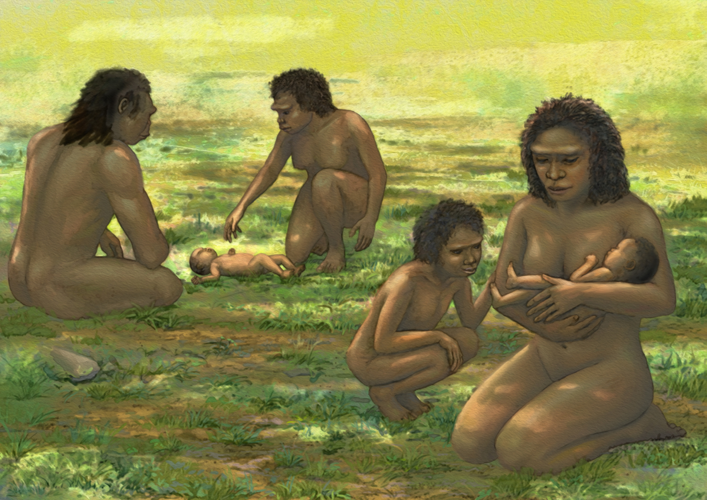
Human ancestors had as tough a time raising babies 1 million years ago as present-day parents, suggests new research.
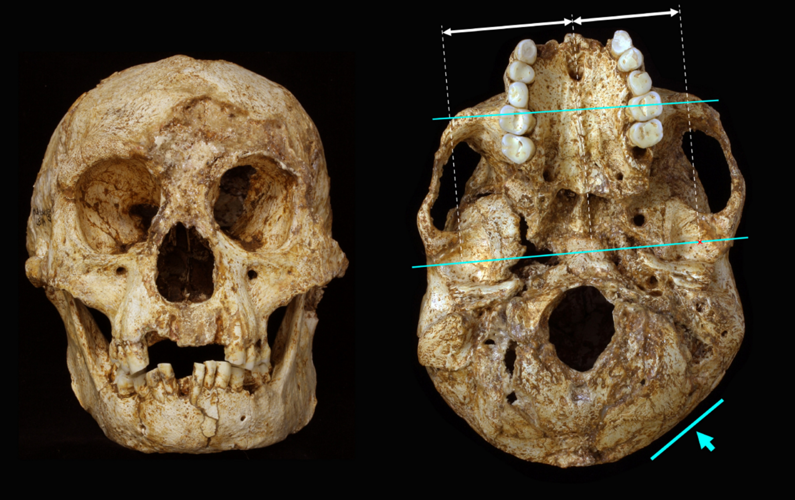
Deformed head shapes in fossilized humans show their infants were probably just as helpless as babies born today - requiring constant parental care, say scientists.
Human babies are born less developed than those of other great apes, and so are unable to move as freely.
A common result of that is deformational plagiocephaly, also called "flat head syndrome".
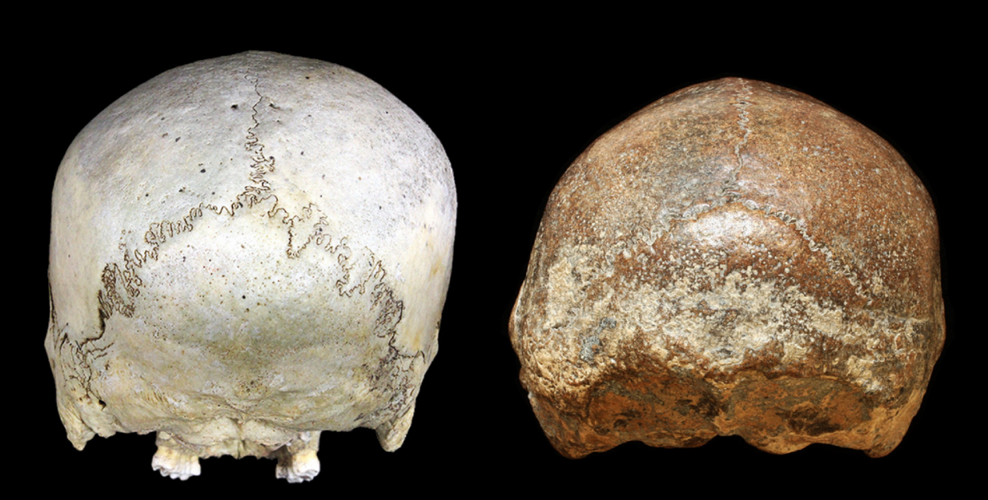
Japanese scientists studied head shapes from scans of living babies, historical Japanese skeletal remains, fossilized specimens of Homo erectus and Homo floresiensis, and compared these to measurements of dry skulls from other great apes.
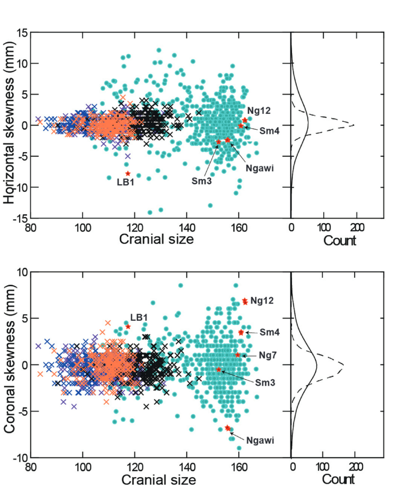
Human head shapes across the ages, as well as the fossilized samples, exhibited a far wider range of deformation, according to the findings published in Proceedings of the Royal Society B: Biological Sciences.

(SWNS)
The Japanese team, led by Yousuke Kaifu at the University of Tokyo, say it is evidence that archaic humans birthed helpless babies, with implications for childcare practices and potentially cooperative social behaviors dating back hundreds of thousands of years.
Kaifu says human babies are born with weak neck muscles, soft cranial bones and still underdeveloped brains, which continue to grow rapidly after birth.
He said one theory for this - called the "obstetrical dilemma" - sees it as a trade-off for being able to walk upright and have large-brained offspring.
But is is not clear in our evolutionary timeline when the helpless newborn phase – and the parental responsibilities which go with it – began.
Fossils of our archaic ancestors are mostly fragmented and rarely of infants.
However, a new approach, which can be applied to fossils of any maturity, may provide the evidence researchers have been looking for.
Kaifu said: "Our method looks for changes in the shape of the cranium - the top part of the skull - which occurred around or soon after birth and remained to some extent into adulthood.
"Nowadays, this is a common condition, called deformational plagiocephaly.

(SWNS)
"The shape of the head is affected by the baby lying the same way frequently due to how they are held or laid down, and from the baby's neck muscles being too weak to control the position of the head."
Kaifu says he was inspired after visiting the skeleton of Homo floresiensis, who lived more than 50,000 years ago. in Indonesia in 2007.
He was struck by the deformed shape of their skull which, from the structure of the bones, appeared to have occurred after birth.
To understand why, he contacted a hospital doctor who identified the cause as deformational plagiocephaly.
That led Kaifu to theorize that skull deformation, which can be identified as not being caused by disease or post-burial, may be an indicator of helplessness in infancy, as it implies a soft, underdeveloped skull and head immobility.
To test the theory, he gathered a team including researchers from Japan and Indonesia to collect and compare CT scans of 123 modern, healthy babies aged from one day to 17 months, measurements from historical human skulls from Japan dated from about 200 to 1,000 years old, great ape skulls, and fossilized human skulls of Homo erectus and Homo floresiensis.
From the results, the team could see that other great apes - including chimpanzees, bonobos, gorillas and orangutans - which are born more physically independent and capable, were grouped within a narrower range of cranial deformity.
The human samples - including fossilized specimens - exhibited a much broader range of deformation and head shapes.
Kaifu said: "This was exciting as we don't know a lot about the behaviour of Homo erectus.

(SWNS)
"They lived between more than one million to 110,000 years ago, and we only have a tiny archaeological record from their stone tools.
"However, if they gave birth to physically helpless babies, then this tells us something about their behaviors, as they would need to have cared for the baby as diligently as we do.
"This likely would have necessitated some social interactions, as it would be difficult for the mother to care for and protect the newborn in that environment, where there would have been other large predators, on her own."
He says another surprising outcome of the research was the level of head deformation in Homo floresiensis.
Often referred to as the "hobbit" due to their small stature, their brain was also much smaller, comparable in size to a chimp, so it is not known why their situation wasn't more similar to other great apes.
Kaifu added: "Even though their brain size was much smaller, their newborn stage was already following the same kind of difficult process as larger-brained modern human ancestors.
"Rather than just being a trade-off for our large brains, the challenging responsibility of childcare and supporting mothers with their infants may actually be an integral part of our human history, at least since the time of the common ancestor of Homo erectus and Homo floresiensis more than one million years ago."