








Photo by angello via Pexels
By Stephen Beech
Pop song lyrics have grown more self-focused over the last 50 years, reveals a new study.
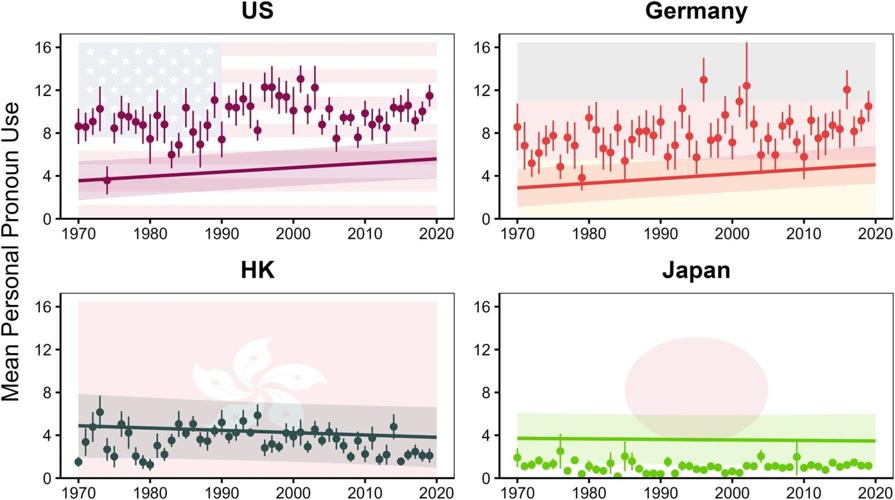
Researchers found that, over five decades, popular songs in the United States — such as Blondie's "Call Me" — have been more likely to include pronouns “I,” “me,” and “mine" in the words.
But no such trend was seen for the most popular songs in Japan and Hong Kong.
Researchers say the changes might reflect changes in culture in "more individualistic" societies.
Scientists have previously examined the possibility that global society may be becoming more self-centric by measuring how often different pronouns appear in cultural products such as books, movie scripts, and lyrics.
Compared to first-person plural pronouns — such as “we” and “us” — a higher proportion of first-person singular pronouns, such as “I” and “me,” can indicate greater self-focus.
Previous pronoun studies show that music lyrics from the US, the UK, and Canada have become more self-focused in recent decades.
But few previous studies have examined trends elsewhere, especially in East Asian societies that place a greater emphasis on the collective group, in contrast to more individualistic Western societies.
Marius Golubickis, of the United Arab Emirates University, and an international team of researchers analyzed the Top 10 most popular songs in the US, Germany, Japan, and Hong Kong for each year from 1970 to 2019.
They used software called Linguistic Inquiry and Word Count to extract the linguistic content of each song.

ONLINE EMBARGO 19.00 BST, 24/06/26Mean use of first-person singular pronouns as a function of Year and Country/Region. (Golubickis et al., 2026, PLOS One via SWNS)
A statistical method known as mixed linear modeling enabled them to analyze changes in pronoun usage over time, while accounting for other factors that could potentially influence pop lyrics.
They found that self-focused language rose "significantly" between 1970 and 2019 in the US and Germany.
But use of self-focused language was relatively stable over time in Japan and Hong Kong.
The research team says their findings, published in the journal PLOS One, suggest that increases in self-centrism, as indicated by pronoun use in song lyrics, may not be universal and may vary depending on societal contexts.

Photo by Jean-Paul Wright via Pexels
Golubickis said: “Popular songs act like cultural time capsules.
"Across five decades of hit music, we found that self-focused language increased in the United States and Germany, but not in Japan or Hong Kong.
"This shows that changes in self-expression are not simply a global trend – they are shaped by the cultural worlds in which music becomes popular.”
He says a prime example of a popular song with "especially high levels" of personal pronoun usage was “Call Me” by New York band Blondie, fronted by Debbie Harry, which topped the charts in the US, UK and Canada in 1980.
Golubickis said: "At that time, the song contained around 6.5 times more self-referential language than the annual average, with repeated first-person phrasing such as 'Call me.'

Photo by Pixabay via Pexels
"Of course, one song alone cannot tell us how self-centric a culture is, but examples like this help illustrate the broader patterns that emerge when thousands of popular songs are analyzed across decades."
He added: "We should be cautious: a few words in a single song cannot tell us much about an entire culture.
"But when we examine thousands of songs across five decades, patterns in language use can reveal
broader shifts in how people express the self in public cultural products.
"Pronouns are not a perfect measure of self-centrism, but they are a well-established linguistic marker of self-focus and become especially informative when studied at scale.
"We are now interested in examining more countries and additional psychological themes, including social connectedness.
"More broadly, we hope cultural archives can help us understand how social life changes across generations."