


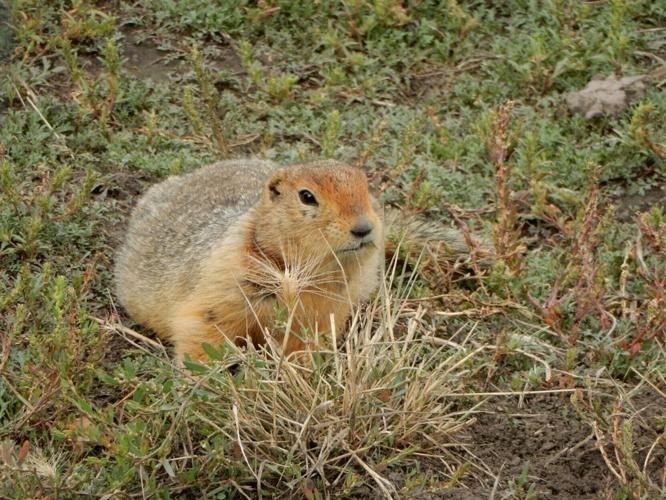
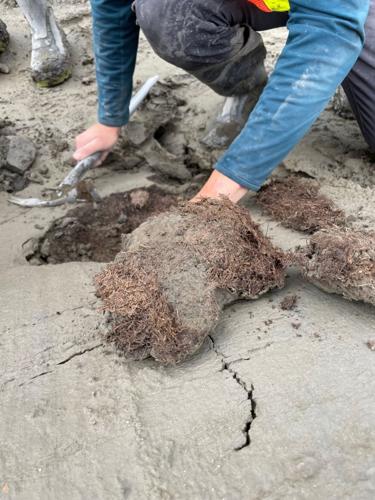
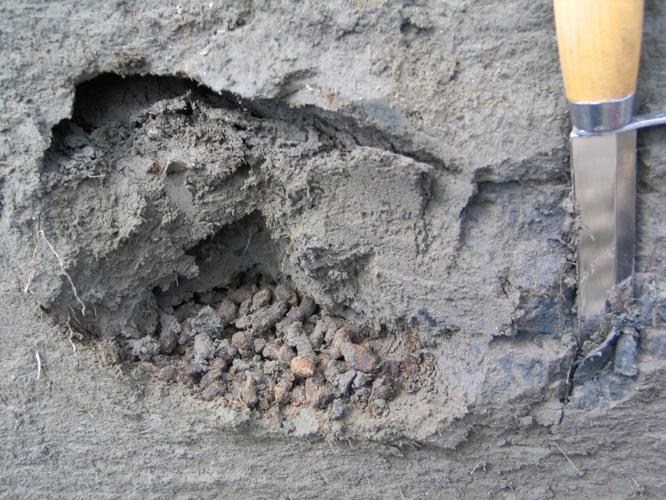

Researchers analyzed permafrost samples collected from ground squirrel burrows that span several glacial periods and can remain frozen and sealed for thousands of years. (Georgia Kirkos via SWNS)
By Stephen Beech
Squirrel droppings dating back up to 700,000 years have revealed "remarkable" new details about the Arctic's evolutionary history.
The dung — preserved for millennia in the deep permafrost of Canada's Yukon — yielded an "enormous" amount of environmental DNA from dozens of species of plants, insects, microbes and large mammals.
The DNA, among the oldest ever recovered and sequenced, provides a unique "snapshot in time" of an environment that no longer exists, say scientists.
Researchers analyzed permafrost samples collected from ground squirrel burrows, spanning several glacial periods, which can remain frozen and sealed for thousands of years.
The samples dated back 30,000 to around 700,000 years.

An ancient Arctic ground squirrel nest found in Lower Hunker Creek, Yukon. (Duane Froese via SWNS)
Canadian scientists extracted a huge amount of ancient environmental DNA, or aeDNA, from the pellets, the size of a rabbit dropping.
The team then reassembled more than 18 mitochondrial genomes from ground squirrels, woolly mammoth, horses and steppe bison.
Their findings, published in the journal Nature Communications, revealed evidence of several other rodents and predators, which included gray wolves, big cat — either cougar or American cheetah — and more than 200 groups of plants.
The data uncovered previously unknown genetic diversity among Arctic ground squirrels, including one lineage dating back 700,000 years that no longer lives in the Yukon.
Its relatives are only found in western Siberia today.
Until now, fossil ground squirrel remains from that period in central Yukon were generally assumed to belong to the same species found today in both northern and southern Yukon.
But that's clearly not the case, according to the research team.
Co-senior author Hendrik Poinar said: "The research shows us that ground squirrel coprolites, or droppings, preserve remarkably diverse genetic snapshots of ancient Beringia, making them exceptional repositories for understanding evolutionary and ecological change through the deep past.
"It helps reconstruct paleoenvironments in much deeper time, providing insights into environmental change, megafaunal evolution, dispersal and ultimately extinction."
The Arctic ground squirrel is widely found within Beringia today, a region spanning the Yukon and Alaska.
The species are known as opportunistic feeders eating a diet which includes a vast variety of plants, fungi and insects.

Squirrel droppings dating back up to 700,000 years have revealed "remarkable" new details about the Arctic's evolutionary history. (Duane Froese via SWNS)
They have meat-eating tendencies, including carrion, whale meat and other rodents.
The wide-ranging feeding habits, combined with their long-term hibernation of up to seven months in frozen burrows, have provided the conditions which have helped to create a detailed biological record of their environment.
Study lead author Tyler Murchie, a paleogenomics researcher at the Hakai Institute, said: "The Arctic ground squirrels that are in the Yukon today act kind of like pack rats.
"So they'll go into the landscape, and they'll collect a whole bunch of different bits of plant material and bones, seeds, and they'll bring it back to their burrow."
The researchers say the material holds far more ecological and evolutionary detail than can be covered in a single study, and opens the door to many future discoveries.
And the fossil droppings appear to preserve ancient DNA even better than bones or surrounding permafrost.
Evolutionary geneticist Poinar, director of McMaster University's Ancient DNA Centre where much of the analysis was conducted, added: "We can look at genes under selection due to climate change in the past and that may help us think about how animals today may, or may not, adapt to our current warming climate."