


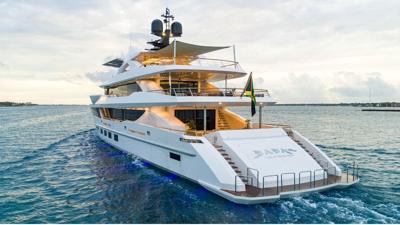

Custom-built 184’ superyacht for charter BABA’s is the largest Hargrave built to date.
The image of the superyacht owner once centered on champagne-soaked deck parties in the Mediterranean and gleaming vessels built to signal status from afar. Modern buyers want something different: high-speed satellite internet strong enough for investor calls in the Norwegian fjords, a wellness deck that rivals a luxury spa, and itineraries stretching deep into the Arctic Circle.
A new report from luxury yacht brokerage Fraser suggests the global superyacht industry has entered a new phase driven by lifestyle flexibility, privacy, experiential travel, and long-term value.
The company’s first Global Superyacht Market 2026 report found that sales of pre-owned superyachts over 100 feet rose just 4% in volume in 2025. Total value jumped 36% as buyers targeted larger, newer, more customized vessels. The average price of a pre-owned yacht reached $19.7 million, a 31% increase from the previous year.
Skip the Starter Boat
Driving this expansion is a younger, tech-driven demographic that is bypassing the traditional yachting ladder. Often in their 40s and fueled by wealth from finance and cryptocurrency, these first-time clients are skipping the starter boat phase entirely. They are moving directly into 197-foot vessels designed for long-range autonomy and months of remote work at sea.
“The sheer growth in global wealth is changing the entry point,” says Fraser CEO Anders Kurtén. “With over 510,000 UHNWIs today and that population set to grow 31% by 2030, many new buyers are arriving with the financial capacity to bypass the traditional 'stepping-stone' approach. And when they enter yachting, they want the full experience from day one—space, amenities, global capability—which naturally pushes them into the 60-meter segment (197-feet).”
Advances in naval architecture and interior design have effectively aged the fleet; a yacht built today is light-years ahead of its decade-old counterparts. This innovation gap is fueling an appetite for larger hulls that can accommodate open-concept layouts.
“What we’re seeing today is a real shift in the psychology of ownership,” explains Kurtén. “A superyacht is no longer simply a symbol of wealth or status—it’s increasingly viewed as a private sanctuary. Owners are placing much greater value on privacy, adaptability, and emotional well-being, often just as much as traditional considerations like performance or aesthetics. As a result, yachts are being used less as display pieces and more as personal spaces designed around how people actually live and spend time with family and friends.”
Work, Charter, Repeat
At the same time, work no longer stays onshore. ‘Work From Yacht’ has moved from a niche concept to something increasingly standard. “Owners today are globally minded and technologically savvy,” observes Kurtén.
“We’re also seeing artificial intelligence be used to simplify both the guest experience and the day-to-day operation of the yacht. On newer yachts, features like the NEXT AI-Integrated System can centralize control of lighting, climate, entertainment, and operational scenarios into a single interface—streamlining both the guest experience and the crew’s workflow,” notes Kurtén.
Fraser reported that 2025 became one of the strongest charter years on record, the Mediterranean and Caribbean accounting for nearly 89% of bookings. In parallel, travel continues to expand into more remote regions, including the Baltic, the Arctic, and the Southwest Pacific.
“ We actually see a clear correlation on the charter side between the size of the yacht and average length of charter,” Kurtén says. “The larger the yacht, the longer the charter. That progression naturally educates clients, refines their preferences, and often leads them toward ownership once they understand what works best for them.”
Despite geopolitical uncertainty and evolving trade pressures, demand at the upper tier remains resilient. The brokerage said 612 superyachts are currently under construction across 29 countries, with sustained activity in larger, highly customized builds. Kurtén attributes this to a realignment of the buyer’s mindset.
“The threshold for what is considered 'acceptable uncertainty' has risen quite dramatically,” Kurtén says. “A yacht offers something quite unique in uncertain times: a fully controlled environment with the amenities of a top-tier luxury resort, combined with complete flexibility. Owners can dictate their itinerary, move between regions, and avoid areas that may feel less stable or appealing. That level of autonomy is incredibly powerful when the broader environment feels unpredictable.”
The industry expects that appeal to grow. Fraser estimates more than 166,000 additional high-net-worth individuals could enter the ecosystem over the next five years. For that next generation, the superyacht functions as something notably more dynamic: a private, mobile platform for work, wellness, family life, and global exploration.
Kurtén says the appeal goes deeper. “For many of our clients, being at sea represents one of the last true forms of freedom.”