
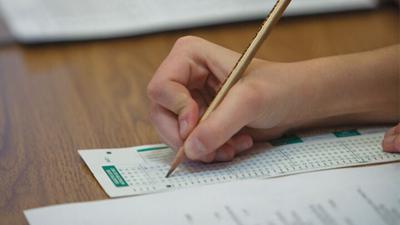

Students across the state struggled to keep up academically during the COVID-19 pandemic, according to an initial look at scores from the Missouri Assessment Program (MAP) test taken at the end of the 2020-2021 school year.
Officials with the Missouri Department of Elementary and Secondary Education (DESE) said the drop in scores was expected since students had to deal with changing school environments and learning from home because of the COVID-19 pandemic. In addition, both students and teachers missed time in the classroom because of illnesses or quarantines resulting from the virus.
“The COVID-19 pandemic presented a number of unique challenges for students, families and schools and educators,” DESE Commissioner Margie Vandeven said. “Blanket comparisons to previous years’ assessment data that ignores a long list of variables would be a serious misuse of the data.”
On Sept. 14, DESE released the early statewide results of the MAP testing from last school year, when just less than 90 percent of the state’s students took the test. Students didn’t take the test during the 2019-2020 school year when schools were closed because of the pandemic.
In the latest test, 45 percent of students scored in the top two categories in English, 35 percent in math and 37 percent in science.
Those scores are for third- through eighth-graders in English and math, as well as for fifth- and eighth-graders in science. They also include high school seniors’ end-of-course exams in English, algebra and biology. The scores are used as part of the school district accreditation process.
In 2019, the last time students were tested, 49 percent of students scored as proficient or advanced in English, 42 percent in math and 42 percent in science.
The MAP scores also showed that students who attended classes primarily in person outperformed those who mainly learned remotely from home.
DESE said 52.2 percent of the students who took the MAP test last spring attended class in person, and 30.3 percent received instruction through a hybrid model where students attended classes in person for part of a week and learned virtually for the other part of the week.
DESE also said 9.4 percent of the students learned through a virtual model with online instruction, and 7.9 percent of the students learned through a distance model that included limited online instruction.
Of the students who primarily attended class in person, 47 percent scored as either proficient or advanced in English, 39.3 percent in math and 39.4 percent in science.
For the students who learned in hybrid settings, 48.6 percent scored as either being proficient or advanced in English, 36.7 percent in math and 39.6 percent in science
DESE reported that 37.8 percent of students who mainly learned virtually with online instruction scored as proficient or advanced in English, 22.8 percent in math and 28 percent in science.
Of the students who learned from a distance model with limited online instruction, 31.4 percent scored as proficient or advanced in English, 17.8 percent in math and 23.3 percent in science.
Lisa Sireno, DESE’s standards and assessment administrator, said about 4,300 fewer students were tested at each grade level last spring than in 2019.
In December, Missouri’s State Board of Education voted to require state assessments be administered but not to factor the test results into either the state or federal accountability system.
DESE officials said they received approval from the U.S. Department of Education to waive federal reporting and accountability requirements.