


Editor’s note: This is the third and final installment of the Leader’s series on the Missouri Department of Conservation’s whitetail deer conservation efforts, and the struggles the department currently faces. This article focuses on the looming threat of declining participation in hunting and what MDC’s deer conservation will look like in the future.
Click here to read part one and two:


Chronic wasting disease may be the biggest threat to maintaining a whitetail deer population in the Show-Me State.
But another threat could be emerging.
A decline in deer hunting nationwide has been drawing more attention from conservation circles. Last year, The Wildlife Society, an organization that addresses wildlife concerns both nationally and internationally, projected a 1.5 to 2.2 percent decline in deer hunting each year until 2040.
The research highlighted the detrimental effects this will have on the conservation effort; mainly, deer hunters help regulate population growth.
An overpopulation of deer would lead to more collisions with vehicles, agricultural damage, reduced forest generation and as a result, reduced biodiversity.
For a state such as Missouri, where deer hunting brought in $1.6 billion in 2025, there would also be economic consequences.
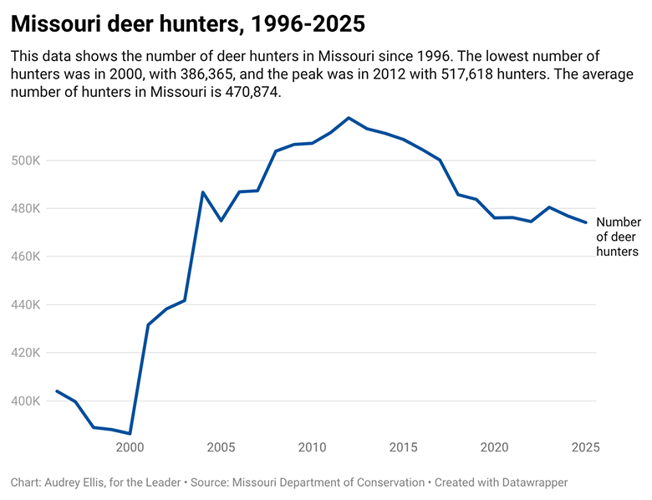
“The big economic driver for deer hunting is (that) we’ve got 474,000 people roughly that enjoy deer hunting and support, based on the latest figures, 13,000 jobs and generate over $1.6 billion to the economy annually,” said Jason Isabelle, the cervid program supervisor for the Missouri Department of Conservation (MDC).
“It’s a big deal here in Missouri. It means a heck of a lot to many, many folks here,” he said.
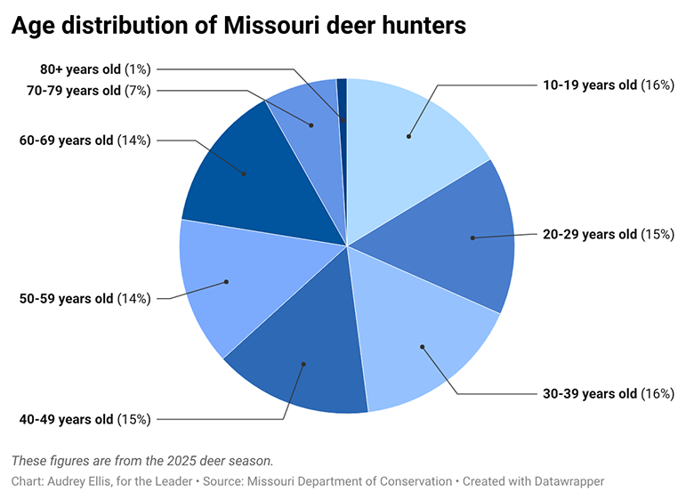
Hunting has declined nationally on a per-capita basis since 1975, according to The Wildlife Society’s 2025 research. The research indicated the decline is caused by an aging demographic, lack of land access and “perceived constraints or alternative leisure choices.”

Local Jefferson County hunters attribute the decline to a lack of access and a lack of interest that’s partly brought on by cultural changes.
Tony Kalna Jr. of Dittmer, who has hunted since he was a child and grew up in a hunting family, thinks the barrier is generational.
“Us old-timers are dying out, and there’s so many distractions for younger generations,” he said. “Back when I was a kid, the outdoors was all I had. I didn’t have a cell phone to be on non-stop or video games to play. I played out in the woods, I spent my days out in the woods, pretty much non-stop. I think that’s one of the contributing factors, just cultural changes.”
Rich Cook of Crystal City, a deer hunter who volunteers with Missouri Disabled Sportsmen (a nonprofit dedicated to taking individuals with mobility impairments and promoting the outdoors to youths) says the outdoors might not be for everyone, but there needs to be a way to get younger generations involved.
“In this economy, having two jobs is almost the minimum now to provide for your family,” he said. “And if their parents don’t hunt, it’s finding somebody that will take them. They don’t have the availability, the land, or not everybody has a gun sitting in the closet anymore. They just need to be exposed.”

Increase of nonresidents
Since 1996, Missouri’s deer hunter population steadily grew until a peak in 2012, which was then followed by a decline. However, the population appears to be beginning to stabilize.
A part of this stabilization is Missouri’s rise in nonresident hunters.
Missouri’s regulations for nonresident hunters are more relaxed compared to neighboring states; namely, nonresident hunting permits are available over the counter and cheaper.
An over-the-counter permit state means that a nonresident does not need to be drawn for a permit, or tag, and can purchase one like any other resident hunter.
Nonresident tags are substantially cheaper in Missouri when compared to neighboring states. In a 2024 study by the MDC, a nonresident deer permit in Missouri cost $277 while the average cost of nonresident permits in surrounding states was $470.
During the 2025 season, a nonresident deer tag was $360; a resident deer tag is $19.50.
The MDC also reported that, between 2014-2024, Missouri’s nonresident permits remained the cheapest amongst the states surrounding Missouri.
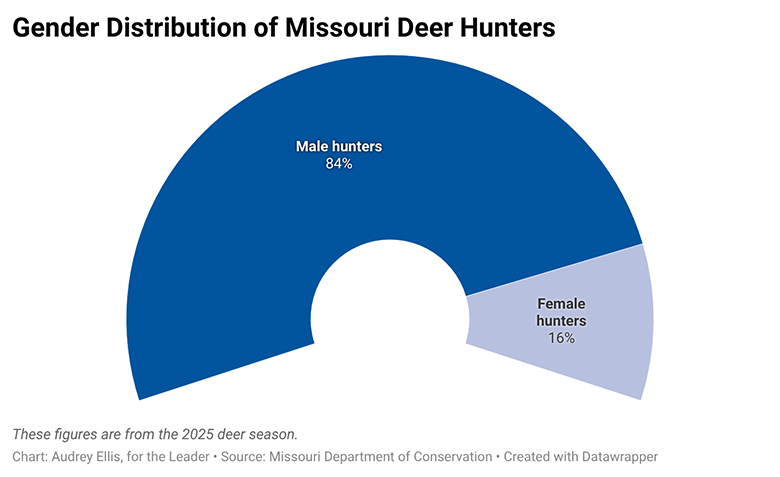
About 9 percent of deer hunters (around 42,000) in the 2025 season were nonresident hunters, more than double the amount of nonresident hunters from 20 years ago, according to the MDC. There were a total of 474,150 deer hunters in 2025.
The rise of nonresident hunters has not come without a cost – resident hunters already have begun to feel the impact on their hunting quality.
While nonresident deer hunting was between 0 to 5 percent in Jefferson County between 2020-2024, according to MDC, nearly a quarter of Jefferson County deer hunters agreed that there were too many nonresident hunters.
The 2023 survey showed between 15 to 25 percent of Jefferson County hunters agreed with the statement, according to MDC.
MDC is currently implementing new regulations to help resident hunters, such as limiting the amount of deer that a nonresident hunter can harvest.
Previously, nonresident hunters’ antlered buck bag limit was two, but starting this year, will be reduced to one. Exceptions will be made for nonresident hunters who own a minimum of 75 acres.
Additionally, the conservation commission gave initial approval to establish an additional permit for nonresident hunters to purchase. If a nonresident hunter chooses to hunt on public land, they would need to purchase an additional permit for $165 on top of their nonresident deer hunting permit.
The conservation commission will vote again in September. If passed, that regulation will appear for the 2027 season.
Conservation going forward
The picture of deer conservation in Missouri varies depending on who you speak to.
Some might say chronic wasting disease will wipe out whitetails if management ends. Others might say the disease prevalence is so low, it isn’t a concern.
The one thing that can be agreed upon, ironically, is that the lack of agreement might be what undoes it all.
Both groups have one thing in common: their love of whitetails.
Both want the same end result of a thriving herd in Missouri – it may be just a matter of setting aside their differences to reap that result.
“We have an incredible conservation success story here in Missouri with the restoration of the deer herd,” Isabelle said. “We have something really special here; we recognize that, we cherish that, as do hunters. We’re on the same page in terms of our goal, we want to make sure that continues in the future.”