





Editor’s note: This is the first installment of a three-part series about the Missouri Department of Conservation’s whitetail deer conservation efforts, and the struggles the department currently faces. This article will discuss the success of the early conservation efforts and how the efforts have been reflected today.
To some, whitetail deer are a nuisance.
To others, they’re a trophy.
For both groups, the deer are a constant – something that’s always expected to be around.
But in Missouri, that wasn’t always the case.
A little over a century ago, there were an estimated 400 whitetail deer in the entire state. Overhunting and habitat loss had decimated the whitetail population, pushing lawmakers to put plans into place to prevent local extinction or extirpation.
The crisis was one of the many factors that helped birth the Missouri’s Department of Conservation in 1937.
The efforts paid off.
Now, Missouri’s whitetail deer population numbers more than a million.
“I certainly describe it as one of the state’s great conservation success stories,” said Jason Isabelle, who is the cervid program supervisor for MDC.
The management of the species has been so successful that Missouri is now one of the top states for deer harvests, according to the National Deer Association’s 2025 report. There are hundreds of thousands of deer hunters, and hunting contributed well over a billion dollars to the economy last year, according to the MDC.

Despite the success in the Show-Me State, MDC is seeing many of the same struggles that other wildlife and conservation programs are seeing nationwide. The effects of chronic wasting disease, a neurodegenerative disease with a 100 percent fatality rate among deer, and a decline in recreational hunting are drawing attention from both MDC and the deer hunting communities.
Conservation, then and now
When the mission to re-establish a strong, healthy whitetail deer herd began, it was done both out of love for the whitetail and fear for the future of wildlife in Missouri.
Isabelle attributes the undertaking as a result of the “many natural resources that were being depleted.”
“Whitetails were one of those highly charismatic species that folks care very deeply about,” he said. “So, I think it was one of those pieces that helped that decision to be made.”
The efforts quickly proved to be effective; in the decades immediately following the commitment, the whitetail population grew by roughly 30 percent per year.
The first modern deer season opened in 1944 after the whitetail population stabilized to 15,000, according to the MDC. Only bucks were harvested during the two-day season.
From the 1960s until the 2000s, the state’s whitetail population growth had slowed to 4 to 8 percent per year.
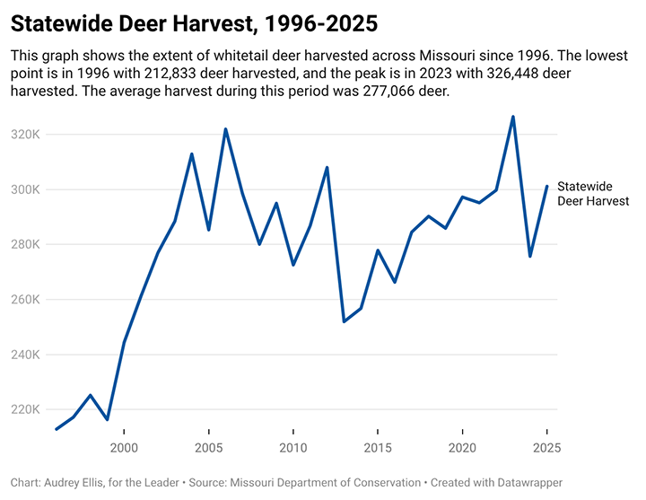
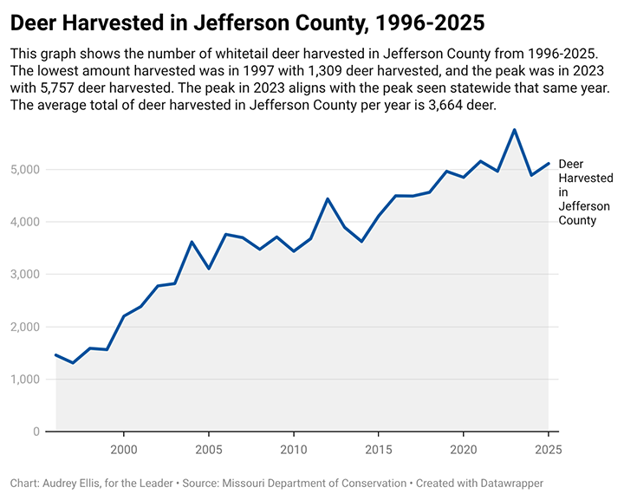
Now, the whitetail population has been stable for long enough to provide a robust hunting season; an average of 277,066 deer per year have been harvested statewide since 1996, and an average of 3,664 deer per year have been harvested in Jefferson County over that same period.
“Given the relatively high human population density and the average property size in the county, deer harvest per square mile in Jefferson County is among the highest in the state,” Isabelle said.

Missouri is a top-producing deer state in the nation; according to the National Deer Association’s 2025 report, Missouri was fifth for the number of antlered bucks harvested nationwide and third nationwide for the number of antlerless deer harvested.
While young Missourians can’t remember a time when deer weren’t everywhere, older Missourians do. And that memory is part of the reason why current management of the whitetails – specifically in regard to chronic wasting disease – has left a particularly bad taste in Missourians’ mouths.
Editor’s note: The second installment of this series will focus on chronic wasting disease, specifically what it is and how it affects Missouri’s deer herd, and the controversies surrounding the disease and MDC’s handling of it.
Click here to read part two: