





Editor’s note: This is the second installment of a three-part series about the Missouri Department of Conservation’s whitetail deer conservation efforts, and the struggles the department currently faces. This article will focus on chronic wasting disease, specifically what it is and how it affects Missouri’s deer herd, and the controversies surrounding the disease and MDC’s handling of it. Click here to read part one.
The first detection of chronic wasting disease – more commonly known as “zombie deer disease” – didn’t initially spark fear.
It wasn’t until the disease spread from one species to another and crossed both state and international lines that it drew the attention and concern it currently gets.
Chronic wasting disease (CWD) was first detected in Colorado among captive mule deer in 1967 and detected in a wild elk in 1981.
By 2001, CWD had spread to deer species across the Midwest.
Eleven years later, it had spread to both captive and wild whitetail deer in Missouri.
CWD has a long incubation period before deer begin to exhibit symptoms such as drastic weight loss, drooling, lack of coordination and losing fear of people. The disease continues to spread before symptoms appear, typically by an infected deer’s bodily fluids and excrement.
The neurodegenerative disease, which was hailed a “slow moving disaster” by the Theodore Roosevelt Conservation Partnership, has a 100 percent fatality rate among cervids, the family of which deer, elk and moose belong. The disease has never been detected in humans.
Unlike other diseases that affect deer, where the population faces a “short-term decline,” CWD has a slim period where it can be managed before the impact on deer populations becomes devastating, said Jason Isabelle, the cervid program supervisor for the Missouri Department of Conservation (MDC).
“Chronic wasting disease is a very different disease,” he said. “It’s a disease that, after it enters a population, spreads pretty slowly at first, but then it eventually hits a tipping point where it can increase pretty rapidly in terms of the number of deer in a population that can have it.
“Then, once it gets to a high enough percentage in a population, (the disease) can have a very significant impact on deer survival rates and can lead to long-term, precipitous declines in deer numbers.”
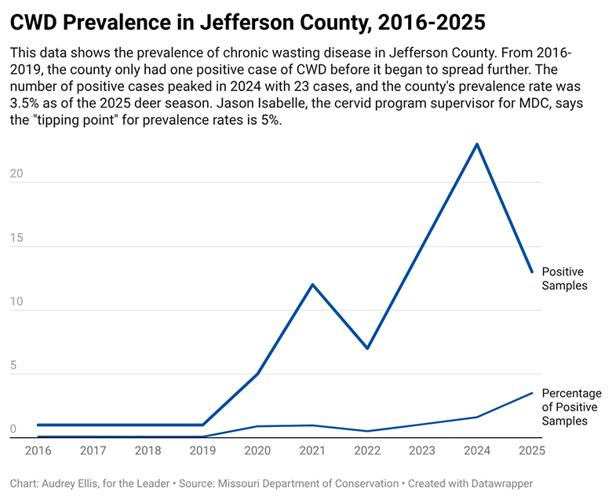
The “tipping point” that Isabelle refers to is a 5 percent prevalence rate of the disease. Once an infected population reaches a 5 percent prevalence rate, the consequences can be disastrous and hard to recover from.
MDC has succeeded in maintaining a population under the 5 percent prevalence rate – the statewide rate is less than 1 percent.
“The fact that few deer are testing positive is a good thing. It’s what we’re striving for,” he said.
In a 2022 report published by the CWD Alliance, which featured MDC’s wildlife health program supervisor Jasmine Batten as a contributor, Missouri’s unique, “noncontiguous clusters” of the disease were highlighted. The clusters were attributed to “constant” management values of detecting early, monitoring, intervening and providing accurate information to stakeholders.
MDC’s detection of CWD lies in both mandatory and voluntary testing for harvested deer. Testing can only be done on dead deer as the lymph nodes are removed and sent to a laboratory.
Mandatory testing was not in place for Jefferson County last year because the county already had “extensive” sampling data. Due to staffing concerns, MDC wanted to prioritize counties that hadn’t had mandatory sampling done in recent years or potentially ever.

Batten’s contribution to the CWD Alliance report also included hunter satisfaction in areas affected by chronic wasting, suggesting that the disease and its regulations were not affecting hunting quality within the state.
“If we were the first state to have CWD, there’d be a lot more uncertainty about what the future might hold if the disease isn’t managed,” Isabelle said. “But we can look at other states who have had the disease for longer, that have not sustained management, and what we see is not good. It’s a very bleak picture.”
Management strategies
MDC’s strategies have been hailed as remarkably effective, particularly in keeping prevalence rates so low, but its methods have begun receiving pushback from the hunting community and landowners.
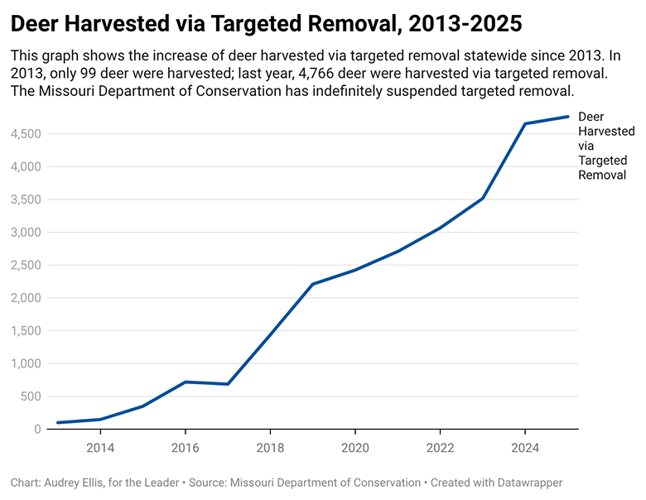
The department’s most effective (and most controversial) method of targeted removal was recently indefinitely suspended due to an increasing lack of support.
Targeted removal is a localized strategy where MDC staff and participating landowners would go onto a landscape for two months after the end of the deer season to remove additional deer in an area affected by CWD.
A localized strategy specifically targets areas within roughly two miles of a positive detection.
Jason Sumners, the director of MDC, addressed the suspension in an open letter that was published in December.
“We remain committed to keeping our deer herd healthy and working collaboratively with the hunters and landowners that are critical to our conservation mission,” he said. “We cannot be successful in this work, and at the scale needed, without hunters’ and landowners’ support and participation.
“At this time, MDC will be pausing our postseason targeted removal efforts to work with hunters and landowners to adapt and identify a more sustainable path forward,” Sumners said.

Targeted removal was previously conducted in Jefferson County but was never done on a countywide scale.
The deer that were harvested via targeted removal and did not test positive for CWD were given to the landowners. Landowners could either consume the meat or donate to Share the Harvest, a program run by MDC to give surplus deer meat to food banks and food pantries.
Since 2013, nearly 27,000 deer were harvested via targeted removal statewide; since 2017, about 1,400 deer were removed via targeted removal in Jefferson County.
Targeted removal kills far fewer deer than the average hunting season, according to MDC. In 2025, only 4,766 deer were harvested statewide via targeted removal, accounting for 1.58 percent of the total deer harvested.
Currently, MDC is working to develop “a strategy that the public can get behind and one that we can sustain through time to try to keep prevalence rates as low as we can,” Isabelle said.
MDC currently allows qualifying landowners in CWD core areas (an area within 1-2 miles of where CWD was detected) to receive five free CWD management permits to use during the deer hunting season.
The new strategy is bound to be more critical to deer hunters in Jefferson County, as prevalence rates are among the highest in the state.
Affecting Jefferson County
“We’re not too far below what we might call that tipping point,” Isabelle said, describing Jefferson County’s prevalence rates.
“I think time is of the essence in terms of management in Jefferson County and in other counties as well,” he said.
Jefferson County’s prevalence rate was 3.5 percent as of the 2025 deer season, although the rates are not evenly distributed; for example, there are higher rates of chronic wasting disease in the southeastern areas of Jefferson County.
This is likely due to the higher prevalence rate in Ste. Genevieve County, which is southeast of Jefferson County, officials said.
During the 2025 deer season, Ste. Genevieve had 17 positive samples of CWD. In comparison, Franklin County (which is northwest of Jefferson County) only had seven positive samples. That amount was the second highest number of samples out of Jefferson County’s five neighboring counties.
The biggest threat to managing chronic wasting disease – and as a result, managing the deer population – lies in the stigma and controversies surrounding the disease.
Among certain hunter groups, the management efforts are too aggressive; among others, the efforts are deemed more than necessary.
“We have a shared goal of maintaining a healthy and sustainable deer herd in Missouri,” Isabelle said. “And sometimes, there may be differences in opinion on what it takes to achieve that goal. But at the end of the day, we all want the same thing: we wanna have a healthy deer herd now, we want that herd to be healthy for the generations that follow us as well.”
Creating a divide
Tony Kalna Jr. of Dittmer shot his first deer at the age of 10. Having grown up in a hunting family, he describes his love of hunting as “in my blood” and a part of his heritage.
“It’s just part of who I am,” he said. “I don’t know anything else.”
Kalna runs the Missouri Deer Hunter Facebook page, which was created to “educate and entertain Missouri deer hunters.” Chronic wasting disease is frequently addressed on the Facebook page.
Kalna does not describe himself as anti-MDC but rather “anti-MDC policy.”
He cites the “different, inconsistent, hypocritical” rules toward chronic wasting disease management, such as regulations for placing feed for deer and targeted removal. He is also frustrated that only hunters are facing the brunt of these regulations.
Placing feed for deer is prohibited within 10 miles of a CWD detection, but an exception is made for placing feed within 100 feet of a residence or occupied building.
Isabelle cites how hunters’ use of feed can occur widely across multiple locations on one landscape, bringing deer into close contact with each other, while recreational feeding is more limited in geography.
Deer are more prone to contact each other more regularly in areas where feed is placed rather than a food plot and/or agricultural field.
“The exceptions to the regulations were given careful consideration and evaluation prior to being implemented,” he said. “Where exceptions can minimize impacts to Missourians’ livelihoods or allow a relatively limited opportunity to view deer, we feel they are justified.”
Feeding regulations in CWD-affected areas are common, and the practice is listed as a recommendation by the Association of Fish and Wildlife Agencies.
On the other end of the spectrum is Rich Cook of Crystal City, and a deer hunter since his early teens. He is concerned for the future of deer in Jefferson County, but places his faith on MDC to manage the disease.
“I’m not the biologist, so I don’t know what the proper way to (manage) it is,” Cook said. “But I do know there needs to be a way to do it. If you get sick, you want to go to a doctor, not an internet doctor.”
Cook attributes rising opposition to MDC regulations to older hunters who grew up with a whitetail population that was not as prevalent as it is today. For many years, MDC only issued permits for antlered deer in order to protect the female whitetail population; if doe tags were given, it was a draw to get them.
“Some of the older people remember when there was not a doe season, and it was a draw to get a doe tag, and they didn’t get them every year,” he said. “Now, (MDC is) just so liberal, that (older hunters are) in the mindset of saving the deer and not shooting them all off.”
Editor’s note: The third and final installment of this series will focus on the looming threat of declining participation in hunting and how MDC’s deer conservation will look in the future.