
Area first responders, including those from the Jefferson County Sheriff’s Office and the Eureka Fire Protection District, are helping with the development of an alert system aimed at making road travel safer.
The Sheriff’s Office and police departments in St. Louis, St. Louis County and St. Charles County currently are testing the MakeWay Safety system, which is designed to warn drivers that an emergency vehicle is approaching or that the driver is traveling toward emergency vehicles stopped along roads. It also will warn drivers if they’re headed toward a construction zone.
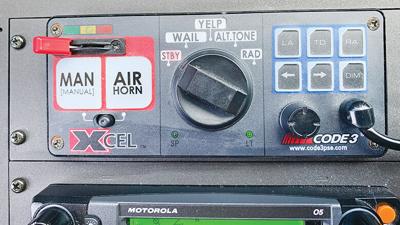
Once the program is implemented, first responder and department of transportation vehicles would be equipped with MakeWay Safety system software that would be activated when emergency lights are turned on. Once activated, the system would send a signal to drivers’ phones or car systems.
“It goes directly into the switch for the roof-top lights,” Sheriff’s Office spokesman Grant Bissell said. “What is nice about that is it doesn’t require a first responder on the way to an emergency call to do anything more or different than what they would have done without this device installed.
“Technology like this has the potential to help people make smarter and safer decisions on the road. It also allows first responders to give extra notice that they are coming.”
Each agency that is testing the system had it installed in five of its vehicles, including the Sheriff’s Office, which had the system installed in four road patrol vehicles and a special operations vehicle in May. The device is expected to remain in the vehicles through August, Bissell said.
MakeWay Safety is the brainchild of Mike Walsh, the St. Louis-based company’s founder and partner.
During the testing phase, the system is a downloadable app for drivers, but Walsh intends to have it embedded in cell phone and connected vehicle operating systems like AMBER Alerts, which notify people about missing children.
Walsh said MakeWay has been developing the system for about 10 years and has patented two aspects of the technology used for the system with a third patent pending.
“The technology is just about ready to be deployed,” he said on June 27. “We may be within 90 to 120 days of a full commercial deployment. We are looking to develop partnerships and collaboration with cell carriers and connected-car manufacturers to bring this lifesaving technology to the marketplace for our first responders, DOT personnel and the general public at large.”
Along with working with police agencies and Eureka, MakeWay partnered with the Antonia Fire Protection District, the Kirkwood and St. Louis fire departments and the Missouri Department of Transportation to test the system.
“We have been one of their beta testers since very early on,” said Eureka Fire Assistant Chief Scott Barthelmass, adding that the district has participated in two rounds of testing in the past two years. “They have worked with our staff to make the product the best it can be. The goal is to alert people that we are approaching or at a scene ahead or nearby. It makes it safer for the responders and the public.”
Cost
Walsh said if the system is embedded in cell phone and vehicle operating systems, there will be no charge for the consumer.
However, he said the company expects to charge first responder agencies about $365 a year per vehicle to have the technology connected to warning light systems.
He also said no agency is being charged to be part of the testing trials.
“We are trying to be sensitive to the budgets that departments, agencies and municipalities deal with,” Walsh said.
He said the alert system could help agencies keep down the cost of replacing vehicles that are struck during emergency responses or in work zones.
“St. Louis County told us they lose roughly 20 to 25 cars a year,” he said. “If you lose 20 cars a year that cost $70,000, that is $1.4 million that you have to budget to replace vehicles damaged in an intersection, crossover or was hit on the side of the roadway. We believe we can reduce that dramatically.”
Creation
Walsh said he came up with the idea for MakeWay about 16 years ago and started developing it after meeting Ginny Foster, an electrical engineer and a company partner.
“I said, ‘I have this crazy idea. Help me feel my way through this to see if we can get this to work,’” Walsh said. “I also visited with friends of mine who were in police and fire services in St. Louis. I said I’m on the highway a lot, and I can’t see or hear you guys coming because any time I’m in my car I’m on the phone. I am a distracted driver. I said, ‘Is this a problem for you guys?’ They said, ‘Yes, Mike, it is an absolute problem for us. It is a problem we have to accept because there is no solution.’
“I was like given technology today and the advent of the cell phone, there has to be a way we can use these tools that cause the distraction to reduce the distraction.”
The need for additional alerts was solidified for Walsh when his niece, Jenny Walsh, was injured while working for the St. Louis Metropolitan Police Department.
He said Jenny was responding to an emergency with her cruiser lights and sirens on, but she was T-boned in an intersection by a driver who didn’t see or hear the police vehicle coming.
“The car rolled, flipped and ended up on the sidewalk,” Walsh said. “She was on disability for several months. She is back with the force and healthy.
“There is significant evidence that the greatest risk first responders are exposed to is in route to an incident or when they are parked on the side of a roadway. We think this technology reduces this risk”
Endorsements
Antonia Fire Chief Matt Krutzsch said his district helped test MakeWay about five years ago. He said he thinks the system will help everyone.
“Alerting and letting people be aware that we are coming or to be on the lookout is good because that is one of our most dangerous things when responding to an emergency,” he said. “It would be great because hopefully people can move over, or at an intersection, people may pause longer for it to clear.”
Barthelmass said the system may reduce response times to calls, but more importantly, MakeWay will help first responders get to emergencies.
“The reality is the warning device could prevent an intersection collision,” he said. “We won’t have to stop after being involved in a vehicle accident and call on someone else to respond. This is another way of making sure we can efficiently, safely and expediently get to those in need.”