

Jefferson County has made a top 10 list, but it’s not a good one.
The Midwest High Intensity Trafficking Area recently released its 2023 Overdose Report for Missouri, and it lists Jefferson County as the fourth highest in Missouri for overdose mortality count regardless of drug type, from 2017-2021, and the sixth highest for inpatient (nonfatal) overdose rates from 2017 to 2020.
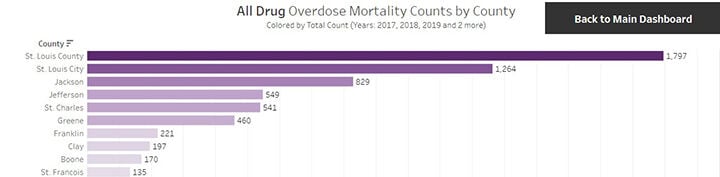
Jefferson County ranks fourth in the county for overdose mortality, according to the Midwest High Intensity Trafficking Area.
The report is based on survey responses from law enforcement and public health partners, as well as on drug trends and information from the Missouri Department of Health and Senior Services.
According to the report, from 2017 to 2021, Missouri saw 8,596 overdoses, with 549 in Jefferson County.
Ranking above Jefferson County for higher mortality counts from 2017 to 2021 were St. Louis County, the city of St. Louis and Jackson County. Other counties in the top 10 were St. Charles, Greene, Franklin, Clay, Boone and St. Francois, the report said.
While fatal overdoses were up, nonfatal overdoses were down – from 9,519 in 2017 to 8,298 in 2020. Jefferson County had 1,499 inpatient visits for nonfatal overdoses in that period. Ranking above Jefferson County were St. Louis County, Jackson County, the city of St. Louis, Greene and St. Charles, according to the report.
Statewide, fentanyl, which is similar to morphine but about 100 times more potent, is ranked as the highest threat in Missouri, followed by methamphetamine, the report said.
Jillian Bissell, prevention specialist for the Jefferson County Drug Prevention Coalition at the Jefferson County Health Department, said she has been sharing the report’s findings.
“According to the report, fentanyl is still the drug that is causing the most overdose deaths in Missouri,” Bissell said. “Non-heroin opioids (such as fentanyl) were responsible for 1,493 overdose deaths in Missouri in 2021 ... a 128 percent increase from 2017.”
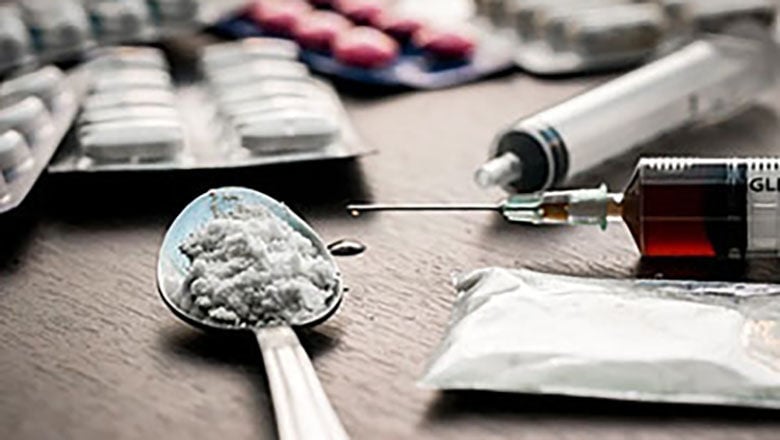
According to the DEA, two milligrams of fentanyl can be lethal, and one kilogram of fentanyl has the potential to kill 500,000 people. Drug organizations typically distribute fentanyl by the kilogram.
The Missouri Overdose Report explains that fentanyl is often mixed with other illicit drugs to increase their potency. It is increasingly pressed into pills to look like legitimate prescription opioids.
“Because of fentanyl’s potency and low cost, drug dealers have been mixing fentanyl with other drugs, including heroin, methamphetamine and cocaine, to increase their profit margin, thereby increasing the likelihood of a fatal interaction,” according to the report.
Anyone who purchases illegal drugs should assume it contains fentanyl, the report said.
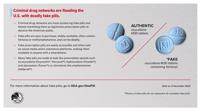
DEA laboratory testing in 2022 showed that six out of 10 fentanyl-laced counterfeit prescription pills now contain a potentially lethal dose of fentanyl, up from four out of 10 in 2021, according to the report.
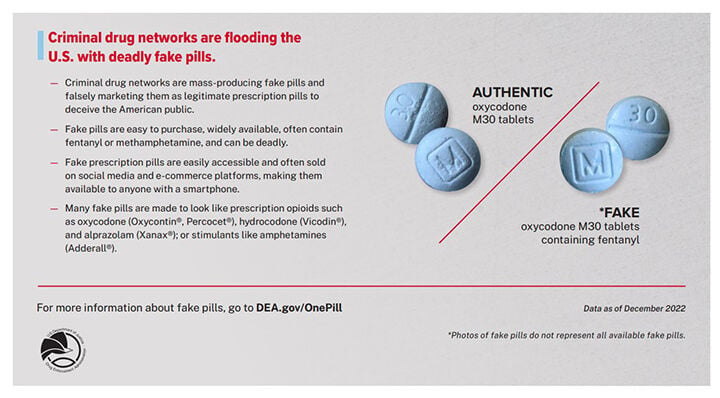
Fake pills are often made to look authentic and are easy to access. Visit DEA.gov/OnePill to learn more
Naloxone/Narcan
Bissell said another important point in the report is that while Jefferson County is in the top 10 in Missouri for inpatient visits and mortality counts, it is not in the top 10 for naloxone (Narcan) kits distributed. St. Louis, St. Louis County and Jackson County were among the top distributors of Narcan, the brand name for naloxone, which is used to temporarily reverse the effects of an opioid overdose.
The state has a centralized naloxone distribution system at getmonaloxone.com, where the drug may be mailed to people at no cost.
“According to Missouri’s statewide standing order, any person who asks for naloxone (Narcan) from a pharmacy for themselves or to help a person experiencing an opioid overdose can purchase naloxone with or without a prescription,” Bissell said.
“Residents can get Narcan at no cost at multiple locations in Jefferson County,” she said. “To find a list of these locations (along with how to recognize an overdose, what to do in the event of an overdose and where to find a support group), go to jeffcohealth.org/anyonecan.”
Time2ActMissouri.com reported 5,609 Missouri lives were saved by Narcan in 2021.
Narcan is one reason nonfatal overdoses are underreported, Bissell said.
“Many people who use drugs do not seek help due to the overwhelming stigma that exists in Jefferson County and not everyone who overdoses passes away,” she said.
The data also shows that while overdose deaths for non-heroin opioids and non-opioid stimulants increased, heroin overdose deaths dropped 70 percent.
“The biggest surprise to me (in the Missouri report) was the prevalence of xylazine found mixed with fentanyl,” Bissell said. “This is extremely alarming since xylazine does not respond to the use of naloxone, which is a medicine that reverses an opioid overdose.”
Xylazine is a veterinary sedative, analgesic and muscle relaxant. It is sometimes referred to as “tranq” or “tranq dope.”
According to the Missouri Department of Health and Senior Services, the FDA has not approved it for human use, and it is not a controlled substance.
According to the Centers for Disease Control and Prevention, the number of drug overdose deaths involving xylazine increased from 260 in 2018 to 3,480 in 2021. The Missouri Department of Health and Senior Services documented 39 such overdose deaths in Missouri in 2021 and 109 in 2022.
In April, the Office of National Drug Control Policy declared the combination of xylazine and fentanyl an emerging threat, stating that people who use opioids containing xylazine are at higher risks for fatal overdoses as it can worsen respiratory depression during an overdose. While xylazine does not respond to naloxone, it should still be used even if xylazine is suspected.
Bissell said the recent overdose report has been shared with members of the Jefferson County Drug Prevention Coalition (JCDPC), and they will share the data on Jefferson County Health Department social media.
“During our upcoming Opioid Task Force workgroup meeting on Sept. 6, we will review the data and determine how it will help guide JCDPC’s initiatives moving forward,” she said. “JCDPC is a group of community members and collaborating agencies that come together to address substance misuse in Jefferson County and help encourage youth and adults to make healthy decisions. We typically meet on the first Wednesday of every month at 9 a.m. both virtually and in Jefferson College’s Viking Room.”