


A total of 279 fatal opioid overdoses were reported in Jefferson County from 2018-2020, the second highest mortality rate from opioid deaths among Missouri counties during that three-year period.
Jefferson County also had the fourth highest number of deaths from opioid overdoses in the state during that period, according to Missouri Department of Health and Senior Services, which launched a dashboard detailing opioid-related data for Missouri through 2020.
Jefferson County Health Department Director Kelley Vollmar said that while she doesn’t have the state’s opioid-related data for the past two years, she believe both fatal and nonfatal overdoses have continued to increase.
“Particularly because of COVID,” she said. “With substance abuse and COVID mixed together, it has exacerbated issues with overdose. and because of the nature of COVID with the issues with breathing and with substance abuse, a lot of times slowing down breathing, they’re finding some correlations there. The hard part will be seeing through the data and really being able to tell what is specific to overdose and what was exacerbated by the pandemic the last couple of years.”
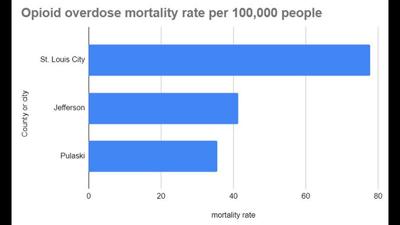
From 2018-2020, Jefferson County had a mortality rate from opioid overdoses of 41.27 per 100,000 people, second only to the city of St. Louis, which had an opioid-related mortality rate of 77.80 per 100,000. Pulaski County was third with a 35.59 mortality rate per 100,000.
As far as the total number of deaths from opioid overdoses, St. Louis County ranked first with 907 deaths, the city of St. Louis was second with 701 deaths, St. Charles County was third with 292 deaths, followed by Jefferson County in fourth and Greene County in fifth place with 163 deaths.
In 2020, the state recorded the highest number of fatal drug overdoses to date with 1,878, which was a 19 percent increase from 2019 when 1,581 deaths were reported.
Vollmar said she is not shocked to hear that the county is at the top of the chart for fatal opioid overdoses and mortality rate related to opioid use.
“The county has long struggled with opioid use and overdoses, and the impact of COVID and of the stressors of the current economic environment are all things that tend to increase substance abuse,” she said.
Over a five-year period, from 2016-2020, Jefferson County had a total of 432 reported fatal opioid overdoses.
Vollmar said she also believes the number of deaths from overdoses is under-reported, which means the total of fatal overdoses is really higher.
“Individuals who died of an overdose could be listed as a different reason,” she said. “It depends on if it was listed as the source on a death certificate.”
Jillian Bissell, Health Department prevention specialist, said she also believes the number of fatal overdoses is actually higher than the statistics indicate.
“Fentanyl is laced in about everything right now, so that is a big reason why there’s so many overdoses,” she said. “People really don’t know what they are taking.”
Jefferson County ranked fifth among the state’s counties for the number of drug-related emergency room visits from 2018-2020, with 1,498 visits. St. Louis County ranked first with 5,620, St. Louis City was second with 3,177 visits, Jackson County ranked third with 3,033 and St. Charles County was fourth with 2,240 visits.
Vollmar said she believes those numbers also were under-reported.
“The availability of Narcan (a brand of naloxone used to treat opioid overdoses) and immediate treatment has, I think, probably masked some of the numbers of overdoses that have happened where people have been revived where it wouldn’t be officially reported,” she said.
Vollmar said the Health Department offers free Narcan and training to use it for those who need it.
“There has been a concerted effort within Jefferson County in terms of doing overdose education and training and distributing naloxone for emergency situations,” she said.
Bissell said she suggests people educate themselves about what to do if someone has an overdose.
“Very rarely do I run into anyone who doesn’t have a loved one or someone close to them that hasn’t been affected by overdoses, substance misuse,” she said.
Vollmar said the Health Department works every day to promote prevention and drug education.
“There are several things that contribute to addiction, and it is dependent on social factors, economic factors and medical history,” she said. “The ability to be able to impact that on a large scale is going to take a very robust system, addressing it within the county looking at not only prevention, but resources for treatment resources for recovery.”
Prevention and resources
Vollmar said one of the best prevention tools is to lock up any prescription opioids, including antidepressants, anxiety medications, pain medications and migraine medications.
Bissell said people also should lock up common, over-the-counter pain medication, like Tylenol, which is acetaminophen.
“If you have young children around, or if there’s people in and out of your house constantly, any opportunity that you have to lock (drugs) up and get them off the counter is definitely a plus,” she said.
Bissell said people also should dispose of unused and unwanted medications, and the county has 10 prescription drug drop boxes where people may throw them away safely. The drop boxes are at the Big River Ambulance Station 1, 6321 Lorens Lane, in Cedar Hill; the Arnold Police Department, 2101 Jeffco Blvd.; Crystal City Hall, 130 Mississippi Ave.; De Soto City Hall, 17 Boyd St.; the Festus Police Department, 100 Park Ave.; the Pevely Police Department, 401 Main St.; the Jefferson College Campus Police Department, 802 Mel Carnahan Drive, Apt. 214, in Hillsboro; the
Hillsboro Police Department, 101 Main St.; and at two Jefferson County Sheriff’s zone offices, 855 Windsor Harbor Road, in Imperial and 34 Dillon Plaza Drive, in High Ridge.
“We recommend not just flushing them down the toilet, because the drugs get into the water system,” Bissell said. “If you can safely dispose of them at our medication drop boxes that’s the best way to go.”
Vollmar said anyone can call the Health Department to get access to several drug-prevention resources, including youth substance abuse vaping education, the youth teen coalition that focuses on youth substance abuse prevention, drug drop boxes, syringe disposal drop boxes and medication lock boxes.
The Health Department’s phone number is 636-797-3737.