



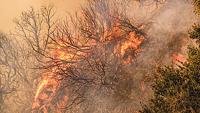
It’s spring, so that means love is in the air. But if you take a deep breath, you might also catch the whiff of the smoke from a distant (or not so distant) fire.
Spring is brush fire season, and Jefferson County residents need to learn how to burn if they want to prevent a tragedy, fire district officials said.
“Right now, in Jefferson County, there are no specific warnings or advisories concerning brush fires, but spring is a dangerous time for brush fires,” said Tom Fitzgerald, chief of the De Soto Rural Fire Protection District.
In a recent four-day stretch that covered a weekend, Fitzgerald said, his district answered 18 brush fire calls.
“We’ve had a relatively mild winter, with little snow, and so far this spring, we haven’t had a lot of rain,” he said. “What we’ve had with rain is that it comes down hard and fast, and then washes away quickly. Then we get some days with strong breezes.
“That leads to a situation where you’ve got a dead leaf cover in wooded areas that is dry. If we go on this way with the rain situation the way it has been, we could be in for a rough summer. All it takes is someone burning something with all good intentions but when they shouldn’t – when there’s a strong wind – and an ember carries and it lands in just the wrong place. Or maybe there isn’t even a strong breeze.”
The Rock Community Fire Protection District, which covers parts of Arnold, Kimmswick, Imperial and Barnhart, responded to 12 brush fires in March, Assistant Chief Kevin Wingbermuehle said.
“Although we have experienced a considerable amount of rain for the month, the high winds quickly dry the vegetation and greatly increase the risk of fire spreading out of control,” he said. “Throughout Jefferson County, there has been an increase in responses (for brush fires).”
Fitzgerald, whose district covers about a third of the county, said many farmers and others use the spring for controlled burns.
“They’ll burn off 40 or 50 acres of their fields once a year or once every other year, and we typically have zero problems with those. They know how and when to do them,” he said. “On the other hand, most of our calls from fires come when someone decides to burn a 4-foot-by-4-foot pile. They do not think it will spread or cause a problem. But sometimes they do cause problems, and you’ll see a garage or shed go up in flames. Sometimes, tragically, it’s a house.”
Education is the key to burning in rural areas, Fitzgerald said.
He suggests checking out the Missouri Department of Natural Resources website for information about controlled burning.
“The state also offers classes on burning. They’re not being held regularly because of COVID, but that may change soon. But there are a lot of online resources,” he said.
Fitzgerald also suggested people who are planning to burn – whether it’s a large field or a pile of rubbish – give their local fire protection district a call.
“We don’t mind sending someone out to look at the situation and give some instructions,” he said. “Some people say we’re overly cautious, but that’s because we get to see the other end of it, which can result in destruction and injury. Some people just go ahead with what they had originally planned, but those are the people we end up seeing twice. We’d rather just see you once when it’s not an emergency.”
Fitzgerald also advises people who are burning to have a garden hose or equipment like a skid steer or bulldozer handy to quickly throw dirt onto a situation that’s gotten out of hand.
“We really want to stress that if things look like they’re starting to get out of control or if you just have questions, get on the phone and call 911 immediately so we can get on the road. In our districts, like in a lot of other districts in Jefferson County, we’re far away from some places, and minutes count. We’d rather get a call a few minutes later that we’re not needed rather than a call that’s a few minutes too late.”
Wingbermuehle said people also should be careful while barbecuing or using fire pits and use a metal screen over wood-burning fires and around fire pits to limit sparks from escaping.
He said grills and pits should only be used outdoors and at least 10 feet away from siding and other flammable materials. He also said charcoal grills should not be used when they are sitting on flammable materials like decking.
Wingbermuehle also said homeowners should remove pine needles and dry leaves from around their home before burning; use rock or stone for landscaping as opposed to wood mulch; and plant high-moisture plants near windows instead of large plants or bushes.