


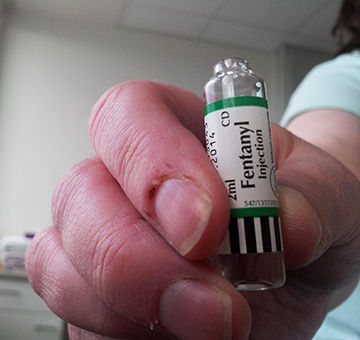
There’s a new deadly drug in town, and its name is fentanyl.
The powerful synthetic opioid sent Jefferson County overdose deaths soaring in 2016, while deaths from heroin and other opioids stayed at about the same rate as the year before.
The Jefferson County Medical Examiner’s Office reports that 40 people died from fentanyl overdoses in 2016 in the county, an increase of more than 200 percent from 2015’s death toll of 13.
Add on another 28 deaths from heroin and other opioid overdoses and 68 people died of an overdose in Jefferson County in 2016, a 62 percent increase from the year before, when 42 people died from overdoses.
According to information provided by the Jefferson County Drug Prevention Coalition, the death rate from drug overdoses in Jefferson County was 29 deaths per 100,000 people – dramatically higher than the statewide average of 17 per 100,000, which ranked seventh in the nation. Nationally, the rate in 2016 was 14 deaths per 100,000.
Brandon Costerison, public awareness specialist for the St. Louis office of the National Council on Alcohol and Drug Abuse, said the increase of overdose deaths from fentanyl is “something we are seeing across the board.”
He said fentanyl is either cut into heroin or into other drugs, and sometimes pure fentanyl is sold as heroin.
The federal Drug Enforcement Administration reports that fentanyl is 50 to 100 times more powerful than morphine as a pain killer. The drug is typically used to treat patients with severe pain or to manage pain after surgery and sometimes for cancer patients. Often the drug is prescribed to people who have become tolerant to other opioids.
Those who abuse the drug might get it by stealing it, writing fraudulent prescriptions or getting it from patients, physicians or pharmacists, officials said.
County Council to vote
on joining registry
With all that in mind, some officials in Jefferson County are pushing to join a regional prescription drug registry run by St. Louis County.
Missouri remains the only state in the nation that does not have a prescription drug monitoring program (PDMP) and, after unsuccessful efforts in the state General Assembly to start one, St. Louis County moved to set up its own and has invited other counties in the state to join.
St. Charles, Ste. Genevieve, Jackson, Cole, Lincoln, Stoddard, Cooper, Audrain and Miller counties and the cities of St. Louis, Kansas City, Independence, Jefferson City and Columbia are subscribing to the database, which requires pharmacists to participate and invites doctors to join as well.
The registry requires pharmacists to provide information on specific medications – typically opioids – that they dispense, and that information can in turn be accessed by doctors.
The County Council heard information for and against joining the St. Louis County effort at work sessions in December, February and again on March 6, and County Executive Ken Waller, who has strongly pushed for the county joining St. Louis County’s database, said he’s heard enough.
“I plan to have an ordinance in place (to allow the county to spend $2,980 to join St. Louis County’s registry) in time for the April 10 meeting. Hopefully, the County Council will finally approve it at the April 24 meeting,” he said.
Waller noted that all of Jefferson County’s cities have passed resolutions urging the county to join the St. Louis County database.
“Every resolution I see is unanimously approved,” he said. “How do you not approve this?”
Some council members have expressed concerns over the security of St. Louis County’s database, and at the March 6 work session, they heard from Clay Rogers, an official with Appriss, a firm based in Louisville, Ky., that is contracted by St. Louis County to administer the database.
Rogers, speaking via telephone, told council members that various databases it manages across 26 states have never been breached or compromised.
Councilman Bob Boyer (District 3, Arnold) asked Rogers how doctors and pharmacists might discover patterns indicating possible abuse.
“Does the system automatically throw up a warning or is it up to the pharmacy or prescriber to look into this?” he asked.
“The user has to use his or her professional judgment,” Rogers replied.
Dr. Marsha Mertens, a family physician for 31 years who in the last year has moved her practice from St. Louis County to Hillsboro, said she has noticed differences.
“The amount of drug abuse I see in Jefferson County is striking,” she said. “Every day, sometimes multiple times a day, I’m seeing patients who are actively using drugs or abusing prescription drugs.”
She said the fact that St. Louis and St. Louis County are participating in a prescription drug monitoring database has affected Jefferson County.
“I believe that the drug monitoring efforts are driving more drug users to move to Jefferson County, where it’s easier to acquire drugs,” she said.
Mertens conceded that any database may not be as secure as some members of the council may want it to be.
“As far as concerns you have about the security of the database, everything can be compromised. Our tax records can be breached. Many of us do online banking, and that can be targeted. But we still do these things,” she said.
Mertens noted that the General Assembly is considering several bills for a statewide registry, including a proposal by longtime drug registry opponent Rob Schaaf (R-St. Joseph). His bill would allow physicians to view a patient’s medical data only after the Missouri Department of Health identifies cases of doctor shopping.
Critics have said Schaaf’s plan would be ineffective and highly expensive to put into place. The Missouri Medical Association called his proposal “a fake PDMP.”
State Rep. Holly Rehder (R-Sikeston) has introduced a bill in the state House that would implement a registry more in line with those in other states.
Mertens said Jefferson County should move to join the St. Louis County registry despite what is going on in Jefferson City.
“We don’t know what’s going to happen, when it will happen or what it’s going to look like,” she said of proposed state legislation.
Mertens stressed that it’s important to monitor prescription drug use.
“Missouri is No. 1 for opioid prescriptions,” she said, “and prescription opioid use usually precedes illicit drug use.”
Prescription opioids
can be a gateway
Mertens’ assertion is borne out by statistics from the National Institute on Drug Abuse, which has concluded that prescription opioid use is a risk factor for heroin use. In 2008-2009, according to the agency, 86 percent of young urban intravenous drug users polled said they abused prescription opioids before they used heroin.
Costerison said it’s difficult to assess the problem of doctor shopping in the region because of the absence of a database.
“It’s hard to know how common it is because there is no exact data,” he said. “What we do know is that when people in recovery programs talk to their drug counselor, they talk about going from doctor to doctor to try to get prescriptions.”
They can do this because “doctors have no way to track it,” Costerison said.