

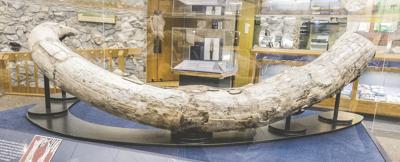
A prehistoric mastodon tusk that had been displayed at the Mastodon Historic State Site Museum in Imperial for nearly three decades is back home following a several-month absence while it was being preserved at the St. Louis Science Center.
The approximately 10,000-year-old, 8-foot-long ivory tusk was excavated in 1976 from a dig site at the corner of highways 61-67 and M in Barnhart. Then, it was put on display at the Mastodon site museum when it opened in 1988, said Brooke Mahar, a site interpreter and naturalist for the historic site.
Last March, the tusk was sent to the Science Center, where it was kept in the Dana Brown Fossil Prep Lab for several months while work was completed to better preserve it, she said.
A new mount for displaying the tusk also was built, and the tusk has been back on display at the Mastodon site museum since December, Mahar said.
“It looks like it went to the dentist and had a whitening done,” she said. “It was browning and all that has been removed and a new sealant was put on it.”
Mahar said the preservation project was kicked off last year after staff from the Mastodon site visited the Science Center to look at artifacts from a collection that had belonged to Robert McCormick Adams, who excavated at the Kimmswick bone beds, where the museum is now located.
“When we were up there, we asked the collection manager if they knew anyone who did preservation work on ivory,” Mahar said. “Ivory is delicate, and over time it needs preservation. You need to keep an eye on it to make sure it’s not deteriorating.”
Brian Thomas, who manages the earth science galleries at the Science Center, donated his time to preserve the tusk.
The Science Center also donated all the material used to preserve it, Thomas said.
The only cost the Mastodon site incurred during the preservation process was for the new mount that was built, Mahar said.
During the approximately eight-month period that the tusk was at the Science Center, people could view it in the fossil lab and watch the preservation work being done, Thomas said.
“People can actually come in and talk to us and see the work we do on dinosaur fossils and anything else we have in the lab,” he said.
Thomas said the tusk “looks so much prettier than it used to.”
Not only does it look better but also the restoration will help the tusk last longer, he said.
“It was preserved in the late ’70s by a high school teacher and students, but the materials they used are not the same ones we use today,” Thomas said. “We use more modern adhesives, glues and polymers that are meant to preserve the fossil. Clays or regular glues used in the past are no longer advisable. So, I removed the original layer (of old chemicals), and it exposed much of the original ivory. I proceeded to remove stains of iron and dirt and any other foreign materials. In those areas where I removed a considerable amount of material, we replaced it with epoxies and polymers and then sealed it. What it looks like now is more of a normal ivory state. It looks more authentic, more natural, and it will last much longer.”
The museum is currently open from 11 a.m. to 4 p.m. Monday, Friday and Saturday and from noon to 4 p.m. on Sunday. However, beginning March 16, the museum will be open from 9 a.m. to 4:30 p.m. Monday through Saturday and from noon to 4:30 p.m. on Sunday.