


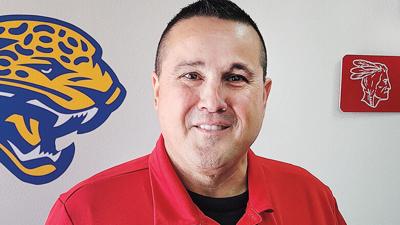

Paul Fregeau’s first year as superintendent of the Fox C-6 School District reaffirmed one of his beliefs about the district.
“I consider this a destination job,” he said. “I don’t want it to sound self-serving, but that has been reinforced this year. This is a great place to work and be the leader. Someone should be proud and honored to be the leader of this district, and I am.”
Fregeau became the Fox district’s third superintendent in a three-year period on July 1, 2021, when he replaced Nisha Patel, who left the district after two years to become the superintendent at the School District of Clayton. Patel had taken over the job after Jim Wipke left the Fox district at the end of the 2018-2019 school year to become the superintendent at the Ladue School District.
“This district has been through a lot of change these last few years, and I think one of his primary goals is to bring people together so everyone is moving in the same direction,” said Randy Gilman, assistant superintendent for elementary education.
Board of Education president Krystal Hargis said she saw Fregeau establish relationships in the district and community during his first year at Fox by visiting all the district’s schools and meeting with numerous organizations throughout the county.
“The pace of his schedule is exhausting,” she said. “This year has been a transition year. I believe as more people get to know him, they will find he is very humble and easy to talk to.”
COVID-19
When Fregeau arrived at Fox, the top three issues he had to deal with were the COVID-19 pandemic, the budget and curriculum.
Mitigation measures put in place to limit the spread of COVID-19, mainly requiring masks to be worn at the start of the school year, drew the ire of some students, parents and teachers. Fox initially linked masking requirements to COVID-19 transmission levels in Jefferson County but adjusted the policy near the end of the first semester to require masks only in buildings that had a 2 percent or higher positivity rate among students and staff.
However, when positive cases surged near the end of 2021, board members voted to require masks through January. That decision changed in February, when the board voted to only require masks in buildings that hit the 2-percent positivity threshold.
“The most challenging was the COVID mitigation plan throughout the year,” Fregeau said. “I think we showed we can evolve as an organization through the year. We don’t come out with a decision that is etched in stone. We continued to gather information, listen to all facets of our community and make the best decisions we could based on the information.”
Budget
The board voted 6-0 June 22 to approve a budget that shows Fox starting the fiscal year, which runs from July 1 through June 30, 2023, with $24 million in its reserve fund and finishing with just more than $20 million in reserve funds. Hargis was not at the meeting.
Last year, Fox’s initial fund balance was $21,217,840, and the fund balance was $16,286,450 at the start of the 2020-2021 fiscal year, district records show.
Fregeau said he is glad the district has been able to improve its fund balance, while also providing raises for all of the district’s approximately 1,850 employees. But he also knows Fox will need to find a new revenue source to remain on stable financial grounds.
“We haven’t had a tax levy in 18 years,” he said. “We have to look at all options moving forward.”
Curriculum
Fregeau said the district evaluated curriculum items it has been purchasing, and teachers flagged material that is not used. CFO John Stewart said more than $500,000 was cut from the curriculum budget for next school year.
Fox also has brought in new curriculum with the board voting 6-0 on June 7 to adopt new elementary math and financial algebra curriculums. Financial algebra is an alternative to algebra II for high school juniors and seniors.
Todd Scott was not at the meeting.
The district also started using the Northwest Evaluation Association assessment tool last school year. NWEA was developed in 1973 in Oregon and Washington to provide ways to measure student growth and proficiency and provide suggestions to tailor instructions, according to the nonprofit’s website.
“It will help identify gaps in our curriculum and instruction as we see trends in certain grades, whether it is consistent growth, no growth or a drop,” Fregeau said. “It will help us make more informed decisions going forward.
“The big thing is it is supposed to be closely correlated with the MAP (Missouri Assessment Program). It should help us predict and learn how our kids are doing on the MAP to improve that score. I know the MAP is not the be-all, end-all, but it is what a lot of parents and community members look at when they research a district.”
Year 2
While student performance and the district’s budget will always be top concerns, Fregeau said he will be working on plans to shape Fox’s future going forward. He said he wants to have a demographic study completed to determine the needs of the district.
Board members were deadlocked 3-3 on June 7 about whether to pay the Ittner Cordogan Clark Group $107,500 to create a master facility plan, which included a demographic study. Ittner is the architectural firm that is designing many of the projects funded by a $40 million bond issue voters passed in 2020 to fund improvements at schools around the district.
Hargis, Jim Chellew and Vicki Hanson voted in favor of having Ittner create the plan, and Michelle Chamberlain, April Moeckel and Kenny Woolsey voted against the study, saying they wanted more bids from other companies for the service.
“Without that (study), we are flying blind,” Fregeau said of having a demographic study. “It will give us a handle on if we will continue to see (the number of) first graders between 750 and 800, when we used to see 800 or more. That will help us plan better for facilities, staffing and everything.”
The district also will create a Comprehensive School Improvement Plan, which is required every five years and maps out how the district will accomplish goals for the next half decade.
“We will have community town halls, meet with staff members, board members and community members to get their input on what they want to see from us,” Fregeau said. “We will incorporate that into our Comprehensive School Improvement Plan, the CSIP, that we have to reboot this year. I don’t want to predict what that may be because we want to hear from the community about what they want from their school. We will put a plan in place to meet their aspirational goals for the district.”