


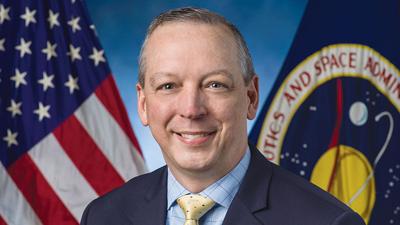

A Fenton native who used to fly planes out of the Festus Memorial Airport is part of a historic space mission.
Sean Fuller, who graduated from Eureka High in 1992, is the international partner manager for NASA’s Gateway program. He works with international partners to develop the Gateway space station, part of the Artemis missions, a plan to send the first woman and first person of color to the moon, explore the lunar surface and one day get astronauts to Mars.
The first step of the mission happened Nov. 16 when the Artemis I rocket was launched from the Kennedy Space Center in Florida. The rocket carried the Orion spacecraft, which is now traveling through space to determine if crewed spacecrafts can reach the far side of the moon.
The 26-day mission, which is scheduled to be completed Dec. 11, tested the Orion spacecraft and the SLS rocket.
The primary objective of the mission was to test Orion’s heat shield. If Artemis I is successful, it will lead to astronauts one day flying to Gateway on Orion.
“The moon holds great scientific possibilities,” said Fuller, 48, who now lives in Houston. “We are just now truly discovering what those could mean.
“It’s kind of how when people set out west in the 19th century,” he said. “St. Louis was known as the Gateway to the West. No one knew then what they would find on the other side. It took exploring. That is what Gateway will be for space travel. We will be able to set up a docking station on the lunar surface as a launching-off point for an eventual trip to Mars.”
The mission
Gateway is coming together in pieces.
NASA is expected to launch sections of the station in 2025 to begin building a small, human-tended space station that will support the Artemis campaign.
Built with help from businesses and other countries, the station’s capabilities for supporting sustained exploration and research in deep space include docking ports for visiting spacecraft; space for crews to live and work; and on-board studies of human health and life sciences, as well as other scientific endeavors, according to NASA.
Fuller said if all goes according to plan, astronauts will one day be able to travel to the Gateway space station.
Gateway will launch in 2025, but astronauts will not fly to Gateway until Artemis IV which is currently scheduled for 2027.
“It’s very exciting,” Fuller said. “We have been able to go far beyond what our Founding Fathers could have ever dreamed. Future generations will be able to go farther than even we can imagine. Gateway is the key.”
Journey to NASA
Fuller said working at NASA has been a lifelong dream.
He said he first became interested in flight while spending time with his father, Randy, at St. Louis Lambert International Airport.
“My father was an air guard at Lambert,” Fuller said. “That’s probably where I got the early exposure. It seems I have always been looking up.
“I remember being in the third or fourth grade and watching the launch of that first space shuttle flight, Columbia, in April 1981. I knew then that my future would be in space. I’ve always had a passion for it.”
Fuller’s interest in air travel led him to earn a pilot’s license when he was 17.
He worked as a private pilot, flying a Cessna 152 out of the Festus Memorial Airport on weekends and during the summer.
After graduating from Eureka High, Fuller attended Embry-Riddle Aeronautical University in Daytona Beach, Fla. He graduated in 1996 with a bachelor’s degree in engineering physics.
He said he began working for NASA shortly after graduating from college.
Fuller said he first worked in the flight control center, working mission control on space shuttle launches.
At that time, the Mir space station had been launched and was operating in low orbit around Earth from 1986 to 2001, under the operation of the Soviet Union, and later, Russia. Fuller helped with flights traveling to and from Mir and with general International Space Station (ISS) operations.
“From a technical standpoint, I have spent a lot of time in Russia, Japan, Canada, Europe and around the globe cultivating partnerships for the ISS, which launched in 2000,” he said. “You have to remember that the ISS is not America’s station. It is a global partnership with countries from all over the world coming together as humans to expand our universe.
“This year marks 22 years since the first crews left Russia to travel aboard the ISS. They are still up there living, working and expanding our capabilities. They are up there working right now to expand our lunar orbit capabilities, which will someday lead to sending human crews to Mars. What we are doing with Artemis and Gateway is a stepping stone.”
Fuller also has led NASA space flight teams.
He likened the Artemis mission to the Apollo program that led to the first astronauts landing on the moon in 1969.
“Apollo was a scouting mission,” Fuller said. “They needed to know how sustainable the moon was and how long they could stay on the surface. We know so much more now.
“This time it will be for a longer duration. We will be able to build up infrastructure, and the astronauts will stay there and work. The Apollo 17 crew was the last crew to touch down, lasting for three days. Our plan is for four crew members to travel on Orion to Gateway. Earlier missions will find a lander at Gateway waiting to take them to the moon, and two crew members will travel to its south pole. That first landing crew will spend about six and a half days on the moon, double the amount of time spent by the Apollo 17 crew.”
Hometown connections
Fuller said he lives in Houston with his wife, Eva, and daughters Ashley and Brooke after spending most of his career in Florida.
He also said he travels to the St. Louis area at least once a year to visit relatives.
Fuller continues to follow the St. Louis Cardinals baseball team from afar, and he said he “bleeds Cardinal red.”
He said he wouldn’t mind traveling even farther and one day taking part in a space mission.
“I wouldn’t be opposed to it,” Fuller said with a laugh. “I’ve never been asked. NASA selects who goes on space missions and I haven’t been on the list. But I have trained flight crews in the past, and that has been rewarding.”