


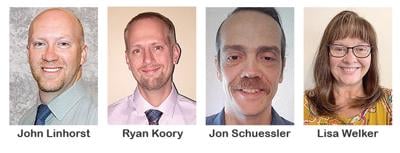

Four people are seeking two available seats on the Hillsboro R-3 School District’s Board of Education on April 6.
The two incumbents are seeking new three-year terms. Lisa Welker is running for her third term and Jon Schuessler his second.
They are being challenged by John Linhorst and Ryan Koory.
School board members are unpaid.
LINHORST, 39, and his wife, Jennifer, who teaches first grade at Hillsboro Primary School, have one child. He is an information technology analyst at Jefferson College. A 1999 graduate of Hillsboro High School, he received an associate degree from Jefferson College in 2001, a bachelor’s degree in management information systems in 2004 from the University of Missouri-St. Louis, and a master’s degree in business administration from Western Governors University in 2019.
KOORY, 39, and his wife, Celia, have two children. He is a director of economics for Mercaris. He received a bachelor’s degree in economics from Missouri State University in 2007.
SCHUESSLER, 44, is single and is a private tutor. A 1994 graduate of Hillsboro High School, he received a bachelor’s in electrical engineering from the University of Missouri-Rolla (now Missouri S&T) and completed master’s level courses in mathematics education at Webster University.
WELKER, 59, and her husband, Ken, have two children. She is retired after teaching for 30 years in Hillsboro R-3, who then worked as a substitute teacher before she was elected to the school board. She also served on many district committees. A 1980 graduate of Hillsboro High School, she earned an associate degree from Jefferson College in 1982, a bachelor’s degree in elementary education from Southwest Missouri State University in 1984 and a master’s degree in education from Webster University in 1992.
Her daughter, Jennifer Welker, is a fifth-grade teacher for the district.
What experience do you have (elected office, civic organizations, volunteer work, etc.) that might serve you well in this position?
Linhorst: I have worked at Jefferson College for more than 20 years in the technology department and have been managing the support of our end-user technology and a variety of types of technology projects since 2013. My experience in project management, team leadership and general support of education over the years would make me an excellent candidate for the board.
Koory: As a father of two Hillsboro students, I deeply value our schools. I’m a director of economics who focuses on agricultural issues. I am passionate about agriculture and the health of rural communities. I have experience breaking down complex problems and an understanding of how solutions impact people.
Schuessler: I ran as an independent candidate for state representative in 2016, visiting thousands of homes in the district. I am concluding my first term on the school board.
Welker: I am serving as the school board president and have been doing so for almost six years. I’ve attended numerous school board member training sessions and in 2019 I was recognized by the Missouri School Boards Association with an advanced board member certification. I have also served on church boards for both the Arnold and the Festus churches of the Nazarene.
What are the biggest problems facing the district and how would you address them?
Linhorst: The biggest problems are both financial and strategic. As we consider the how and what of the district’s post-COVID response for the coming school year, we must be concerned with how to best educate our students. We want students and teachers in classrooms but must balance that with the need to keep students and staff safe. We must also be mindful of the financial impacts of the ways in which local funding may change because of the pandemic’s ripple effect on the economy.
Koory: The current efforts by the Missouri Legislature to weaken the public school system. The Legislature has made serious efforts this year to reduce resources of public schools and to remove the voice of parents and the community from schools. As a parent with children attending Hillsboro, I am appalled by those actions and if elected, I will be a vocal opponent of actions that diminish our schools.
Schuessler: The district must better reflect its community. Currently, many policies have been imposed by outside bureaucrats, special interests and federal and state politicians. Teaching has become impossibly politicized on all fronts – from what gets taught, to how it’s taught and tested. The Missouri School Boards Association and the No Child Left Behind Act have more to say about policy than the board, and the same goes for the Gates Foundation and Common Core, the testing corporation Pearson, and lately, the Jefferson County Health Department. The district also must live within its means by properly budgeting for known maintenance.
Welker: Getting our students back to school full-time while keeping all our students and staff healthy. Next year’s school calendar already has been approved by the board for a five-day, in-person week. Some families may be concerned about returning, so online learning might still be offered. Teachers will need additional training to help them up the rigor with virtual lessons. Offering optional evening or weekend computer workshops might also improve learning.
Why should voters elect you to this position? List your goals, if elected.
Linhorst: I believe in the combined efforts of the district and the community to improve education and will use my voice to advocate for opportunities to provide for continuous improvements and impactful changes. I would look at the use of technology, particularly the rapid implementation of new technology as a response to COVID-19. I would look at failing grades, particularly at the high school, and consider curriculum and support changes to address this challenge. I would look at the district's capital improvement process and discuss ways that the district can enhance its long-term strategic plan.
Koory: Building a strong community begins with viewing our youth as future citizens and a strong public school is the bedrock of this. My priorities are teachers’ pay, budgetary planning and stability, secure public school funding and post-graduation opportunities.
Schuessler: I seek to represent the frustrated parent, the discouraged teacher and the marginalized taxpayer. Things have improved, but the district is still miles away from boldly advocating for the working parent, from providing a creative, hassle-free environment for teachers and from doing so by efficiently spending money rather than borrowing and losing the interest to banks, currently $1 million per year. I support a return to more practical (hands-on) subjects and traditional techniques (particularly in math), the removal of mask mandates, fewer hats and red tape for teachers and as little borrowing as feasible.
Welker: I’m really excited to see how the recently acquired farm will impact our students and the community. I want to get all students more involved with using the farm as lessons become more hands-on and enhances the curriculum. I would like to partner with the community and the Chamber of Commerce to set up small lending libraries in neighborhoods all over the district to help improve reading skills. I’d like to see the district develop an early childhood center.
What letter grade would you give your school board on its policy regarding virtual vs. in-classroom learning during the current school year, and why?
Linhorst: B-plus. Virtual learning has been a challenge. Our teachers should have received better professional development in the past year to meet the needs of struggling virtual learners. I am concerned about the uptick in failing grades this school year. Overall, I believe keeping the two-day hybrid schedule for the first semester was the correct choice, and requiring masks was the proper decision for the spring semester to ensure that we can get our students as much in-class education as possible while still navigating CDC and Jefferson County Health Department guidelines.
Koory: An easy B-plus. The board has navigated a year of unimaginably difficult decisions. In addition to addressing unprecedented challenges, it struggled to address the needs of a divided community. I cannot say that I have supported every decision made. However, I believe they chose the best path available and made decisions that they felt best served the community.
Schuessler: C-minus. When the administration admitted that hybrid was bad for teachers, parents and kids, but its hands were tied by the county and state, the system failed. The county and state privately said, “do this” but publicly said, “not us!” This web of overlapping, conflicting authority gives residents no avenues to act. It’s tyranny by way of confusion. Schools should have challenged these officials, forcing them to take responsibility or back down, but instead played the victim. By avoiding governmental conflict, the district created conflict with its community. Worse, F grades doubled in high school compared with last year.
Welker: Policies and procedures were developed but were often modified because guidelines kept changing. The policies were not perfect, but they protected everyone, kept students in school, prevented a total shutdown, allowed the district to keep a consistent learning schedule, provided meals for all students every day, used the barn as a supply hub for the community, started a daycare center for first responders, provided all students with Chromebooks, and gave hotspots to those without internet access. The overall grade would be a B-plus.