

Once just a hobby, playing video games is beginning to be recognized as a legitimate sport.
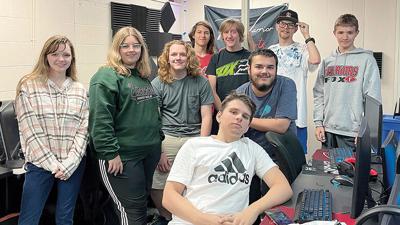
Many local school districts have gaming clubs, and five high schools – Fox, Windsor, Hillsboro, Herculaneum and Crystal City – have begun esports teams that compete against other schools.
“I think eventually there will be a normalization of gaming culture,” said Kyle Anderson, co-sponsor of the fledgling esports team at Hillsboro. “The feeling used to be, ‘Oh, those nerds are wasting time; they need to get out and socialize more.’ But the truth is, video games are a part of kids’ lives in a way they just weren’t for their parents and teachers. This is how they socialize.
“So what we’re trying to do is meeting kids where they are, trying to tap into what they are already doing. Instead of making gaming the bogeyman, you build on what’s positive about it.”
Officials say esports engage kids who don’t typically participate in school activities.
“You’re going to get kids who don’t like the regular sports or who are physically unable to participate,” Hillsboro activities director Chris Schacht said. “The objective is to get as many kids involved as possible. (Gaming) is important to them, so that makes it important to us.”
Learning the healthy way
At Fox High School in Arnold, the esports team is in its fifth year as a board-approved extracurricular program.
“We participate in a league of MOSEF, the Missouri Scholastic Esports Federation,” coach Lindsey Neal said. “There are more than 200 schools in the state involved. Our program serves 50-60 students.”
Like any other sport, gamers have to try out for a spot on the team.
“We have eligibility rules about attendance, academics, citizenship,” Neal said. “At practices, we often scrimmage against other schools in the league. We review games to analyze our play, and then we try new strategies and practice our skills.”
Neal, 41, is in her 18th year teaching at Fox. She said esports aren’t just about games and strategy.
“We start each practice with stretches, and we talk about ways to protect ligaments and tendons,” she said. “Everything they’d get out of a traditional sport, they get out of this. They learn to communicate, be on a team, be responsible, show up on time, deal with coaches. They learn emotional regulation through dealing with losses.
“For me, it’s important to get these kids out of their basements and bedrooms, where they play largely unregulated, and get them into an environment where they’re supervised, where they can take something they already do and learn to do it in a healthy way.”
At Hillsboro, the esports program is just getting off the ground.
“This is our inaugural season here,” Anderson said. “Back in 2019 or so, they were doing the groundwork, but then when COVID-19 hit, it kind of put everything back to square one. We tried again last year, having it as a club, just to gauge the interest level and work out the logistics.”
Anderson, 40, in his 10th year at Hillsboro, said this year’s group is eager to jump right in.
“We had our first meeting (Aug. 22), and we had about 10 kids. My hunch is, once we’re done, we’ll have between 15 and 20. Our goal is to get our kids into competitive play, JV and varsity.”
He agreed with Neal that supervised gaming is healthier for kids.
“Gaming culture isn’t always pretty,” he said. “Having them play in the classroom allows us to review and reinforce communication styles and talk about behavior standards.”
At Festus Middle School, science teacher and self-professed “gamer geek” Helen Maschmeyer Douglas sponsors an extracurricular gaming club during the school year and teaches a “History of Video Games” class during the summers.
“My classes never have an empty seat,” she said. “Kids are really excited to learn about and play video games. And it’s nice for them to have an adult, a teacher, who speaks the language, so to speak.”
Opening new paths
Esports teams play a variety of games, which must be approved by each school’s board of education and administration.
“We play Overwatch 2, Rocket League, Super Smash Brothers, Valorant, just to name a few,” Neal said of the Fox teams. Anderson said the Hillsboro team will focus on Rocket League and Super Smash Brothers in its weekly practices.
Coaches believe gaming can help students develop skills that could be useful down the line.
“It’s so much more than a hobby,” Douglas said. “There are many career paths beyond playing – game design, marketing – that are tangential to gaming.”
Neal said Fox has already seen four students head for college on esports scholarships.
“Colleges like UMSL and Lindenwood have started (esports) programs, and the Maryville team is semi-pro level,” she said. “One of our graduates had been a state qualifier in cross country; she chose to focus on esports instead and now she’s semi-pro.
“This a new industry, still in its infancy, so it’s a little volatile. But it’s growing, and there are more and more opportunities for kids to take non-player roles – lawyers, payroll, even CFOs and CEOs.”
Gamifying the curriculum
Douglas said the seamless blending of gaming with classroom technology is a logical next step for education.
“So many of these kids grew up with a tablet in their hands that there’s very little learning curve,” she said. “This generation is good about exploring tech, very technologically motivated, and when I introduce new technology, they tend to master it very quickly.”
Douglas said an increasing number of teachers use game tech in their curriculum.
“There are some great platforms where teachers can put questions into a game bank and kids can play in the classroom in individual or team modes,” she said. “It’s an attractive way to engage students, and it’s a good way to drill and practice without it feeling like it’s a drill or practice.”
Although esports coaches seem to think gaming will ultimately be sanctioned by the Missouri State High School Activities Association, they recognize that could have some negative impact.
“MSHSAA says you have to be a school employee to coach a team,” Neal said. “A lot of volunteers do it now, but under MSHSAA rules, they’d be prohibited.”
She said MSHSAA academic eligibility rules don’t give much leeway for participants who might be struggling academically.
“If I have a kid who’s having trouble, I can work with them instead of just saying, ‘You are failing three classes; you’re done,’ as MSHSAA dictates,” she said.
“It’s a really complicated issue, and I honestly don’t know how I feel about it. The legitimacy and recognition (of being MSHSAA sanctioned) are very appealing. In the long run it will be a good thing, but the transition is a little scary.”
Neal said one of the most significant benefits of the esports program is the social aspect. Team members develop close friendships.
“For some of these kids, it’s the first time they’ve had friends,” she said. “That’s one of the biggest rewards – teaching these kids they’re loved and accepted.”