

A young Jefferson County boy is the inspiration for “Will’s Law,” legislation that would require all school employees to learn how to respond to students and others suffering from seizures.
The legislation is a provision in a bill related to health care and has passed through the state House and Senate and only awaits Gov. Mike Parson’s signature. If the governor signs off on it, the law will go into effect by the next school year.
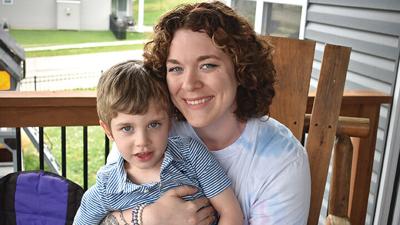
Will Capps, a 4-year-old boy with epilepsy, was the impetus for the legislation.
He is the son of Air Force Tech. Sgt. Adam and Kayci Capps of Herculaneum, and his mother came up with the idea to require the seizure-response training in schools. She reached out to Sen. Doug Beck (D-St. Louis County) for help, and he sponsored the legislation (Senate Bill 710).
Kayci said she believes the governor plans to sign the bill.
“From talking to Sen. Beck, we expect it to be signed,” Kayci said. “Even if it wouldn’t be signed, there’s enough support in the Senate to override (the governor).”
She said the law would not only help her son, who is prone to multiple seizures a day, but also the approximately 8,300 Missouri students who have epilepsy or seizures.
“Will’s Law requires every employee in every (school) district to have seizure training every two years,” Kayci said. “So, if Will has a seizure at school, they will know basic care for him until a nurse can implement a rescue plan.”
Kayci said her son especially needs the protection the legislation will provide.
“He has a form of epilepsy called Dravet syndrome and has dozens of seizures a day,” she said. “He could die during a seizure. He has been intubated 10 different times. So, his epilepsy is extremely severe. He has had seizures lasting as long as three hours.”
Will was diagnosed with Dravet syndrome in 2018, when he was 6 months old. The medical attention he needs during seizures can be involved, Kayci said.
“If he has a seizure, he has an implant in his chest called a VNS (vagus nerve stimulator),” Kayci said. “Someone must swipe a magnet across that implant. That’s the first step for stopping his seizure for the first 15 minutes. After that, he takes medications. If those don’t work, we call 911.”
Kayci said she has no problems with the care her son has received at the Dunklin R-5 School District’s Taylor Early Childhood Center in Herculaneum, but she wants to make sure all children who have seizures get the attention they need during serious medical situations.
“They (Taylor Early Childhood Center staff) have been fantastic,” she said. “They’ve had me come in to instruct them on Will’s seizure rescue plan. They take care of him like he’s their own child. I can’t say enough about the Taylor building.”
Kayci said she reached out to Beck’s office for help because one of her friends worked for him.
“I went to high school with an intern (in Beck’s office), Andrew Young, at North County High School (in St. Francois County),” she said. “Andrew, and my husband and I went there. I reached out to (Young) and asked for help.”
Beck said he supported the idea when Young presented it to him and agreed to champion Will’s Law in the state Legislature.
“I thought it was something a parent would want for their child,” Beck said. “The training is already done in many school districts. I thought it should be required. Now, it’s going to the governor’s desk.”
He said Will’s Law drew bipartisan support.
Kayci said she and her husband have pushed for Will’s Law for a couple of years.
“We reached out to Sen. Beck back in 2020,” she said. “In 2021, it went through the Senate, but it ran out of time before it got out of the House. This year, it got through both.”
Dunklin Superintendent Clint Freeman said his district is fully prepared to adapt to the requirements Will’s Law would put in place.
“I think it’s important that at Taylor Early Childhood Center and the entire district our teachers and paraprofessionals never stop training,” Freeman said. “Our students change every year. Their needs change. Medical procedures are always being updated. We, as educators, must change to continue to meet the needs of all students.
“The Department of Health and Senior Services will be coming out with ways to implement Will’s Law. We at the Dunklin R-5 School District are looking forward to those guidelines.”
The training would include both online and in-person instruction approved by DHSS, according to the bill.
Matt Lichtenstein, Dunklin R-5 communications director, said district officials didn’t know how much it would cost to implement “Will’s Law” training.
“We don’t expect it to be a burden,” Lichtenstein said. “We look forward to any additional training provided by the state.”
Kayci said she is thrilled that Will’s Law appears likely to be approved soon.
“It’s a huge win for our family,” she said. “Dravet syndrome has given us very low, lows. This is very positive for us and for Will.”
She said her son, who also has autism, has a bubbly personality.
“He’s very active, very cuddly,” Kayci said. “He never met a stranger. He doesn’t speak but communicates well.”
Will has two siblings, Ben, 7, and Charlotte, 1.