
The Jefferson County Council has approved spending $4,125,371.71 of the county’s share of the federal Coronavirus Aid, Relief and Economic Security (CARES) Act money.
That leaves $22,281,120.29 to allocate before Dec. 30.
Earlier this year, county officials learned the county would receive $26,406,492 through the federal government’s CARES Act to help pay for unexpected expenses dealing with the COVID-19 pandemic.
After weeks spent deciphering the shifting guidelines associated with the money, the county started accepting applications from political subdivisions and from small, county-based businesses and nonprofit groups on Aug. 17.
The council voted unanimously Sept. 14 to approve the first distribution of CARES Act money to entities other than county government and the Jefferson County Health Department.
Council members agreed to allocate $128,377.41 to the Dunklin R-5 School District -- the first distribution to one of the county’s local governmental entities (cities, fire and ambulance districts and public and private schools).
Superintendent Clint Freeman said the funds will be used to reimburse the district for a purchase of Chromebooks for students enrolled in his district’s virtual learning program.
In a separate unanimous vote, the council also agreed to distribute CARES Act money to three businesses.
Kozeny-Wagner Inc. in Arnold will receive $5,000, B.F. Mahn and Sons Inc. in De Soto will get $814.82 and the Melodee Lang certified accounting firm in House Springs $179.48.
All three, said Todd Tracy of the Jefferson County Economic Development Corporation, which is coordinating the application process for businesses and nonprofits, qualified under the Business Safe Reimbursement Program.
“That program provides reimbursement for items businesses bought to make their businesses, employees and customers directly safer, such as face masks, personal protection equipment and cleaning supplies,” Tracy said.
Those reimbursements are capped at $5,000 per firm.
Another type of payment to businesses and nonprofits, which maxes out at $25,000, is intended to provide relief for other expenses.
“If a business had to add people because they had to change their business model because of COVID, that might be something they could recover,” Tracy said. “If they had to make software upgrades to cash registers, or purchase equipment to minimize customers touching items.”
Tracy said the EDC has received a total of about 140 applications from businesses, some for each type of relief, but processing them has been slow because of the amount of paperwork involved to verify expenses.
“We’ve had to hire people to handle these applications,” he said.
The council also approved spending $25,000 of the CARES Act money to defray some of the EDC’s costs to process the applications.
The deadline for businesses or nonprofits to apply for CARES Act funds is Oct. 10. “We’ll keep doing more rounds, closing out on the 10th of the month,” Tracy said.
He said businesses with questions about whether an expenditure might qualify for reimbursement may email his office at edcjeffcomo@gmail.com.
For information on the business and nonprofit reimbursements, go to
jeffcountymo.org/colibri-wp/caresact.
Health Department gets more
Also on Sept. 14 the County Council unanimously approved a reimbursement of $582,082.50 to the Jefferson County Health Department for various unbudgeted expenses the agency spent in June to address the pandemic.
County Executive Dennis Gannon said to date, the Health Department – which is an independent agency, not an arm of county government – has received $1,142,000 in CARES Act funding.
He said recent guidelines issued by the Missouri Treasurer’s Office mandate counties designate at least 15 percent of their CARES Act funding to their local health agency.
That would mean the Jefferson County Health Department would be in line for at least $3,960,973.80.
“Because the money passed through the federal government through the state and then to the individual counties, the Treasurer’s Office can put those kinds of stipulations out,” Gannon said. “We only learned of this recently.”
For county government expenses, $2,824,000 has either been spent or will be spent on COVID-19 expenses, Gannon said.
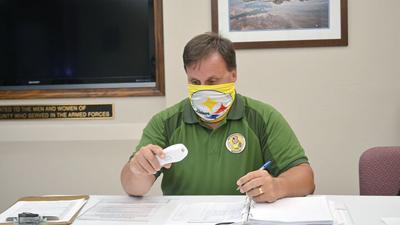
“We’ve already spent much of it – an outlay for PPEs, for instance – and we’ve got ongoing expenses such as staffing the doors of our buildings to monitor temperature checks for staff and visitors. We’re looking at a way to streamline that.”
Gannon said about 30 additional local government applications are being processed.
Those applications are vetted by Leah Smith, Gannon’s executive assistant, and Auditor Kristy Apprill before going on to a review panel.
“We’ve had requests for $3,528,768 as of Friday (Sept. 18),” Gannon said.
Like the business applications, Gannon said, the review procedure takes time, and in the case of political entities, applications must include a budget that was approved before the pandemic to ensure any reimbursable expenses were unbudgeted.
He said some municipal officials have said they don’t know what expenses are eligible for reimbursement so they’re reticent about spending on big-ticket items.
“As we’re finding out, that’s a moving target, and I understand why a city doesn’t have money to purchase something only to find they’re not getting any money back for it. I encourage them to communicate with our office. We will try to find a way to make it work, legally, under the guidelines we’ve been given. What is certain is that no CARES Act money can be used to recover lost income.”
Gannon said the county continues to accept applications from local governmental entities but would likely cut them off on Nov. 10.
“We will need time to process them before the Dec. 30 deadline to spend the money,” he said.
Gannon said he doesn’t know whether the county would have to return some of the $26.4 million to the federal government if it is unspent by year’s end.
“I’m not so worried about that as I am making sure everyone who is in line for some relief is able to get it,” he said.