

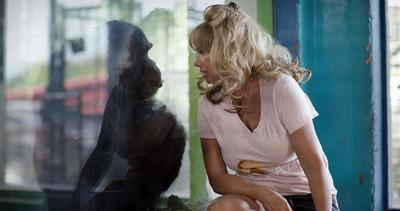

A lawyer for a former Festus-area chimpanzee caretaker who gained fame from the HBO documentary “Chimp Crazy” argued to a three-judge panel that his client’s 46-month prison sentence is too long.
On Sept. 22, Ian Murphy told the judges in the 8th U.S. Circuit Court of Appeals that Tonia Haddix’s sentence is 16 months longer than typical perjury and obstruction of justice cases. Federal Judge Stephen Clark on Aug. 7 sentenced Haddix after she pleaded guilty to two counts of perjury and one count of obstruction of justice in the U.S. District Court for the Eastern District of Missouri.
Murphy told the judges his client did lie throughout a yearslong court battle with the People for the Ethical Treatment of Animals over the care seven chimpanzees were receiving at the Missouri Primate Foundation, a facility formerly known as Chimparty, south of Festus, but he said the court ignored his client’s lack of a criminal history, low risk of committing similar offenses and her traumatic personal history.
Murphy said Haddix lied because she developed an emotional attachment to one chimp named Tonka, who is best known for his role in the 1997 film “Buddy” with Alan Cumming and appeared in “George of the Jungle.”
Haddix admitted to lying about Tonka’s death in July 2021, secretly moving the chimp to a facility in Ohio, and then moving him to her home in Sunrise Beach near Lake of the Ozarks. Tonka was recovered in June 2022 and moved to the Florida sanctuary, where the six other chimps under her care – Crystal, Mikayla, Tammy, Connor, Candy and Kerry – were transferred to the prior year.
“In justifying the upward variance in this case, the district court concluded that Haddix had moved Tonka the night before he was supposed to be moved to a facility by PETA pursuant to a district court order, and that she violated the orders of the court by owning another chimpanzee after she pleaded guilty to the information in this case,” Murphy told the judges.
“These aggravating factors had already been accounted for by the guidelines. They did not justify an extreme 53 percent increase above the top end of the guidelines. These so-called aggravating factors had already resulted in a four-level increase under the guidelines, and they did not justify an additional 16-month imprisonment on top of that.”
The nearly four-year prison sentence Clark imposed was nearly double the advisory guideline based on an offense level and criminal history, which recommended 24-30 months in prison.
Haddix’s other attorney, Justin K. Gelfand, had requested in court papers that his client be sentenced to one year and one day in prison, and federal prosecutors initially agreed to recommend a prison sentence of 10-16 months in exchange for the guilty plea, court records said.
On Sept. 22, U.S. assistant attorney Hal Goldsmith told the appellate judges the harsher sentence was justified due to the district court having nine years of records from the civil proceedings that generated numerous motions for civil contempt from PETA and two separate recommendations to the U.S. Attorney’s Office to look into potential criminal conduct by Haddix.
“The record clearly shows the district court sufficiently considered the statutory sentencing factors and did not rely on an improper factor,” Goldsmith told the judges. “In sentencing this appellant, the district court emphasized the nature and circumstances of Haddix’s offenses, which in the district court's opinion, were substantially more serious than the garden variety perjury and obstruction crime these statutes usually cover.”
The chimps previously belonged to Connie Casey, who transferred ownership of the animals to Haddix in an attempt to end a lawsuit PETA filed against her in 2016.
The legal battle between Haddix and PETA appeared to have concluded July 2021 when a federal judge ordered Haddix to give up ownership of the seven chimps and allow PETA to transfer them to the Center of Great Apes in Wauchula, Fla. The order came after the judge ruled Haddix had not followed a consent decree she had reached with PETA, which would have allowed her to retain ownership and care for Crystal, Mikayla and Tonka.
Crystal, Mikayla, Tammy, Connor, Candy and Kerry were transferred from the Festus-area facility to the Florida sanctuary on July 28, 2021. Tonka also was supposed to be transferred that day, but Haddix said Tonka died May 24, 2021, after suffering a stroke or heart attack.
Haddix had testified that Aswegan cremated Tonka’s body.
However, in June 2022, Tonka was discovered alive and living with Haddix at her home in Sunrise Beach near Lake of the Ozarks. The chimp was then transported to the Save the Chimps Sanctuary in Florida.
The discovery of Tonka came about because of Haddix’s role in the filming of “Chimp Crazy,” which didn’t debut until 2024. The documentary showed a video hearing in which Haddix appeared from her home and told the court Tonka had died of congestive heart failure.
After that hearing, she told the film crew she had lied. “I opted to go against the court order,” she said in the third episode of the documentary.
In April 2025, a visit by U.S. pretrial services officers to Haddix’s Sunrise Beach home, where she also operated a roadside zoo, led to the discovery of a second hidden chimp.
After the pretrial visit, special agents executed the warrant on July 9, 2025, and they found and removed a female chimpanzee from a basement cage, according to court documents.
Murphy argued on Sept. 22 that Haddix’s admission of lying in court and refusing to obey court orders in the HBO documentary was not reliable evidence to justify an enhanced sentence. He also said the U.S. District’s Office argument that Haddix profited from her lies was exaggerated.
“You know reality TV does not always accurately reflect reality, and uncorroborated statements from a heavily produced television show are not sufficient for a district court to make findings," he told the judges. “The district court talked about Miss Haddix’s efforts to commercialize her lawlessness, but when you review the presentence investigation report, it concluded that any earnings she received from outlets such as Etsy, Cameo and Spotify were modest at best. We are talking about a few thousand dollars.”
Goldsmith told the judges the 46-month sentence was justified because Haddix had continuously demonized the judge, PETA and attorneys representing PETA throughout court procedures. He also said she clearly defied court orders by owning a female chimp after Tonka was taken from her, and she cashed in on her notoriety by launching an Etsy shop to sell branded apparel, starting a podcast and delivering personalized video messages through the social media platform Cameo.
Goldsmith said all of that was on top of the elaborate lies she told in an attempt to secretly keep Tonka.
“She was reaping profit and money by violating district court orders,” he said. “She glamorized her conduct through any medium that she could, social media, podcasts and, of course, the HBO documentary. She had reaped six figures from her businesses, which included the captive chimpanzees, but hadn’t filed tax returns since 2016. That is an extensive record to support the district court’s variance of 16 months in this case.”
The court of appeals took the case under advisement.