


While many organizations have seen their membership numbers sag over the past several years, the Jefferson County Beekeepers Association continues to grow and has even expanded its operation, selling honey for the first time in its 52-year history, said Linda Els, a board member and treasurer for the group.
“Lately, our membership has been going up,” said Els, 69, of Hillsboro. “The members are from all around the county, plus a few from outside the county.”
She said the association, which was founded in 1970, currently has 95 members.
James Buxton, 76, of Catawissa, said new members are always welcome to join the association, which is “dedicated to the growth, preservation and distribution of beekeeping information,” according to the group’s website.
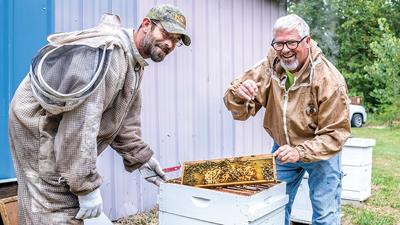
Recently, Els and Buxton, along with board members James Wilson, 55, Imperial, and Jesse Birkenmeier, 35, of Hillsboro, gathered at the club’s apiary in Hillsboro and despite bees buzzing around them and the group’s hives, they stood nearby unfazed and spoke about their group, as well as beekeeping in general.
They said beekeeping is an interesting pastime.
“They’re just fascinating,” Buxton said. “I started with it years ago. What they do is amazing. Also, I like honey. I have a sweet tooth.”
The group members also said beekeeping is “vital to society.”
“(The world’s diminishing bee population) is a concern. Beekeeping is important,” Buxton said. “They pollinate the crops. Other insects also pollinate, but bees pollinate about 75 percent of the fruit and vegetables we eat.”
Wilson said “bees are a much-needed asset.”
He said he remembers when American beekeepers helped bring back bees after an invasive insect lowered their numbers in the 1980s.
“Prior to 1985, American bees didn’t have a problem,” Wilson said. “Then Varroa destructor mites arrived in America from places like Japan and Russia. Our bees weren’t used to them. It was decimating American bees through a virus.”
Over time, American bees began building defenses to the parasite, Buxton said.
Some bees have become “hygienic bees” that have become resistant to the parasite that lodges and reproduces in cells of hives. Those hygienic bees can clean out the cells, controlling the spread of the parasite and preserving the colony, according to online sources about bees and the parasite.
The Jefferson County Beekeepers Association holds meetings at 6:30 p.m. the second Tuesday of each month at Hillsboro City Hall, 101 Main St., to discuss beekeeping topics.
“We don’t really have a headquarters,” Els said. “We meet at Hillsboro City Hall.”
Established club members have their own hives, and the association maintains a number of hives at its Hillsboro apiary.
“The club has hives,” Wilson said. “We’ve got eight hives. We have two people assigned to maintaining the hives.”
Some new members may come into the association with vast knowledge of beekeeping, but even people with no background with bees may join, Buxton said.
“If you have no knowledge at all, you join during the fall or winter,” he said. “Bees aren’t active in the colder temperatures. They don’t go dormant, but if it’s 50 degrees or lower, they don’t fly around.”
The newbies who join at those times learn from the veteran group members, presumably putting to use what they learn in setting up apiaries of their own during the spring.
“The club offers classes to teach you all you need to know,” Wilson said.
He said that while the instruction provides a base of beekeeping knowledge, people must experience beekeeping to truly understand it.
“It’s different to see bees on a video than in person, when you might have 50,000 in your face,” Wilson said.
There are financial considerations for those who want to try beekeeping.
“It can cost $150 to $200 for 3 pounds of bees,” Wilson said. “That will get you about 10,000 bees with one queen. They’re about 95 percent female. The queen is the only one that lays fertile eggs.”
People who investigate the hobby before jumping in likely will have a better chance of developing thriving hives, Els said.
“It depends how much research they do,” she said.
The group members estimated that, all things considered, getting into beekeeping could cost someone $250 to $500. That includes the bees and beekeeping gear and equipment.
“You also have to work in their medicine,” Buxton said. “You put it in their feed.”
Wilson said beekeepers can set up hives in a surprisingly small space.
“If you’ve got 4 feet of ground, you can have a beehive,” he said. “Most people won’t even know you have a beehive, except a beekeeper.”
Beekeepers may establish hives almost anywhere, the association members said.
“I know people that have them on balconies,” Birkenmeier said.
Wilson cautioned that those interested in beekeeping should make sure there are no rules or ordinances against having them wherever they live.
“You need to check with your city or subdivision for restrictions,” Wilson said.
The association members encourage people with bee problems to contact them to relocate the bees.
“People think they can just spray them,” Wilson said. “That’s the wrong thing to do. No. 1, you kill them. Then, you leave the honey (where the bees resided). That attracts mice, other rodents, roaches.”
Any of the association’s veteran members can remove a swarm of bees from a place they are not wanted, and they said they actually appreciate the chance to do it to save the bees, Buxton said.
“When bees swarm, they form new hives,” Buxton said.
Birkenmeier said he can extract bees from structures.
“Say they are living inside your walls. I’ll cut out the hive and take them to a safe, new home,” he said.
Buxton said bees should be admired.
“The honeybee is the only insect that produces a large amount of food – honey,” he said. “It’s all natural, no preservatives.”
Els said some club members sell the honey their bees produce and the association recently began selling the honey created at the association’s apiary.
“This is the first year our club has harvested honey from our apiary,” she said. “We are going to sell our honey at the Arnold Senior Expo, at festivals and one of our members sells it at the Arnold Farmers Market.”
The association leaders said while they do not have a problem attracting new members to their group, newbies do not necessarily last in the hobby.
“Some people will start keeping bees and two years later, don’t want to do it anymore,” Wilson said.
Jefferson County Beekeepers Association members are scheduled to give a presentation about the group during the Arnold Senior Expo at 9:30 a.m. Wednesday, Oct. 5, at the Arnold Recreation Center, 1695 Missouri State Road. The group also will have a table at the event to sell honey.
For more information about the association, including its honey sales, visit the jeffcobeekeepers.com website or go to the association’s Facebook page.
To access the association’s Facebook page, a person must join the group’s page on Facebook, but it is not required to actually join the association.