






Like most school districts across the state, those in Jefferson County saw their Annual Performance Report scores fall.
The Department of Elementary and Secondary Education released the latest APR scores on March 7, which are based on the results of scores from the Missouri Assessment Plan (MAP) tests taken last spring; academic growth over time; attendance and graduation rates; climate and culture surveys; and the success of graduates.
The number of districts across the state that scored in the highest category on the latest APR – those that received 95 percent or more of the possible points – dropped significantly.
Districts that score 95 percent or above are categorized as accredited with distinction. Districts with scores between 70 and 94.9 percent are considered accredited; those with scores between 50 and 69.9 percent are provisionally accredited; and those with scores below 50 percent are unaccredited.
However, DESE officials said they will not use APR scores to determine school district accreditation until after the 2023-24 school year.
Only four districts in the state scored at 95 percent or above on the latest APR, which is based on tests and data from the 2021-22 school year.
That’s a huge decrease from the 320 districts that scored 95 percent or above on the APR released in 2019 before the pandemic struck.
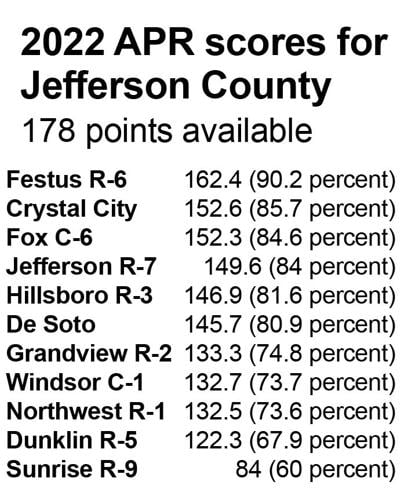
None of the 11 school districts in Jefferson County scored 95 percent or above on the latest APR.
The Festus R-6 School District was the closest, receiving 90.2 percent, the highest score in the county.
The Sunrise R-9 School District scored the lowest, at 60 percent.
DESE officials said the system used for the latest APR was new, so it is not appropriate to compare 2022 APR scores to previous years.
“For the release of this pilot year data, we encourage stakeholders, including community partners and families, to focus less on the APR score and more on the underlying data to learn how they may better support student learning,” DESE Commissioner Margie Vandeven said in a written statement.
DESE and county school officials said the APR scores provide a baseline and help districts determine how to improve students’ performances.
“The academic part of the APR allows us to examine the classroom instruction taking place in the tested areas,” Windsor C-1 assistant superintendent Mike Rickermann said. “We are taking this opportunity to restructure some of our assessments and ensure they contain relevant, rigorous material. Additionally, this process has allowed us to examine our data collection processes and ensure we are reporting information that is reflective of what is taking place within the district.”
The APR also shows most county districts, as well as districts throughout the state, had lower attendance rates than in past years. The state average for students attending school at least 85 percent of the time was 80.9 percent last school year. Before the pandemic, the average attendance rate across the state was 90 percent or higher.
In Jefferson County, the Sunrise School District, which has students in preschool through eighth grade, had the highest attendance rate last school year, at 91.8 percent. Festus had the highest among district’s with students in preschool through 12th grade, at 88.8. The Dunklin R-5 School District had the lowest attendance rate, at 78.2.
County district officials said they believe that as attendance rates will return to pre-pandemic levels, students will begin to perform better on tests that factor into APR scores.
“When students are absent, their learning is interrupted,” Northwest R-1 Superintendent Jennifer Hecktor said. “When students are regularly absent, they have gaps in their learning, and it becomes more difficult for them to advance without the solid foundation needed. COVID interrupted family routines and changed the way our society views ‘in-person’ attendance at school, in the workplace, etc.
“Our students need to be in school every day of the school year barring illness, and we continue to work with our families and community to reinforce the importance of good attendance.”
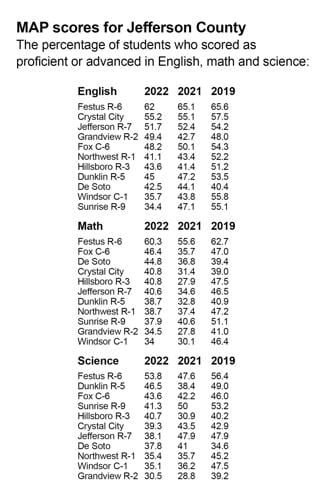
On MAP tests, Festus R-6 was the only county district to have more than 50 percent of its students score as proficient or advanced in English language arts (62), math (60.3) and science (53.8).
“The classroom is where the difference is made,” Festus Superintendent Nicki Ruess said. “It is the teachers working with students that makes the difference.”
The following provides a closer look at how all the county’s school districts performed:
Crystal City
Taylor Massa, the Crystal City School District’s director of student services and curriculum, said its APR score would firmly place Crystal City in the accredited category if DESE were using the latest results to determine accreditation.
“Our students and teachers have really worked hard to identify areas where we can grow,” she said. “We believe there is always room to show improvement and growth. We have focused on different strategies we can use in different areas and priority standards we can focus on. With that, you can see we did well.”
On the MAP tests, students showed improvement in math, with 40.8 percent scoring proficient or advanced. Last year, Crystal City had 31.4 percent of its students scoring at that level.
“We revamped what we were doing with RTI (response to intervention), and we added two math interventionists at the elementary building,” Massa said. “We knew that was an area of weakness for our students.”
De Soto
Josh Isaacson, the De Soto School District’s superintendent, said he expects the district’s 80.9 APR score to rise when the APR is released next school year.
“Our APR score demonstrates we are doing extremely well, and we anticipate our students will continue to score even higher this coming year as a result of their efforts and the continued efforts of De Soto educators,” he said.
De Soto students did better on the MAP math test this year, with 44.8 percent scoring proficient or advanced after 36.8 percent reached that mark last year.
“Math scores have been low, specifically in the fourth and fifth grade levels throughout the state for years, including pre-pandemic,” Isaacson said “The addition of DESE priority standards and the focus on these standards in current state assessments may have been a catalyst for growth for Missouri districts. Our teachers have been working diligently to use collaboratively designed, rigorous, common formative and summative assessments to ensure our students are working towards mastery of the Missouri learning standards.”
Dunklin
The Dunklin R-5 School District would be provisionally accredited based on its 2022 APR score of 67.9 percent, and Superintendent Clint Freeman said he expects the district’s scores will be better next school year.
“Our district has made changes that have already impacted some of the data points measured by the APR algorithm,” he said. “Keep in mind some of the data points in the just released APR for the 2021-2022 school year, such as attendance, were not released to schools until October of the 2022-2023 school year.”
Dunklin students showed improvement on the MAP math test, with 38.7 percent scoring proficient or advanced after 32.8 percent reached that level last year. Students also showed growth in science with the number of students scoring at proficient or advanced rising from 38.4 percent to 46.5 this year.
“The most important process we are taking is aligning our district curriculum to state standards,” Freeman said of how the district will improve MAP test results. “This allows for continuity within the district to improve our instruction and to align which standards are taught at which grade levels.”
Festus
Ruess said the Festus R-6 School District’s APR score shows the district managed the pandemic well by having students attend class in person five days a week, while also offering an online learning option. Most districts had students attended school in a hybrid, or in-person-and-online, model.
“I think that score tells me we made some good but tough decisions during that time frame for the best interest of students,” she said.
Ruess said she believes the district was the top performing county district on the MAP tests because of its data-driven approach to teaching that relies on multiple student assessments.
“We don’t focus on one data point,” she said. “Teachers know to look at multiple data sets to push kids to the next level. I think we will continue to see performances increase because our teachers are very focused. It is truly the culture and philosophy of how we do things.”
Fox
Superintendent Paul Fregeau of the Fox C-6 School District said it is in a good spot to build from its APR score of 84.6 percent.
“I was glad to see we are in the upper third of the state as far as APR goes,” he said. “We will do our best to understand the system and work to improve student achievement at all levels of the district.”
Fregeau said the Fox district is not where it wants to be on MAP testing, with 48.2 percent of its students scoring as proficient or advanced in English, 46.4 in math and 43.6 in science.
However, he said district officials were pleased that the classroom time students lost because of the pandemic didn’t negatively affect their performance on the tests as much as anticipated.
“I think we were pleasantly surprised by where we ended up compared to where we thought we might be,” Fregeau said. “Now we need to build on those numbers and be better the next time around.”
Grandview
Don Jeffries, the Grandview R-2 curriculum director, said the district is expected to score better in next school year’s APR.
“The students are beginning to recover from the slide that we have seen in math and science from the pandemic,” he said. “Also, we have a little better understanding of how the points will be scored and have looked at ways we can strengthen the areas that scored low.”
Jeffries said Grandview made adjustments to improve students’ performance, and they scored 49.4 percent proficient or advanced in English and 34.5 percent in math.
“To address learning loss in both math and English language arts, we have implemented a program called Exact Path,” he said. “In this program, students take a diagnostic test and the program develops a learning path that addresses the needs of the individual student.”
Hillsboro
Melissa Hildebrand, the Hillsboro R-3 assistant superintendent for curriculum, instruction and assessment, said district officials are confident it will retain its accreditation status when the next APR is released, and it is using the data from the 2022 report to help students continue to improve.
“We are consistently analyzing data for the purposes of improving our practices,” she said.
Hillsboro students showed improvement in English, math and science MAP tests. In English, 43.6 percent of the students scored as proficient or advanced after 42.7 scored at that level last year. Math scores rose from 27.9 to 40.8, and science scores rose from 30.9 to 40.7.
“We are happy to see the hard work our staff and students put in daily represented as positive growth in many categories,” Hildebrand said. “We also recognize the areas in which we have opportunities to improve and use the data presented to plan such improvement.”
Jefferson
Jefferson R-7 Superintendent Clint Johnston said a better understanding of the new scoring for APR should allow the district to improve student performance. However, he also said the district uses other assessments along with APR and MAP scores to maximize individual student learning.
“The education of an individual child has never been and should never be about the bureaucracy of the state performance model,” he said. “The education of a child should be about individual growth measured over a period of time against that child’s starting point in the process. If we focus on the child and their needs, learning styles, and educational attainment of knowledge, growth will occur resulting in success for the child, the family and the district.”
Jefferson R-7 students showed improvement on the MAP math test, with 40.6 percent scoring at proficient or advanced after having 34.6 hit that mark last year. There was a slight dip in English scores, going from 52.4 to 51.7, and science scores fell from 47.9 to 38.1.
Northwest
Hecktor said the APR results are released so late Northwest R-1 educators can’t use them much to guide student learning during the current school year. However, she said the APR data can be used to assess the curriculum for the next school year.
“The state does provide item analysis reports from the data we use to ensure our curriculum and instruction is aligned to state standards,” she said. “If we see low scores on a standard, this offers us an opportunity to analyze the way we are teaching, the resources we are using and the level of depth or rigor we are addressing.”
Hecktor said the district will look to improve student MAP scores. The district had 41.1 percent of students score as proficient or advanced in English, 38.7 in math and 35.4 in science.
“We are implementing our (Comprehensive School Improvement Plan) and have our resource allocation, professional development, building school improvement plans and professional growth plans all aligned with our focus on high quality, engaging, rigorous instruction,” she said. “We also believe our children are more than ‘scores,’ and we focus on improving the life of the whole child.”
Sunrise
Sunrise R-9 School District officials did not respond to questions about the district’s APR and MAP tests performances.
Sunrise would be considered provisionally accredited with an APR score of 60 percent if the state were using the 2022 data to determine the district’s status. It is still listed as accredited on the DESE website based on data released in 2019.
Sunrise MAP scores fell in each category with the percentage of students scoring as proficient or advanced falling from 47.1 to 34.4 in English, 40.6 to 37.9 in math and 50 to 41.3 in science.
Windsor
The Windsor C-1 School District received a 73.7 percent APR score, and Rickermann said information from the report will be used to improve the scores for next school year.
“We are viewing this as an opportunity to examine our instructional delivery at all levels and ensure we are providing the best learning opportunities for our students,” he said. “We are confident our MSIP 6 performance scores will provide guidance that will result in increased student growth, resulting in a continued accredited classification.”
Windsor students’ performance in math improved to 34 percent scoring at proficient or advanced in the latest MAP scores after scoring at 30.1 the previous school year. However, the district saw drops in English and science, with a decrease from 43.8 to 35.7 this school year in English, and from 36.2 to 35.1 in science.
“Our teachers are taking a deep dive into their classroom assessments to ensure alignment to the Missouri learning standards,” Rickermann said. “Our teachers are collaborating on a weekly basis to review classroom performance data to identify gaps and ensure that we address student learning needs so that our students are performing at their highest level.”
