


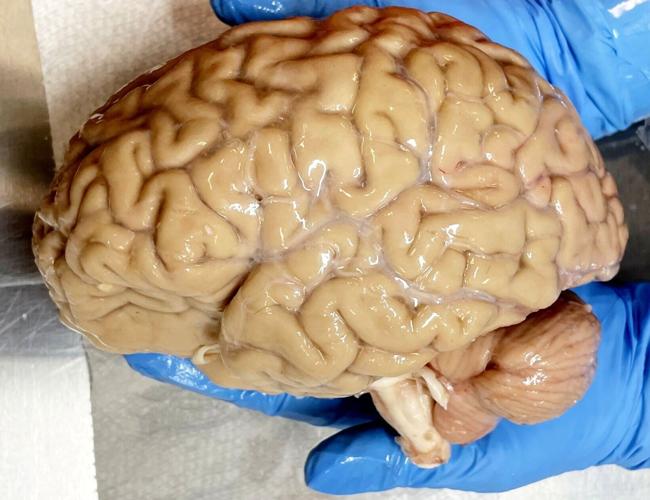





Lateral view of a human brain from the Apex Neuroscience Brain Bank preserved by perfusion fixation. (Apex Neuroscience via SWNS)
By Stephen Beech
Deep freezing humans before reviving them in the future has a one in four chance of working, according to doctors.
But suspended animation — a feature of classic sci-fi films such as "Alien" and "2001: A Space Odyssey" — could have moral implications if it becomes reality, say some medics.
A survey of more than 300 physicians about human preservation found that some were concerned that preparation for preservation could interfere with best practices for a patient's care.
Nearly half of the doctors who took part were primary care providers, with the rest being various kinds of specialists including neurologists, intensive care doctors, anesthesiologists, and doctors who specialize in palliative care.
In the sci-fi film "Alien," Ripley — played by Sigourney Weaver — and the rest of the Nostromo crew wake up from "hypersleep" pods after drifting for 57 years.
The crew in the movie "Interstellar" use "hibernation pods" for their multi-year trek across the cosmos.
The new research, published in the journal PLOS One, was designed to address three main themes.

(Photo by Mariana Montrazi via Pexels)
One was the perceived feasibility of preservation procedures, another was clinical interventions that could improve preservation outcomes, and the third was ethical and legal standing of preservation as an end-of-life option.
Study author Ariel Zeleznikow-Johnston said it was unclear whether there was a consensus among doctors regarding preservation — the storing of bodies at extremely low temperatures, or using preservative chemicals, in the hopes of future revival.
He said: "Preservation is not the only way in which physicians have to balance concerns about unproven treatments with patients' preferences, but it is one with high stakes as it pertains to the end of someone's life.
"The technologies necessary to revive someone have not yet been realized, though current preservation organizations report several hundred patients preserved globally, with thousands more signed up for future preservation."
Neuroscientist Zeleznikow-Johnston, of Monash University, Melbourne, Australia, said: "About one in four of the physicians said they believed it was plausible, or even very plausible, that someone could be revived in the future after preservation.
"Just under half said it was unlikely.

(Photo by Sergio López via Pexels)
"Neurosurgeons, on average, rated the possibility of revival highest, though most of the other specialties showed a wide spread of opinions that slanted more towards skepticism."
He says the way doctors are most likely to interact with preservation in their professional capacity is in the choices a patient may make for end-of-life care.
Zeleznikow-Johnston said: "A majority of physicians supported prescribing anticoagulants to dying patients, which could help with the quality of preservation.
"However, fewer respondents were comfortable with more extreme procedures, such as patients going through medically assisted death and opting to begin the preservation before cardiac arrest."
The doctors who most commonly have conversations about end-of-life care were overall more supportive of that kind of choice, according to the findings.
Around one in five of the physicians polled were concerned that decisions to increase the odds of successful cryopreservation would clash with providing the best standards of care.
Zeleznikow-Johnston said: "Currently, pre-cardiac arrest preservation in humans is, to the best of our knowledge, not legally permitted anywhere in the world, but if the technology develops further, may become an issue healthcare professionals must grapple with."
The research team say that clarifying the clinical, legal, and ethical frameworks for use of preservation as an end-of-life procedure is important, and noted that the speculative nature of the findings should be carefully considered.
Zeleznikow-Johnston added: "A lot of physician hesitancy may come from simple unfamiliarity with the scientific basis of modern preservation methods.
"The doctors who have actually thought about this — and who regularly sit with dying patients — tend to be more receptive, not less."