


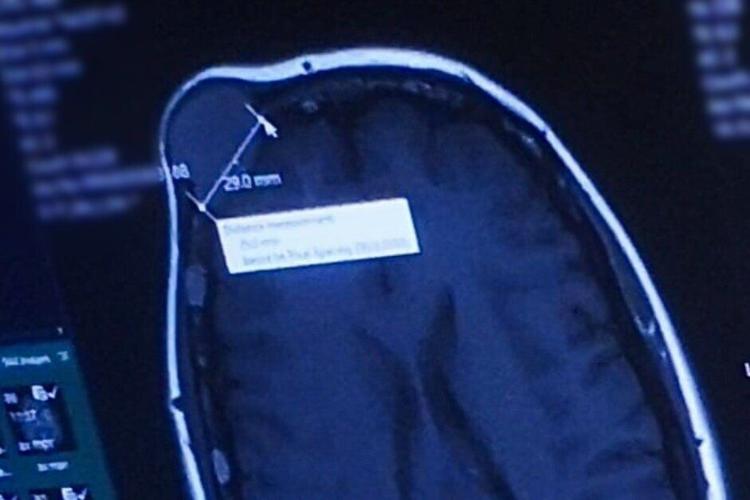


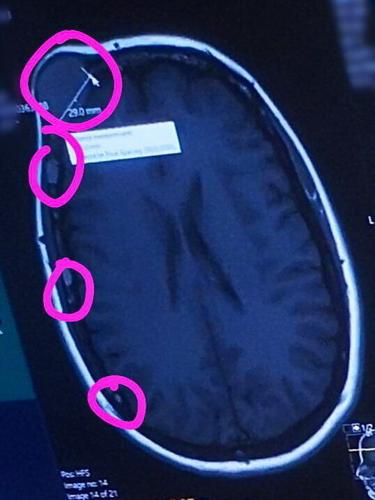



CAT Scan shows lump and lesion in Katrina Fox's head. (Blood Cancer Research UK via SWNS)
By Isobel Williams
A woman who developed a golf-ball-sized lump on her head that she thought was a cyst discovered it was actually a skull-eating cancer.
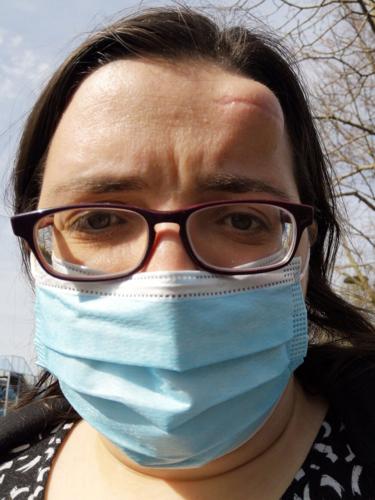
Katrina Fox, 38, says the growth first appeared in 2021 starting as the size of a pea, and she had joked about it with colleagues — nicknaming it "Bert."
Her GP told her it was likely a harmless cyst and she was referred to a dermatologist to have it removed.
However, when the doctors cut into the lump, they saw a mass and some of Katrina's brain through a hole in her skull.
It turned out the pub worker from Medway, Kent, actually had a deadly blood cancer called myeloma which was eating away at the bone.
She said: "I was warned that it might smell and I might feel a rush of fluid but then the doctors would sew it up and I could get on with my life.

Katrina Fox, with the golf-ball sized lump on her head, in April 2022. (Blood Cancer Research UK via SWNS)
"But when I had the surgery, under local anesthetic, I was chatting to the doctors but as they cut in, I heard a shocked silence. You could hear a pin drop.
"Myeloma attacks the bone so it had eaten my skull.
"I was absolutely devastated. I couldn't believe a lump we had joked about and named Bert was something so deadly."
The lump first appeared in September of 2021, and by October it was the size of a golf ball.
Following the shocking dermatologist appointment in February 2022, Katrina was sent for several MRIs in May.
Results revealed that she had multiple lesions and holes in her skull including a 3 cm hole where the lump had been.
A bone marrow biopsy then uncovered it was an incurable form of blood cancer called myeloma, and that without treatment she might not survive the year.
Blood cancer is the fifth most common cancer in the U.K. and the third biggest cancer killer with only one in three surviving the deadliest kinds, according to Blood Cancer Research UK.
The lump had been caused by a solitary plasmacytoma, a mass of abnormal cells.

CAT Scan shows lump and lesion in Katrina Fox's head. (Blood Cancer Research UK via SWNS)
Katrina had six rounds of chemotherapy and a stem cell transplant in December, before more chemotherapy.
She is now on a chemotherapy tablet to keep the cancer at bay, and her life expectancy has jumped up to roughly 10 years.
She said: "It's been really hard adjusting to life with cancer.
"I get very fatigued and have bone pain but I know that I have to make the most of life while I can so I swim in the sea, taught myself crochet and have been to Disneyworld with family.
"I am incredibly hopeful that I will get longer than 10 years. They gave me a year to live so I am grateful to be past that and I am grateful for every day since."

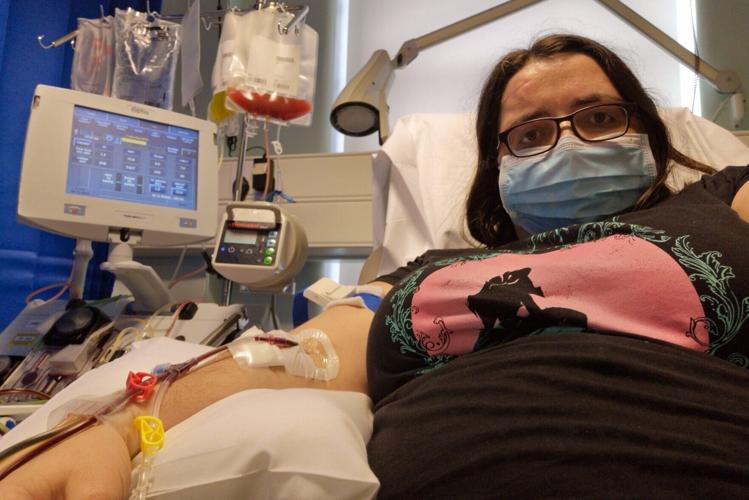
Katrina Fox during stem cell collection, in October 2022. (Blood Cancer Research UK via SWNS)
Looking back, Katrina says she had visited the GP several times about fatigue and rib pain since she was 28 which are both symptoms, but it was dismissed as a sprained rib and being tired from work.
She is now campaigning with Blood Cancer Research UK for more funding into research to find kinder treatments and spot the condition earlier.
She said: "Myeloma is one of the harder to treat cancers and what keeps me going is knowing that research into blood cancer that might eventually save my life.
"My golf-ball-sized lump turned out to be sinister and revealed cancer was eating my skull but blood cancer signs aren't always so obvious so I want to raise awareness so that others can get an early diagnosis."
Gemma Trout, senior nurse at Blood Cancer UK, added: "It must have been a huge shock for Kate to discover that a lump she had initially thought was harmless was cancer.

Katrina Fox, with the golf-ball sized lump on her head, in April 2022. (Blood Cancer Research UK via SWNS)
"There can be many reasons why someone develops a lump or swelling and most won't be cancer, but it's important to speak to your GP about any unexplained changes to your body, particularly if they persist, grow or change.
"Myeloma is a type of blood cancer that affects around 35,000 people in the U.K. It can be difficult to diagnose because the symptoms can be hard to spot, develop gradually over time or may be happening in different parts of the body. In fact, nearly one in three people with blood cancer have to visit their GP three or more times before being diagnosed.
"Myeloma is treatable but currently incurable. While research has transformed treatment and survival for people with myeloma, there is still much further to go.
"That's why it's vital that charities like Blood Cancer UK continue to fund research into kinder, more effective treatments and ultimately beat blood cancer."
Katrina is supporting the charity's partnership with Omaze, which is giving away a home in Yorkshire worth over £4 million ($5.35 million) — plus £250,000 ($335,000) in cash.