Those who want a good chance of finding a job at the end of their training might want to consider vocational education, said Chris DeGeare, dean of instruction at Jefferson College.
“Through 2024,” he said, “48 percent of job openings will be middle-skill jobs. That’s from the National Skills Coalition. We’re talking jobs in automotive and welding, manufacturing, information technology.
“One field where there is perhaps the most severe employment gap (not enough applicants for the available jobs) in Jefferson County is in the manufacturing industry.”
DeGeare said some health care occupations also fall into the middle-skill category.
“Middle-skill jobs are jobs that require some training or education beyond high school, but not a bachelor’s degree,” he said. “These are really good-paying jobs.”
DeGeare said Jefferson College offers a variety of vocational training opportunities, including the Area Technical School.
“People who go through the programs are very successful at gaining employment,” he said.
Jefferson College instructors backed up DeGeare’s optimism for vocational employment opportunities.
Gerard Uhls, professor of automotive technology at Jefferson College, said those who take his classes have a promising job market ahead of them.
“I’ve been in the automotive field about 40 years and I’ve been an instructor and a professor for 17 years,” Uhls said. “I would say within the past five years, it’s been relatively easy to place students in jobs. The students in our program are getting hired in their first semester because there is such a void in the industry. Both high school and college students are getting hired.”
However, the key for job seekers is to show potential employers they are ready to get to work, he said.
“The industry does not seem as interested in hiring people off the streets as in the past because things have become so complicated,” Uhls said. “It’s more complicated to work on cars.”
Uhls said while some students in his automotive technology classes arrive with an aptitude for working on motor vehicles, it does not mean newcomers to the field will be left behind.
“Some students have a natural aptitude to work on cars,” he said. “Others need to learn the skills.”
Auto repair is no longer an all-male occupation, Uhls added.
“I have both male and female students,” he said.
Uhls said his students gain the type of training that employers in the automotive technology field covet.
“When the students leave the program, they are ASE (Automotive Service Excellence) certified,” he said. “It’s a voluntary certification in our field we encourage students to earn to show their competence in the field.”
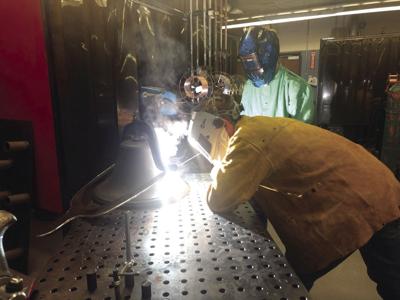
Joe Candela, Jefferson College professor of welding, said he has seen a steady increase in jobs in his field over the last decade.
“Right now, chances of getting a job in welding are pretty good,” he said. “It’s just been a gradual increase since the economic downturn. As the economy has improved, more jobs in the field have cropped up.”
Candela said in the early part of the 2010s, the best welding job opportunities in Jefferson County were in the railroad industry, but many other industries have been seeking welders since then.
“It’s a lot more open,” Candela said. “We have former students working on cars. I just had one go to work for Ameren UE.
“We had one recently get hired by Continental Fabricators in St. Louis, a Boilermakers union shop.”
He said welding is a skill that can be learned.
“Everybody can learn how to do it,” he said. “To be really good at it, you need good hand-eye coordination.”
Those who complete his welding program should have solid employment prospects, Candela said.
“They’re going to have a real good chance (at a welding job),” he said.