


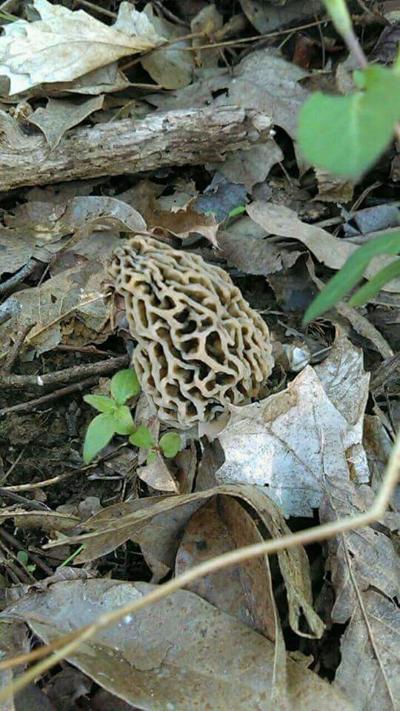
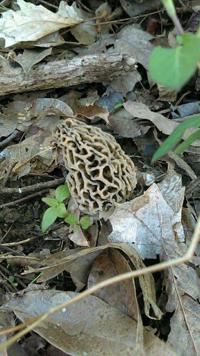
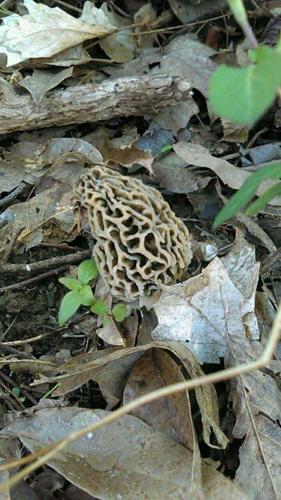
It was early April when Jimmy Govro found what he was looking for. He was out in the woods searching in the same spot he usually does, and there they were – a bed of tiny, but thriving, morel mushrooms, poking up from beneath a layer of last fall’s dried leaves.
“I got a spot that I go to every year that I stumbled upon,” he said. “I start watching the ground temperature. Once it starts getting to 45-50 degrees, I’ll start going to look.”
Govro, 35, of Hillsboro described his search for morels as the equivalent of “an adult Easter egg hunt.”
“It’s usually Easter time when I’ll start looking for them,” he said. “After the kids’ Easter egg hunt and dinner, we’ll usually go out and look in the woods. Sometimes we find them right in the backyard.”
The Missouri Department of Conservation describes morels as “hollow-stemmed mushrooms emerging from the ground in the spring, with a somewhat conical cap covered with definite pits and ridges, resembling a sponge, pinecone or honeycomb. “
Govro, who grew up in Jefferson County and works for Caldwell Outdoor Equipment in De Soto, remembers hunting for morels with his dad when he was five or six years old.
“I have twin girls now, and I take them out with me,” Govro said. “They just turned 12.”
He said his favorite place to search for morels is located somewhere on his two-acre property, but he won’t say any more than that.
“That’s kind of secret between (morel) hunters,” he said. “They don’t show other hunters their morel patch.”
Typically, you’re likely to find morels near dead elm trees or other trees that are “stressed or decomposing,” he said.
In previous years, he has come away with quite a harvest.
“I’ve come out with hundreds,” he said. “It (the piece of land where they grow) is not even as big as this room here.
“I’m hoping this year is going to be the same, even though it (the growing season) is pushed back, but I think the cool temperatures and the warm temperatures are going to combine and make it nice.”
Govro said morels take anywhere from four to nine days to be ready for harvest once they pop out of the ground. “I’ve seen some take two weeks.”
He said he knows the morels he finds are ready to harvest by the way they look.
“The tips will start looking that they’re getting a little dry,” Govro said. “Later in the season, you know that once the temperature starts getting warmer, they’ll burn up. And once they start burning up a little bit, you know they’re done. They hit a peak, and that’s about it.”
Asked to describe the taste of morels, Govro said, “It’s all its own. It’s not like a regular portabella or a mushroom that you would normally get in the store. The texture’s different. The taste is different, but it’s a desired taste. My wife doesn’t eat them, but my kids love them.”
He said he prepares his mushrooms the same way most of the time.
“I cut them at the stem, and then I cut them in half, and then I’ll soak them in salt water for an hour or two, not very long,” Govro said. “Then I egg them and flour them and put them in a pan with a little bit of butter and bacon grease, which makes all the difference.”
He admits the fried morels that he ends up with are not the healthiest things to eat, but he said it’s worth it. He also likes morels sauteed with steak, “or you can mix them with anything else, just like a normal mushroom.”
Govro said it is important not to harvest every morel you see in the woods if you want to ensure a future crop. “If there’s a patch of 60, I’ll leave five or six,” he said.
He also carries a mesh bag to pack the mushrooms out of the woods. “That way the spores drop as I carry them.”
He said he’s introduced a number of friends to the joy of hunting for morels.
“They never knew they existed,” Govro said. “It’s kind of a thing that it if doesn’t get passed down from generation to generation, then it gets lost in the translation.”
One thing to watch out for when hunting morels is not to collect “false morels,” which can be poisonous.
“I know the difference,” Govro said. “A real morel will be one continuous mushroom. A false morel, the cap will come off with the stem. The stem will go inside the cap.”
If you’ve never searched for morels before, the Department of Conservation recommends going to workshops or joining a mushroom club and going on forays.
For a membership fee of $20, you can join the St. Louis chapter of the Missouri Mycological Society, whose mission is to foster and expand the understanding of wild mushrooms. To register or find out more information, email Shannon Stevens at sstevens@momyco.org or call 314-481-4131.