


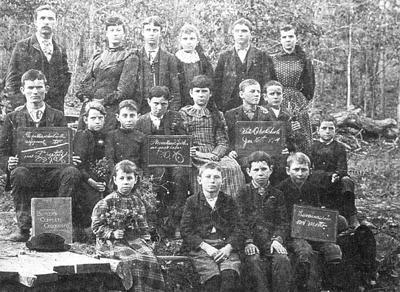
Small one-room schools began to dot the Jefferson County countryside during the 19th century as settlers began to tame the wilderness and wanted their children to have an education.
The earliest school in Jefferson County was established in 1806 on Sandy Creek, according to Della Lang in her book, Country Schools, Jefferson County, Missouri, 1806-1952.
The school was a subscription school, which meant it was funded by tuition. Early schools were mostly tuition based and/or funded by a church, but over time, public education became more and more prevalent.
A federal law enacted in 1841 set aside public land that states sold to support school operations. But, the money invested from those land sales never went very far, so later, after the Civil War, the government began using state property taxes to fund the schools, according to Lang.
“With few exceptions, public schools in (Jefferson County) were established between 1868 and 1900,” she wrote.
One of those early school districts, located in what is now the Jefferson County portion of Eureka, was the “Kidd District.”
The school was named White Oak School. It was built from logs and opened Oct. 1, 1889, Lang wrote.
The schoolhouse was located off (what is now) Hwy. W on White Oak School Road in Hoene Springs.
Usually, families in a community would gather together to discuss starting a school, a farmer would donate an acre of land or it, and people in the community would work together to build the school. Materials for the building and the subsequent operation of the school were then funded by taxes.
It may be that the Kidd District was named after a farmer, according to Lang.
“Whether that was ever an official name or simply a nickname is unclear. The Kidd family lived nearby and may have donated the original land to the school district,” Lang wrote.
A Mr. Haverstick was hired to teach that first year at the White Oak School, according to Lang, and a George Franz consented to become a candidate for overseer in the Kidd District, according to a Jefferson Democrat article dated March 6, 1890.
Education was on its way, but the money from property taxes didn’t provide much money to buy equipment at White Oak School. One student, the late Emil Wallach, remembered sitting on split-log benches in the school and writing with chalk on wooden boards painted black because slate was too expensive, Lang wrote.
In 1901, the log building was replaced with a new frame building. School enrollment in 1916 was 29 students.
As the county population grew, so did the number of school districts. By 1936, there were 89 school districts in Jefferson County, Lang wrote.
In the Kidd District, however, the Great Depression years of the 1930s began a slippery slope to the end.
The frame building was destroyed by fire in 1933. A brick building was built to replace it, but it is unclear why the district went to the expense. There were only seven students enrolled during the 1931-32 school term, and by 1936, despite the new building, White Oak School had closed and children were being transported to House Springs School.
The last White Oak School building is a private residence today.
Send submissions to LOOKING BACK with a photo to nvrweakly@aol.com or mail them to the Leader office, 503 N. Second St. (P.O. Box 159), Festus, 63028. Please include your name, phone number, a brief description of what’s in the photo and tell us how you came by it. Please also include when it was taken, where and by whom (if known). A new LOOKING BACK is posted regularly.